
Book by Jan Dyer
Original Score Steven Lutvak
Directed by John Doyle
Set design by John Doyle & David Arsenault
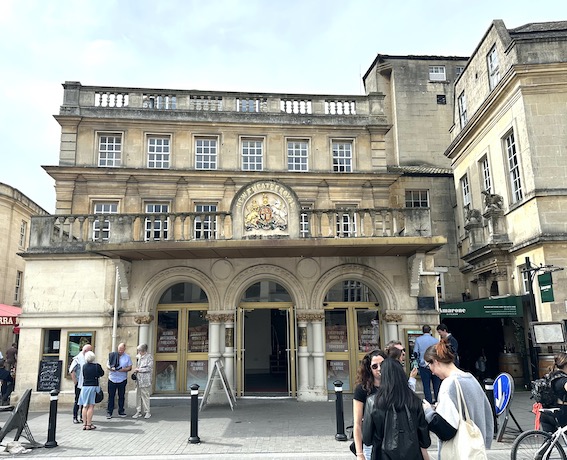
Bath Theatre Royal
Saturday 12th April 2025 14.30
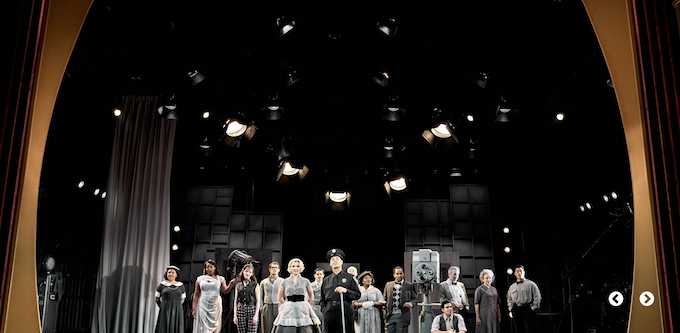
CAST
Keanna Bloomfield – Millie
Alistair Brammer – Richard & Ray
Matthew Caputo – Tommy
Ahmed Hamad- Arthur & Jerome
Nicola Hughes – Eve
Damian Humbley- Courtney
Mark Meadows – Maloney & Waterbury
Gary Milner – Detective Novak & Roman
Landi Oshinowo – Blanche & Millie’s mama
Jade Oswald – Lisa & Nurse Thornhill
Scarlet Strallen – Mary
Liam Tamme – Fred & Carl
Sally Ann Triplett – Lottie Croakem & Sadie Grimes
Joaquin Pedro Valdes – Michael & Deitz
BAND
Benjamin Holder- piano
Jonathan Williams- keyboard
Gavoin Tate-Lovery – flutes, clarinet, alto sax
Dan Czwartos – clarinet, bass clarinet, saoprano sax, tenor sax
Alice Luddington – cello
Matt Hollick- upright bass
James Pritchard – drums, percussion
The original TV series started in 1955 and ran for seven series and 268 episodes until 1962, with the lugubrious Alfred Hitchcock introducing the half hour (or rather 25 minutes) long stories. Then they added 93 hour long episodes. This production is only referencing the short ones. Hitchcock directed seventeen out of the 268.
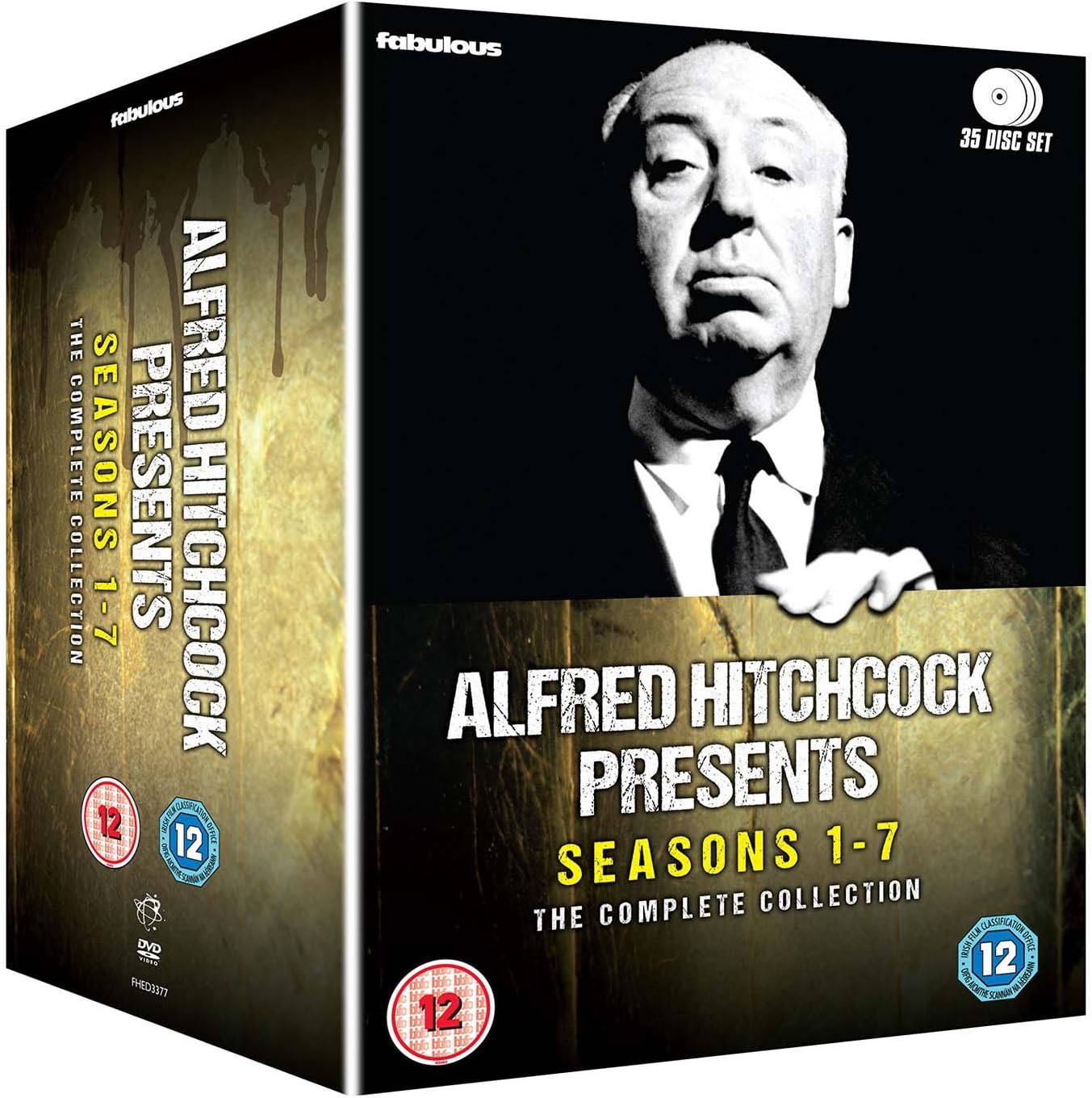
You can get the lot for £99 if you have 111 hours to watch it. I’m not tempted.
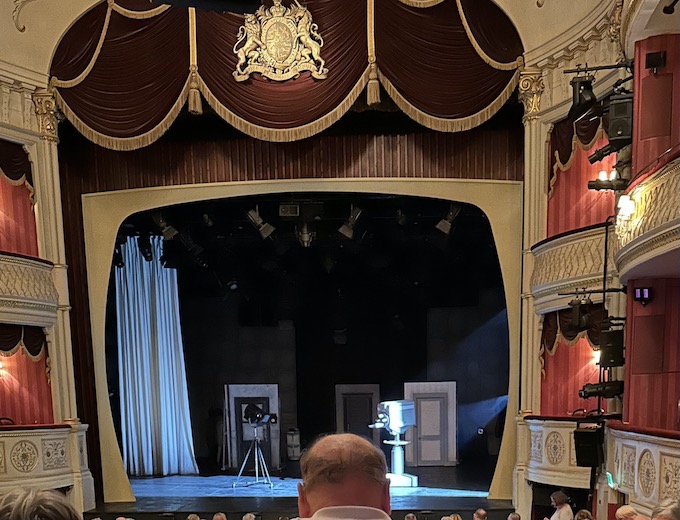
The stage has a retro TV frame. The costume colour palette reflects black and white TV. Of the 268 tales, the musical presents eight of them. Far too many, said the reviews. I had read the almost universally negative reviews. Was it going to be worth the journey? I had my doubts. My companion is post-op and couldn’t come with me. I was on the verge of not bothering. I did, in the end. I found they were herding everyone into the stalls / Royal Circle as ticket sales were poor. Poor sales on a Bath Saturday matinee? Almost unknown. The play was trumpeted as destined for Broadway. It won’t be going, I fear. I doubt the West End too. This is sad. It’s the last day too.
Do we start with the positives or the negatives? Because I’d read that there were too many intertwined stories, which rendered it incoherent, confusing, I focussed hard and so I managed mainly to follow the various mixed up threads. The bad reviews helped me follow it. There’s a cast of fourteen, they work non-stop performing stage hand roles too, manipulating set, lights and camera. The stage direction of fourteen constantly moving actors is superb. Actors do not leave the stage when they’re not up front, we are always in a TV studio.
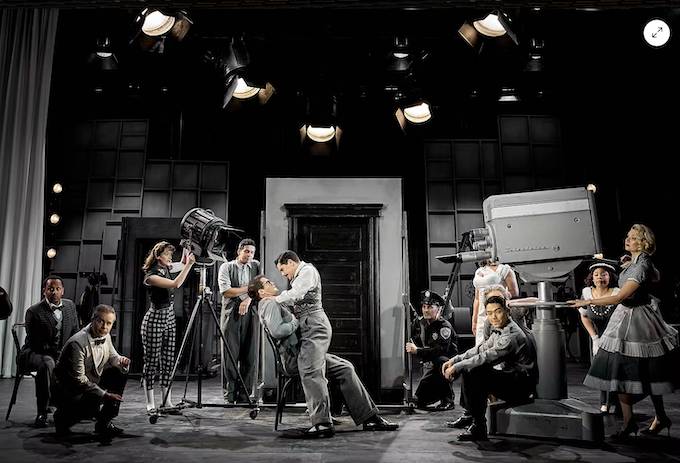
I worry about plot spoilers, but I doubt you’ll ever see it so interest is historical. They start with a tale of two men in a sadomasochistic relationship, plotting to murder a stranger. Tommy is played by Matthew Caputo. Richard by Alistair Brammer. They choose the victim, apparently at random from the Chicago telephone directory. There will be a twist. The stranger is the man that Richard’s wife, Marian, ran off with. Richard set Tommy up to commit the murder. I suspect the men being gay is an addition this time. The 1958 original, The Motive, describes them as crime-obsessed best friends. Two gay men doesn’t sound like 1950s US TV. That story gets resolved in Act One.
Lamb to The Slaughter runs right through, and as it stars Scarlet Strallan, the best known actor here, I think they padded it to last out. She gets a long song about making Lemon Chiffon with a Betsy Crocker mix. The performance is technically brilliant, but I don’t think the song drives the plot at all. She believes neighbours are murdering their wives and calls the police and FBI, which embarrasses her husband, though we don’t realize until late in Act Two that her husband is a policeman. He announces he will divorce her. She murders him with a frozen leg of lamb, which is then served cooked to the investigating officers, so a less nasty version of Titus Andronicus. Thanks to the Guardian review for revealing the title of the original episode, aired in the USA on 13th April 1958- I was watching on the 12th April. I checked and in the original she was pregnant to add villainy to his departure. Not here.
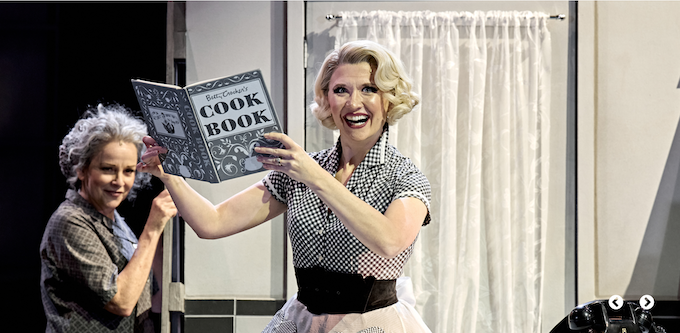
The stars are obviously Scarlet Strallen as Mary (a fantastic rendition of what might be ‘The Betty Crocker’ song) and Sally Ann Trippett taking the comedy role of Lottie Croakem and the serious role of Mrs Grimes (without changing costume). I never really got the plot of her piece. She is being interviewed as a baby sitter who knows something and gets murdered as the ender of Act One. I think this must be The Baby Sitter (1956). They changed the name from Armstaedter to Croakem (geddit?).
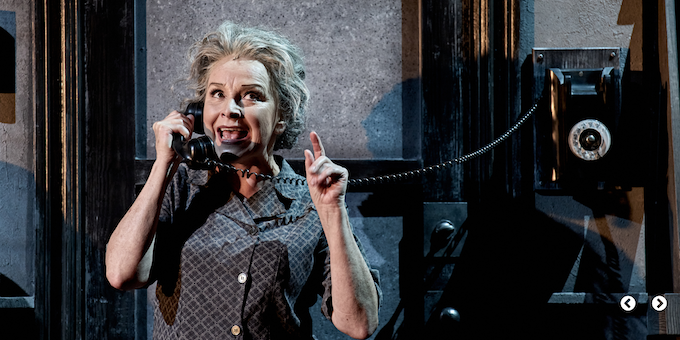
In the second Act we get a complete playlet from The Right Kind of House (1958) without intertwining. Sally Ann Trippett is Mrs Grimes who poisons Waterbury (Mark Meadows)a man posing as a real estate agent. She has advertised her $6000 house at $50,000 knowing that her dead son’s accomplice and murderer will try to buy it knowing that their $200,000 heist might be hidden there.
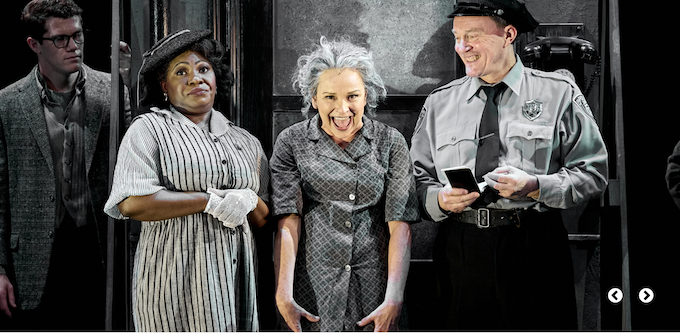
Then there’s Dead Weight. Rich philanderer Courtney Masterson (Damian Humbley) and his mistress Eve (Nicola Hughes) are making out in a car. Eve is plotting with her boyfriend to turn up and blackmail Courtney who turns the tables and locks him in the trunk. He has to decide what to do, and shoots him. Joseph Cotten was Courtney back in 1959.
That intertwines with The Woman Who Wanted To Live (thank you for the title The Guardian) where a woman (Jade Oswald) is taken hostage by an escaped convict (Alistair Brammer) who has shot a gas station owner, and she has to turn the tables on him. The original was in the 1962 seventh series and starred Charles Bronson as the convict.
Both sets of characters (Courtney & Eve, Lisa and the convict) are in cars at a stop light with a motor cycle policeman in between.
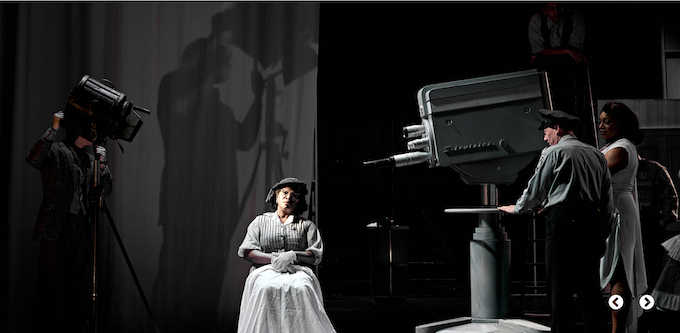
Another that runs right through is Coming, Mama the story of Millie (Keanna Bloomfield) and her fiancé Arthur (Ahmed Hamad). Millie has to poison her demanding invalid mother, only to find herself equally burdened with his demanding invalid mother. I managed to find the title, even though in the original the daughter is called Lucy. Maybe they thought Millie fitted the ethnicity of the actors better.
All the way through we see a suicidal man on a ledge (or rather a stepladder). That is The Man With A Problem which becomes a complete story in Act two where the local police officer tries to talk him down, but gets pushed down himself, being the guy who ran off with the man’s wife.
Then where’s the dance? There isn’t any (ten seconds of feeble tap from the police officers).
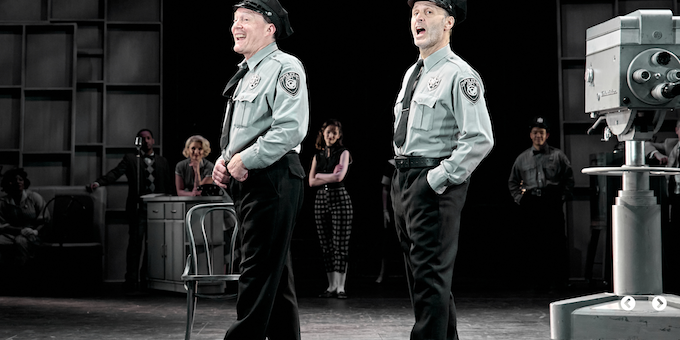
I expect dance in a musical, and this experienced cast have a track record that indicates they could do it and have done it with aplomb in the past. No dance? Major conceptual flaw.
Act one is confusing (but only an hour long). Act two is 40 minutes, and starts with a recap then two full contained stories without inter-twining. It helps.
Then the programme is poor and uninformative. Don’t bother. The cast list is online. A musical normally lists the songs and which characters sing them. Not here. The programme tells us that Hitchcock directed Psycho but I expect we all knew that.
I would have listed the eight original TV dramas which are used in the programme notes and assigned the characters to them in blocks. The Guardian review revealed two original titles, I Googled and found others from character names. The issue with the mixed plot lines is that the creators would have been so immersed in the stories that the separation seemed obvious to them. It need an editor /producer to say, ‘Sorry, I don’t get it.’
There is live music, expertly played. The singing is extraordinarily good from all. Is it too ‘democratic’? Everyone on stage gets a decent solo song. In a musical you expect to single out two or three “star” roles. Not here, it’s shared.
OK, excellent direction, especially stage movement. Great monochrome costumes. Really good simple car scenes. Excellent lighting plot. Superb cast with excellent singing. The musicians played it beautifully. However, the really weak point is the score: the jazzy songs and the melodies. For a musical that is the kiss of death. They’re musical narrative pieces carrying storyline. We’re told at the start that it’s 1957. Then seven series take us to 1962. The song style is 1947 at best, perhaps 1937. 1955-1957 hasn’t happened (except in Mary’s skirt with layers of frothy petticoats). Not one tune stuck in my head.
Overall, it’s not as bad as the reviews suggest. I actively enjoyed the performances. But if the songs don’t make it, the musical doesn’t make it. The reviews with the universal two star rating seem harsh. Maybe they saw it early, and it gelled more as time passed. Maybe they tweaked it. I’m almost inclined to a three. I was never bored, I’m glad I went, but no, the plot incoherence and far more the out-of-date music really do deserve a 2 star.
**
WHAT THE CRITICS SAID
A near universal two star rating
three star
Kris Hallet, What’s on Stage ***
two star
Dominic Maxwell, Sunday Times **
Domenic Cavendish, The Telegraph **
Arifa Akbar, The Guardian **
It is hard to understand what this musical seeks to do. A jumbled medley of too many of Hitchcock’s episodes, it does not have the impact of any one. “What makes a story work?” the cast sing at the beginning. Not this.
Susannah Clapp, The Observer **
Rosemary Waugh, The Stage **
Daz Gale, All That Dazzles **
LINKS ON THIS BLOG
NICOLA HUGHES
Opening Night, Ivo van Hove, London 2024
Caroline or Change, Chichester 2017
DAMIAN HUMBLEY
A Chorus of Disapproval, Salisbury 2024
Hedda Gabbler, Salisbury 2016 (Ellert)
SALLY ANN TRIPLETT
A Damsel in Distress, Chichester 2015
AHMED HAMAD
Sunset Boulevard, Savoy Theatre, 2023
 Peter Viney's Blog
Leave a comment