
By George Orwell
Adapted by Ryan Craig
Directed by Lindsay Posner
Set, costume, video design by Justin Nardella
Bath Theatre Royal
Thursday 26th September 2024, 14.30
CAST
Mark Quartely- Winston
Eleanor Wyld – Julia
Keith Allen – O’Brien
David Birrell- Parsons
Ensemble:
Paul Sockett
Niamh Bennett
Lewis Hart
In filmed sections only:
Big Brother – Nicholas Woodeson
Telescreen Newscaster – Doña Croll
Goldstein – Finbar Lynch
Ampleforth- Matthew Horne
Gladwell- Oscar Batterham
Syne- Zubin Varla
Medic – Martin Marquez
Mother- Janie Dee
Child – Asia Sky Fenty
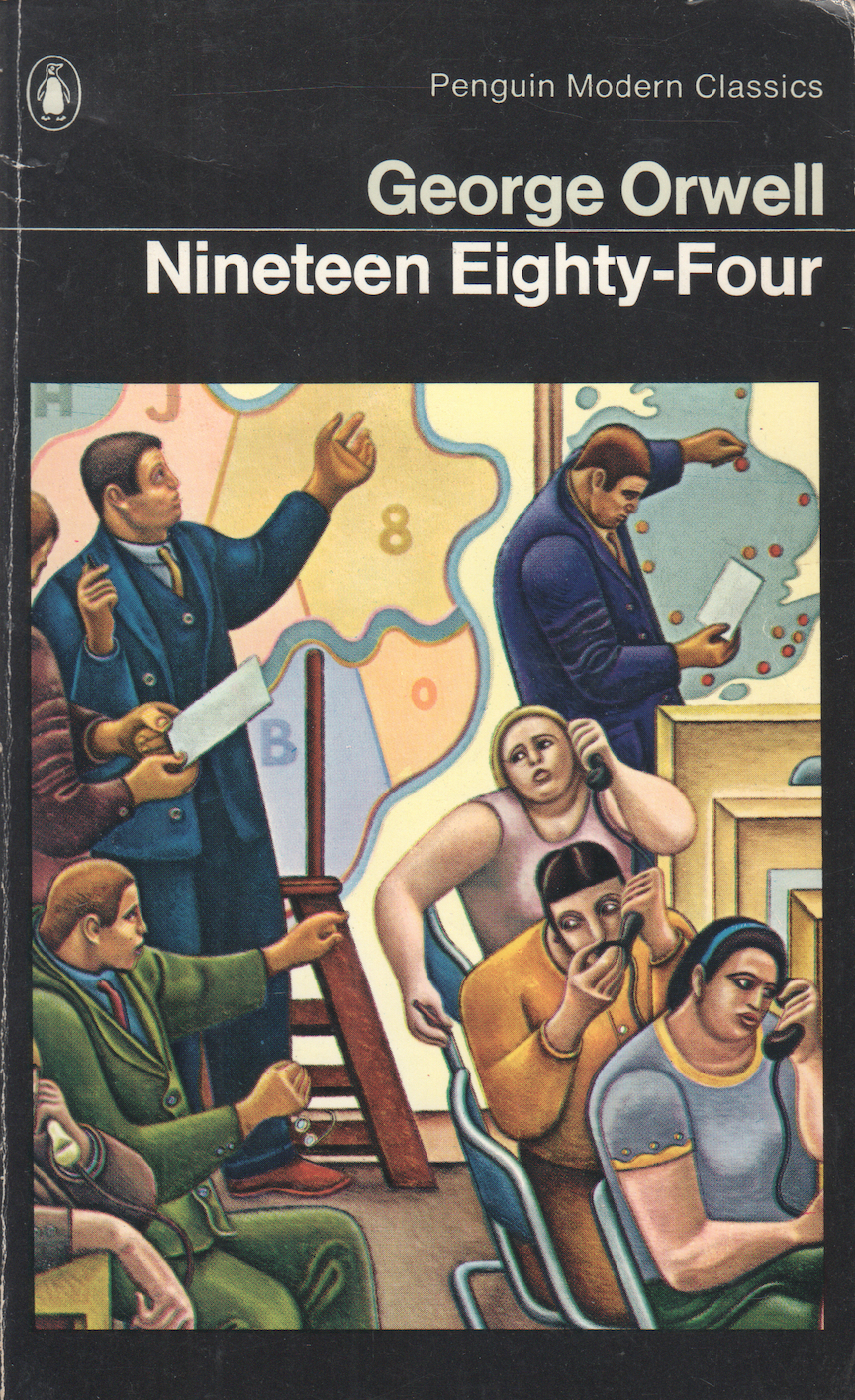
So, 1984. It’s imprinted the language: Big Brother Is Watching You. Room 101. Newspeak. Doublethink. Thought police. My local secondhand record store is called Big Brother. Room 101 became the title of a TV show.
Orwell drew on Stalin, Trotsky, Hitler, Franco. The (unseen) character of Enemy of The People, Goldstein, manages to be both Trotsky, airbrushed out of photographic history, and then the name indicates the anti-Semitism of Hitler. Orwell’s future totalitarian world of 1984 was best imitated by China in 1966 in the Cultural Revolution, and they managed to do it without the technology. You can’t argue who killed more, Mao, Hitler or Stalin. After eight million the numbers just whirl. I have read that Pol Pot wins in terms of the percentage of his own population that he killed. The aim at total control has never gone away. Iran’s theocratic state and the Taliban leap to mind. The world stage is still dominated by liars, Putin and Trump for starters. In comparison, Boris Johnson was merely inclined to fibs. A nod to Brexit, is that in 1984, Britain, or Airstrip One, is part of Oceania with America, NOT part of Eurasia, which starts across the Channel. In 2024 we have a man who nearly half of American voters seem to favour, claim on national TV broadcast that Haiitians in Springfield, Ohio are eating your dogs and cats. When proven that it was a direct lie, he is still able to claim ‘an underlying truth.’ Newspeak.
My grandma used to suspect that her TV set was two way, and would turn it off if she wanted privacy. Now when there’s a major crime, the police study hundreds of CCTV images from public places. We have a Ring camera on the front door. If you cross London, you will have been filmed hundreds of times. Ah, but it’s not at home yet, is it? Try a little test. Search on your computer or phone for double glazing. Perhaps you want to know how to spell it. For the next two days you are likely to get Facebook feeds to double gazing companies, and e-mails advertising double-glazing. We’ve all experienced it. Twice recently we have been checking hotels’ own sites, and before we can book, a box advert jumps onto the screen offering a lower price from one of the major booking companies. Yes. Big Google Is Watching You. Orwell had assumed a Socialist totalitarian state watching its citizens’ every move. Capitalism beat them to it.
Back to the production, which we selected purely on the basis that it’s directed by Lindsay Postner. Also, it is touring which to me is good + + (this is Newspeak for excellent). As expected on a matinee for a potential set book, there were large numbers of schoolgirls being escorted in by their teachers. We watched them queuing for drinks and snacks, recalling how we would press money into hands for a school trip, ‘Get yourself a drink and something to eat.’ They’d inevitably return with a pencil printed with the name of the cathedral or castle or theatre. We like school kids in a matinee because they react. At Bath in particular, they contrast with an audience in which we might be in the younger half. Unfortunately they were in an upper balcony so we couldn’t hear them, although the entire play was watched in silence. There are not a lot of (any?) laughs.
However, I do hope none of the girls will rely on the play for an exam question set on the book.
Ryan Craig’s adaptation is good+ + in that he has made bold decisions. First it’s stripped to four characters with a couple of walk ons. Winston Smith and Julia. O’Brien. Then Parsons the neighbour becomes more important. I won’t do the plot at all. Everyone should know the rough idea, if not the outline. If you don’t, the novel plot is on Wiki. Perhaps if you look, you’ll be bombarded with adverts offering the printed book on amazon and eBay.
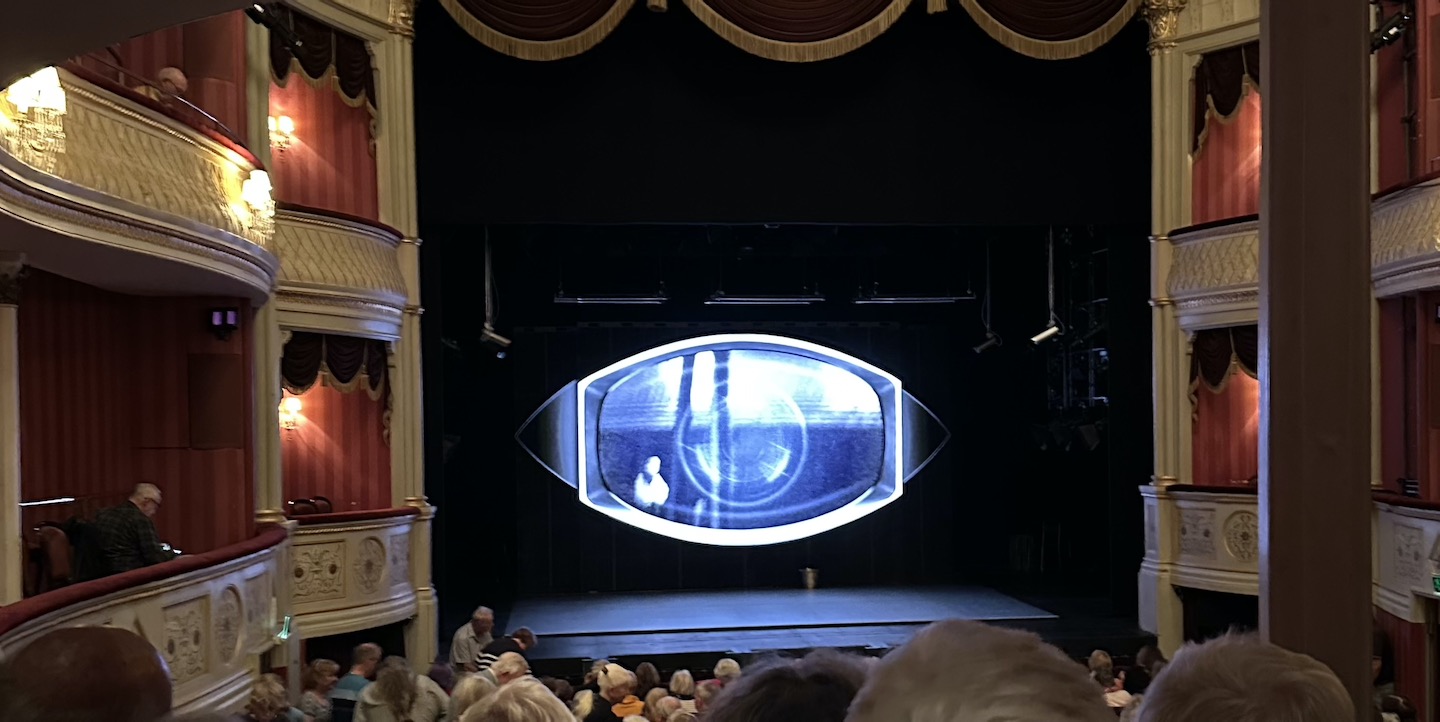
When you come in, the huge TV eye shows a camera feed scanning the audience, which is repeated after the interval. I’m pretty sure this is real time, not a recording.
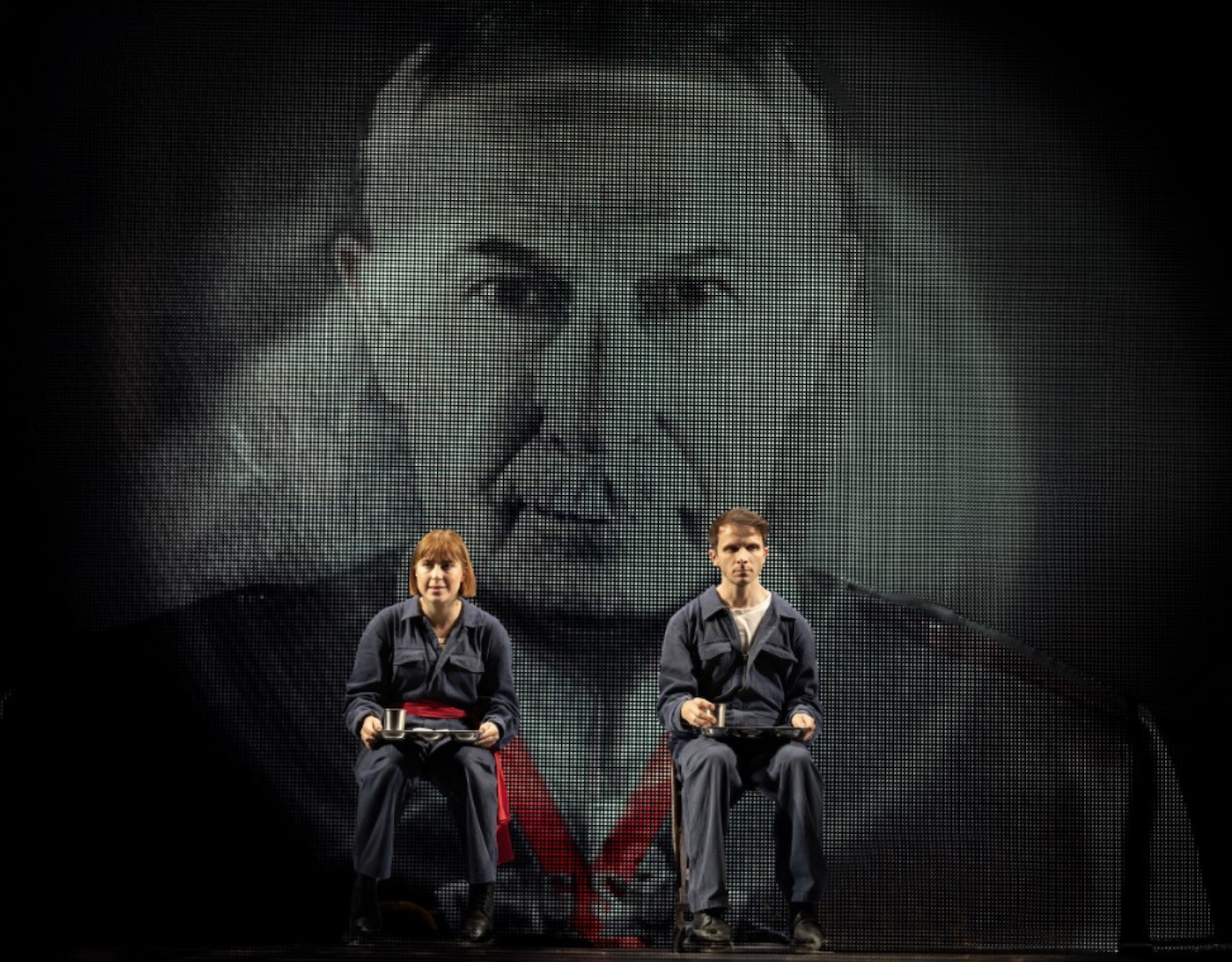
Then the TV screen is used extensively for pre-recorded segments from well-known actors as Newscaster, Ampleforth, Big Brother, Medic etc. A projected screen is used for sets – the TV screen, the golden woods, the cell, Winston Smith’s room, the safe house flat. We see a back set behind the screen (which becomes transparent) of wrecked buildings for his childhood home and Mr Charrington’s Antique Shop (Mr Charrington does not appear). We see his mother back there, but his sister looks like a moving hologram. OK, the technology is there, not least for ABBA at the O2, but the RSC used it for The Tempest. I’m amazed they can tour it. Also, if I had the technology, I’m amazed at the restraint of using it once. It might just be film. Technically, all this is superb … uh, good plus plus. I liked the way the epic length and story complexity worked with many short scenes (I thought it failed in Birdsong recently).
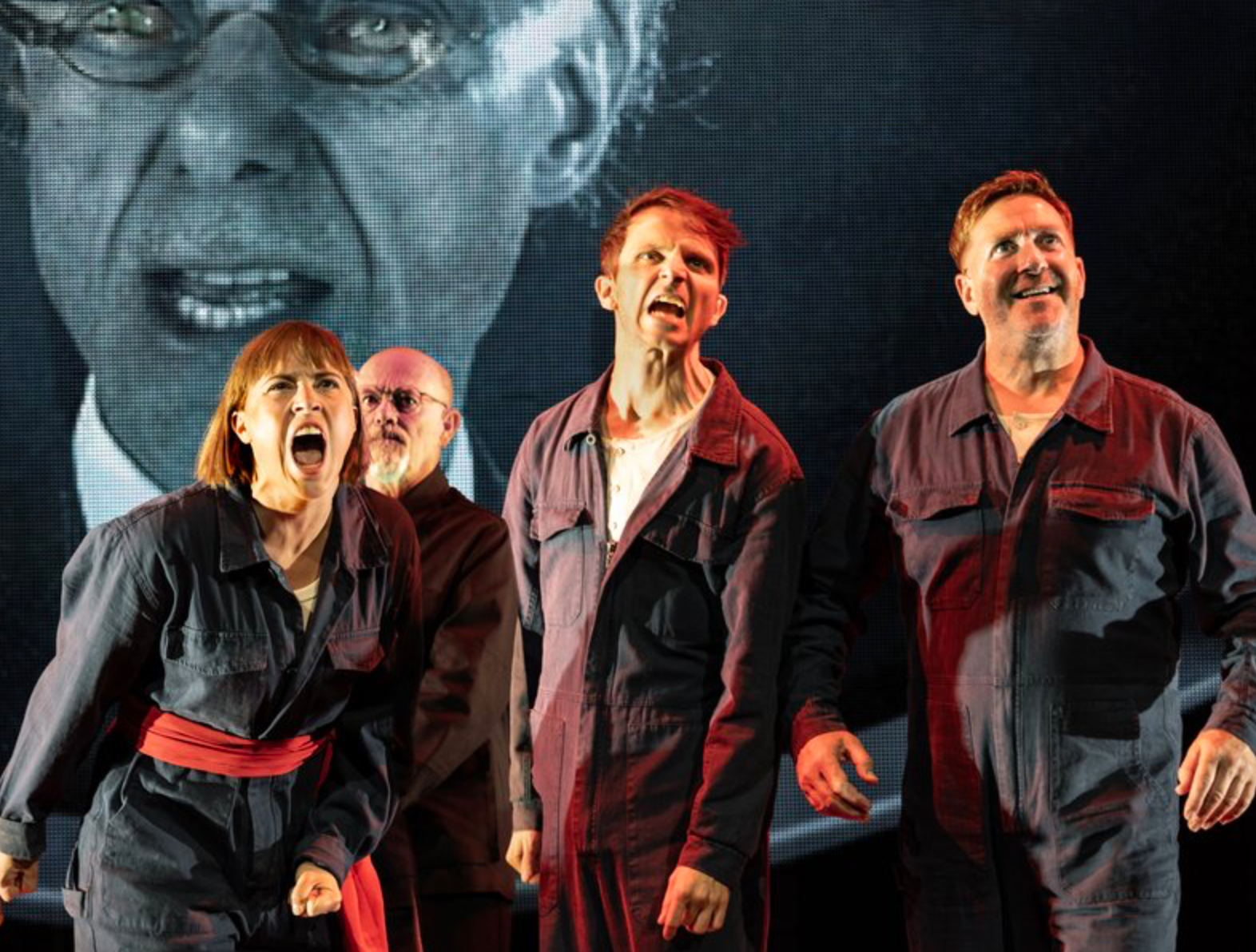
Eleanor Wyld- Julia, Keith Allen – O’Brian, Mark Quartely – Winston, David Birrel- Parsons
I liked the way Craig used whole chunks of the original text almost verbatim where it counted, but adapted freely in between. An example from the novel that was chosen in full because it reflects on today is from chapter one.
April 4th, 1984. Last night to the flicks. All war films. One very good
one of a ship full of refugees being bombed somewhere in the Mediterranean.
Audience much amused by shots of a great huge fat man trying to swim away
with a helicopter after him, first you saw him wallowing along in the
water like a porpoise, then you saw him through the helicopters gunsights,
then he was full of holes and the sea round him turned pink and he sank as
suddenly as though the holes had let in the water, audience shouting with
laughter when he sank. then you saw a lifeboat full of children with a
helicopter hovering over it. there was a middle-aged woman might have been
a jewess sitting up in the bow with a little boy about three years old in
her arms. little boy screaming with fright and hiding his head between her
breasts as if he was trying to burrow right into her and the woman putting
her arms round him and comforting him although she was blue with fright
herself, all the time covering him up as much as possible as if she thought
her arms could keep the bullets off him. then the helicopter planted a 20
kilo bomb in among them terrific flash and the boat went all to matchwood.
then there was a wonderful shot of a child’s arm going up up up right up
into the air a helicopter with a camera in its nose must have followed it
up and there was a lot of applause from the party seats but a woman down in
the prole part of the house suddenly started kicking up a fuss and shouting
they didn’t oughter of showed it not in front of kids they didn’t it ain’t
right not in front of kids it ain’t until the police turned her turned her
out I don’t suppose anything happened to her nobody cares what the proles
say typical prole reaction they never—-
That’s a diary entry by Winston in the book. From my recall (They didn’t sell play texts) it was given to Julia as a direct report of the film she had just seen in the play instead, so more dramatic. It was tweaked in several places – the woman wasn’t a Jewess. there was no mention of the camera in the nose. It worked good + + because it’s not impossible that countries will start shooting at refugee boats at some point..
The major plot shift is the elimination of Goldstein’s forbidden book The Theory & Practice of Oligarchical Collectivism. In the original novel, O’Brien gives this to Winston Smith. In the novel Winston reads it and the extract is 22 pages of text (my Penguin Classic edition) in even tinier print than the rest of the book. It’s the backstory. I can’t see how it could have been put on stage. The theatrical switch is to a copy of Hamlet.
Instead of Goldstein’s book, the play focuses on Winston finding photos of Goldstein with other party leaders which proves he was not in Siberia plotting a 1972 assassination, but in New York with his fellow leaders. Later the TV will show the picture with Goldstein’s face morphing into a stranger. There is a book on airbrushed photos, (before Photoshop they literally used an airbrush) with the most significant one being a photo of Stalin and pals in various versions as they were eliminated one by one. The camera never lies? Well, the print out certainly does.
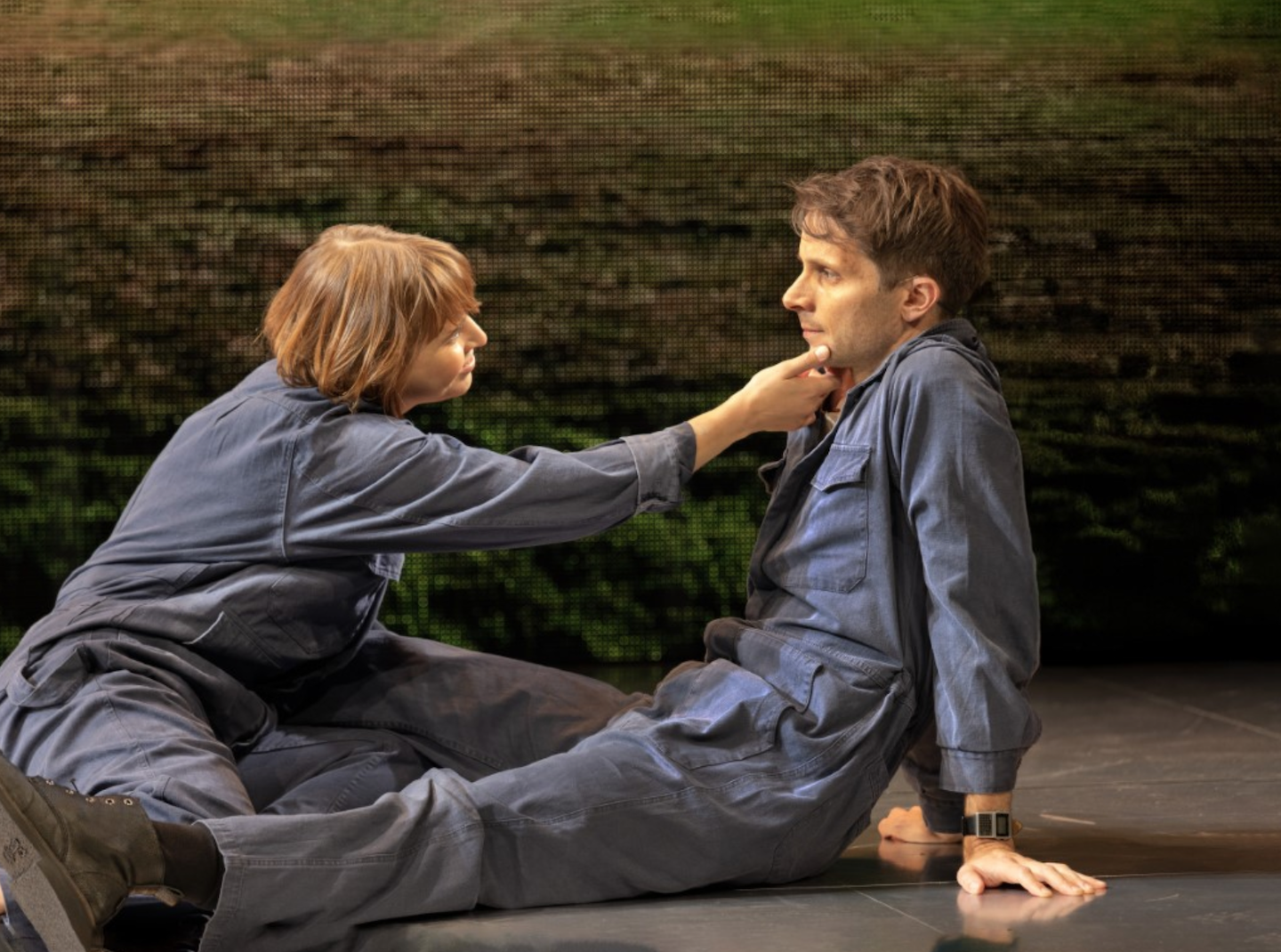
The forest love scene has a good + + projection of a forest, and though they only half strip, you see that the underwear of Oceania is designed to be unsexy. I checked in the novel, and was amused by Orwell’s description of ‘dappled light.’ Dan Brown must have read it because he overworks ‘dappled light’ in his novels.
In The Guardian, Arifa Akbar notes:
Eleanor Wyld, as his lover, Julia, has a similar look to Suzanna Hamilton in Michael Radford’s iconic film and is a spirited presence but the relationship between these central characters does not come to life. There is a significant lack of fizz between them which undercuts the love story and subsequent betrayals.
26 / 9 / 2024
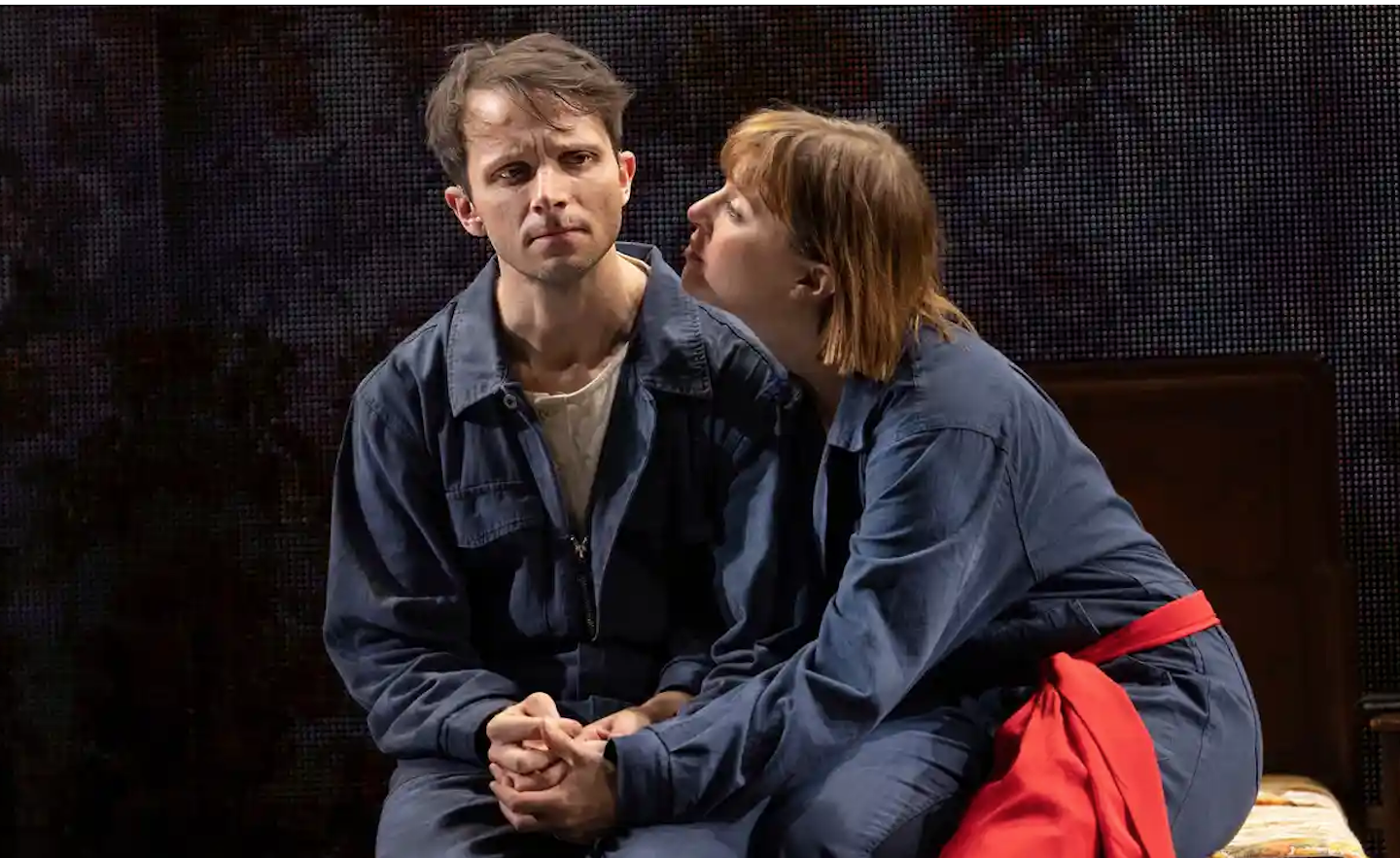
To be fair to the actors, Winston and Julia have been so repressed all their lives that their capacity for passion would be constrained. I thought Eleanor Wyld and Mark Quartely played them right + +.
The ‘safe flat’ was switched from above Mr Charrington’s shop to donated by O’Brien. There is a switch I liked where Julia arrives with real coffee and sugar, and there is a question you can see in Winston’s mind as to how she got it – O’Brien had made obvious advances. She is delighted to appear in a frock. They must have been banned in the distant past.

Act two is the switch to the dark + +side. Winston has been arrested and is in a cell with Parsons. Both have been tortured. The bucket will be put to use. It what happens when you’ve been that scared.

The acting highlight is the interrogation and torture of Winston Smith (Mark Quartely). He is so convincing, so vulnerable, so in agony that it is terrifying to watch.

There is a famous 1960s psychological experiment that must have been inspired by the novel (and this scene). Volunteers were put in charge of an alleged electric shock machine. An actor was in a chair and white-coated ‘scientists’ (so authority figures) ordered the volunteers to increase the power up to fatal levels while the actor screamed. A majority followed orders and I’ll bet the actor wasn’t as convincing as Quartely.
Keith Allen is O’Brien, a character who is enigmatic + +, manipulative ++ and ultimately sadistic ++.

One point we discussed. In the play, Mark Quartely has to be stripped and stand full-frontal naked. Given the “set book” appeal in getting school parties on the tour, we thought it a mistake. We recalled being in A&E last year and an old man had to be helped out of his wheelchair and his track suit bottoms and baggy pants fell to the ground, and he was full frontal to the overcrowded waiting room. He was fearfully embarrassed. A woman said, ‘Don’t worry, dear. I’ve worked in a care home for years. I’ve seen hundreds of them.’ Laughter breaks the ice. A woman next to us whispered, ‘that reminds me. I have to order a turkey for Christmas.’ So in front of an elderly / adult audience, fine. Sixteen to eighteen year old girls? I think not. We were at Shakespeare’s Globe once where one whole side of the audience was Muslim girls in uniform with headscarves. There was a long kissing and fondling scene. Their teachers led them out in the interval not to return (being thought police minded, I guess.) Here, it’s in Act Two so that possibility is avoided. For the actor, it must be ordeal enough to strip, but to do so in front of school kids? He gets degraded enough. It works without it.
The Room 101 scene is played in total darkness. How else could you do it on stage? It’s also of note that at the start, Winston is filthy and besmirched, when the lights come up, he is clean and smart. Either he could act while getting changed or was recorded.
Sound
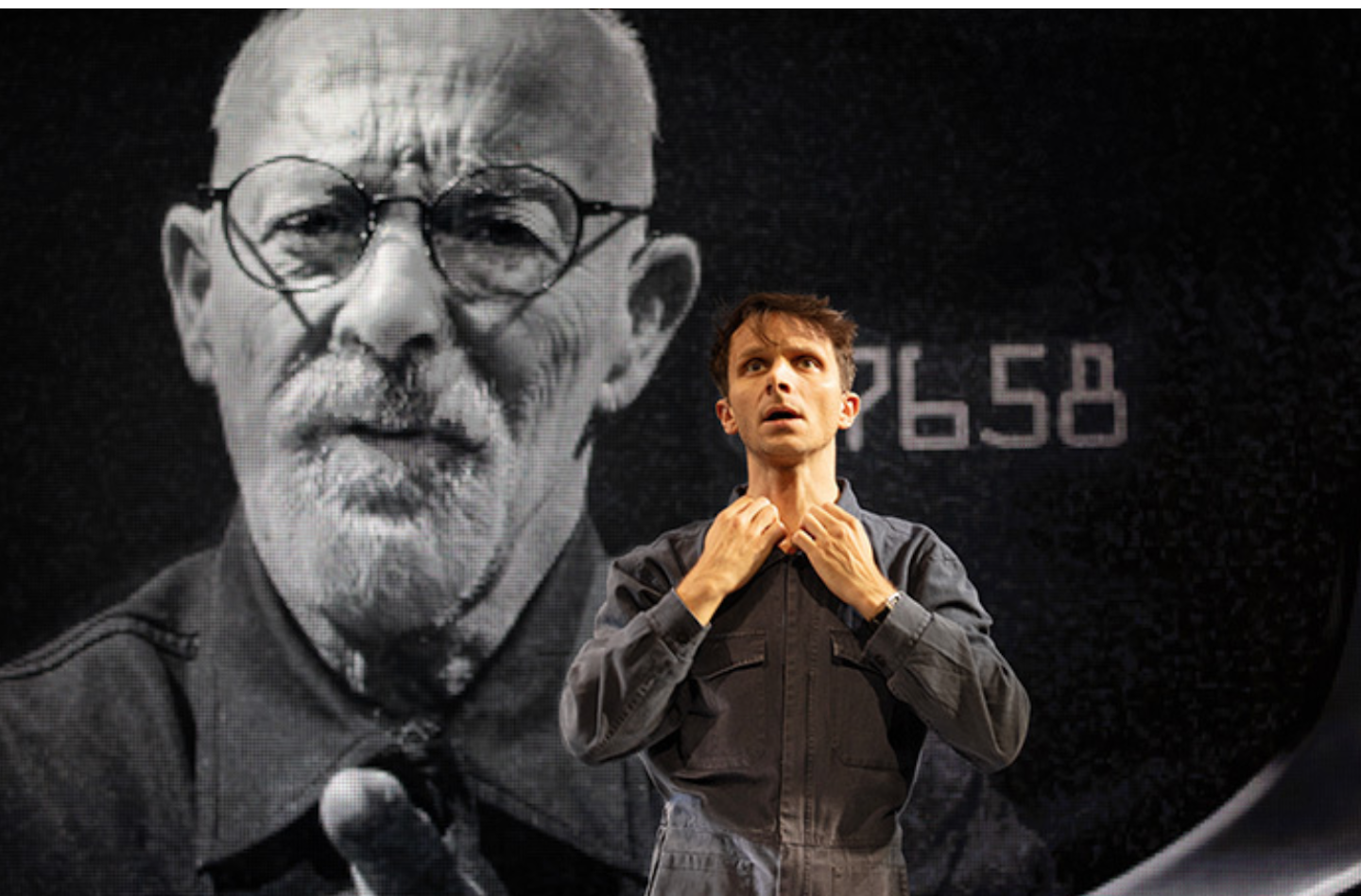
The technology was visually good + +. The sound design and recording was good + +. Unfortunately, the sound execution was poor minus minus. This was the issue. The TV screen actors were loud and clear, at a much higher volume than the stage actors. When you had Winston and TV, the contrast in levels was too great. Yet David Birrel as Parsons and Keith Allen as O’Brien were loud enough to work against the recorded level behind them. Eleanor Wyld was in the early scenes. Mark Quartely definitely wasn’t. When you had two live actors, in general we could adjust to that volume level. In general, but in the last Chestnut Cafe scene, both Winston and Julia were under-projecting. Two live actors? Usually fine. Actor plus TV voice? Problems. Was it our position? We always used to sit in the front row of the Royal Circle, but the lack of legroom moved us three or four rows back so you have a fairly low ceiling above you. That impacts on sound and we’ve noted it before (we decided to book front row of the circle or stalls again in 2025), but then the sound engineer was in the Royal Circle too, at the back, potentially the weakest spot. That’s the right place to be. However, it’s a tricky sound plot, constantly changing, so he had headphones on throughout. A music engineer would definitely take them off briefly to hear the ambient sound. If you do that, you’d know Mark Quartely was often too quiet – certainly not too quiet in the torture scenes. We felt he’d been told to do depressed, blank, and you can’t do that and be loud. I feel awful criticizing him as otherwise it was an incredible + + acting performance. I’m fairly sure the actors didn’t have head mics … after all when Winston was naked there was no where to hide one. Perhaps they should use them.
Sound detracted for us. It knocks off a star. I still recommend catching it on tour (see dates below). Poole Lighthouse, for example, has better sound in the auditorium than the Bath Theatre Royal. It’ s powerful. If you know the book very well, the plot changes made by Ryan Craig are fascinating and well thought through.
Overall: Three star ***
WHAT THE CRITICS SAID
Little did we know, Press Night was the day we saw the matinee, but in the evening.
four star
Clive Davis, The Times ****
Dfiza Benson, The Telegraph ****
Bryony, Theatre & Tonic ****
three star
Arifa Akbar, Guardian ***
Kris Hallett, What’s On Stage ***
The tour
1984 – Tour Dates 2024:
1 – 5 October 2024 Malvern Theatre
8 – 12 October 2024 Lighthouse Poole
15 – 19 October 2024 Yvonne Arnaud Guildford
22 – 26 October 2024 Cambridge Arts Theatre
29 October – 2 November 2024 Brighton Theatre Royal
12 – 16 November 2024 Richmond Theatre
19 – 23 November 2024 Liverpool Playhouse
We were both highly pissed off. Not with Bath Theatre Royal, but with Poole Lighthouse. We booked Bath months ago, then it turns out much later that it’s going to be at Poole Lighthouse in just ten days time. Three miles away from our house instead of seventy miles. A comfortable theatre instead of being squashed in … no one over 5 foot would ever “love” the Theatre Royal, atmospheric as it is. Poole is much more comfortable. Poole is 25% or more cheaper. We wouldn’t have to pay £2.85 for a tea bag in a paper cup with a sachet of Long Life milk either. Most of all, we would be avoiding the horrendous diversions trying to get into Bath while the A36 is closed. Poole needs to get itself together. Announce programmes when everyone else does. Allow full weeks for theatre companies, rather than blocking off too many one evening events. Still, time in Bath is always good.
LINKS ON THIS BLOG
LINDSAY POSNER (Director)
A View From The Bridge, Theatre Royal Haymarket, 2024
The Deep Blue Sea, Bath Ustinov 2024
The Lover / The Collection by Harold Pinter, Bath Ustinov 2024
Farewell Mr Haffman By Jean-Philippe Gaguerre, Bath Ustinov 2023
God of Carnage by Yasmina Reza, Bath Theatre Royal 2018
The Lie by Florian Zeller, Menier Chocolate Factory, 2017
The Truth by Florian Zeller, Menier Chocolate Factory 2016
Communicating Doors by Alan Ayckbourn, Menier Chocolate Factory 2015
Dinner With Saddam by Anthony Horowitz, Menier Chocolate Factory 2015
The Hypochondriac by Moliere, adapted Richard Bean, Bath Theatre Royal, 2014
A Little Hotel On The Side By Feydau, Bath Theatre Royal 2013
She Stoops To Conquer by Goldsmith, Bath Theatre Royal 2014
Hay Fever by Noel Coward, Bath Theatre Royal 2014
Abigail’s Party by Mike Leigh, Poole Lighthouse 2013
MARK QUARTELY
Henry VI-Wars of The Roses, RSC 2022 (Henry VI)
Henry VI – Rebellion, RSC 2022 (Henry VI)
The Tempest, RSC 2016 (Ariel)
Strife by John Galsworthy, Chichester, 2016
ELEANOR WYLD
Macbeth – Globe 2023
Leopoldstadt, London 2020
Don Juan in Soho, Wyndham’s Theatre, 2017
Doctor Faustus, RSC 2016
Don Quixote, RSC 2016
KEITH ALLEN
The Homecoming, Trafalgar Studios, 2015
Hogarth’s Progress: The Taste Of The Town, Rose Kingston 2018
DAVID BIRELL
South Pacific, Chichester, 2021
MATTHEW HORNE (on film)
The Lover / The Collection by Harold Pinter, Bath Ustinov 2024
The Miser by Molière, West End 2017
 Peter Viney's Blog
Leave a comment