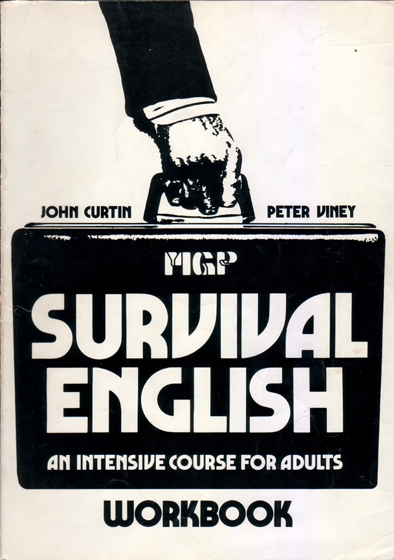
It started badly. My first ever publishing lunch was with Mary Glasgow Publications. John Curtin was appointed Head of ACSE London in Ealing and set out to write a ‘Business Lite’ course for the new school, still working from Bournemouth as the building in Ealing was being converted. I took over his job as Head of Elementary Studies in 1975, a promotion from Deputy Head. Diane Crawford and Ralph Mowat from the ACSE Research & Development Department asked to speak with me. Diane thought it essential that I join the project and co-write it. She added, ‘or rather rewrite it.’ She had noted John’s instructions could be bizarre, such as using string puppets for a dialogue. Her request was for me to put structure and clarity to the course. John was not happy. He tended to extreme anger, especially when I pointed out that business students were unlikely to want to order staples and drawing pins in English. I said that if I wanted these items abroad, I would go to a stationer’s, pick them up and put them on the counter. I also noted that it would be a lowly admin task conducted in the mother tongue within any company. I lost that one … until the revised edition for Heineman ten years later, which I wrote on my own. It was the first unit to be binned. In fact we had split the units 50/50 and I simply binned all John’s units.
Back to 1976. We completed ‘Survival English.’ It was printed at ACSE. Then John announced that he had discussed it with MGP, Mary Glasgow, and they wanted to publish it. I said that he was setting his sights very low, and I would suggest approaching Longman first. I was ignored.
So the editor, Simon (his surname escapes me), came to see me in Bournemouth. John was in London. He invited me to lunch. It was modest- the Swiss Restaurant, in Bourne Avenue which did a cheap 3 course Lunch Special. Course one was soup. Course three was tea or coffee. The meal ended. He fumbled in his jacket and produced a well-creased cheque book. He opened it, examined the empty space between the covers dolefully and said, ‘I’m so frightfully sorry, old chap. I appear to be out of cheques. Might I prevail upon you to pay the bill? Of course we will reimburse you in due course.’ The bill was certainly not large enough for a normal person to use a cheque for. Ah, but unfortunately he did not have any cash either. Access card? No, no. Perhaps he might send me a cheque? I think I got one the third time I asked. I’m surprised it wasn’t a postal order.
The Mary Glasgow connection did have a result. They came to see our ARELS course on Teaching Through Drama, and signed up Karen for a reader on ‘English Food.’ She did it, and so she was published before ‘Survival English’ or Streamline.
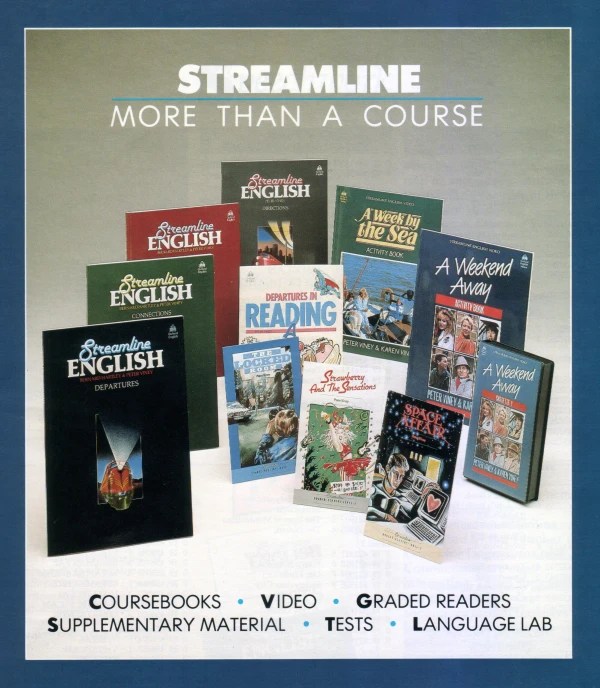
When we completed Streamline, we sent it to everyone. It was posted to eight or nine UK publishers on the same day. Three minor publishers offered to publish it but we were holding out. Longman, our first choice, told us they had Mainline Beginners, Kernel One and Starting Strategies all in preparation the next year and a fourth beginner course was impossible. Then they offered us both a job writing a course for the Middle East full-time. We declined. We thought them fair and straightforward.
Next, Cambridge came through. They offered a six level course to be entitled The Cambridge English Course. They used that name later. The Managing Editor, Adrian du Plessis, met with us and with Leo Jones who was doing Functions of English for CUP. I was head of Elementary, Leo was head of Advanced. We went to a famed Italian restaurant near the station. When I say ‘famed,’ signed photos of Frank Sinatra, Tom Jones, Cliff Richard and many others covered every inch of the wall. We had been there a few times before at our own expense. The issue was colour illustration. We wanted it. They couldn’t do it.
A few days later. We had the CUP contract ready to sign on the desk. The phone rang. It was Keith Rose from OUP. He said he was investigating the adult beginner market and my name had been given to him. I said I did not want to give OUP any of my time because they were the only publisher who had not acknowledged our submission several months earlier. He asked what it was. He said, ‘I’ll phone you back in half an hour.’ He did, and said he would like to discuss it. I said that we were about to sign the CUP contract, and Keith said, ‘Don’t do that yet. I’ll be there tomorrow. We’ll have lunch.’
We suggested that same Italian restaurant. He was clearly shocked when he saw the prices. It was a top restaurant. We had not realised that a Managing Editor and an Editor have different expense levels. We said the issue was colour Illustration, and the attraction of OUP is that they had used it for Access to English. He said, ‘You can have colour. But come to Oxford to meet my boss.’
So we did. That was OUP’s Private Dining Rooms. Bernie had said, ‘If it’s not colour, we’ll go to CUP.’ Simon Murison-Bowie agreed to colour. Bernie went to see Robert O’Neill in Brighton and asked, ‘CUP or OUP?’ Robert pointed out the disparity in size and told him OUP was the obvious choice.
Our next lunch was a week later. Simon came to ACSE to clear the deal with the directors. That went amicably. Simon said, ‘Keith told me about a wonderful Italian restaurant you showed him last time. Shall we go there for lunch?’ Simon was always cool.
The pub for lunch
When we were doing the first Streamline, Keith said it was so design heavy, that he suggested we go to the pub where the designers had lunch each time. We did. A half of beer and a sandwich, but we got to know the designers. Invaluable.
The Chinese restaurant.
On publication, Keith said he had been told we could celebrate somewhere above the normal ELT budget level. We went to an expensive Chinese restaurant in Oxford. Keith was shocked to see virtually every table occupied by editors from the Academic Division, wining and dining prominent Oxford academics. As he said, ELT made the money. Academic spent the money. However, as he pointed out, those esteemed professors would get a couple of fine dinners and their name on a book. Royalties would be negligible. We had the pub sandwiches and a good royalty.
Duke of Cambridge
For years, we generally had lunch at the Duke of Cambridge in Little Clarendon Street. It was a good lunch with wine, and lasted two hours or more. If Bernie and I were on the train, it finished with brandy. A couple of times contracts were put on the table with the brandy, but we always said, ‘Never sign any legal document in a place where alcohol is served.’ Later puritanical regimes frowned upon that old style publishing lunch, but I think OUP did very well from it. Simon Murison-Bowie and I sketched out the whole concept of Departures and Connections in Reading, then Streamline Graded readers, in the Duke of Cambridge. It was creative and productive, as meetings with Simon always were. OUP’s biggest error ever was not making Simon the Managing Director. Simon noted the outline neatly on napkins and beermats which I took away. It continued to be the venue for video meetings later.
In later years, the private dining rooms were usually marketing, not editorial locations. I had a few where important distributors were coming, and I was asked to combine a day editing at OUP with a lunch with an important distributor or area manager. They knew how to play it too. We met the owner of a group of schools in Japan who were a major customer. He was asked to sign the guest book, and they nonchalantly pointed to a page they had found in Japanese and asked if he’d like to sign there. As they knew well, the signature directly above was the Emperor.
Streamline Destinations
Things were falling apart between me and Bernie. We started on Level Four of Streamline. That was odd. Our editors, a man and a woman who had best be nameless to protect the guilty, said they preferred to meet us in Bournemouth. I think there were three trips. They arrived at twelve, suggested we go straight to the restaurant opposite our office. They drank like fish, held hands and giggled and left at two. I later discovered those trips had involved overnight hotel stays for two days editing. We didn’t even know they were in town. When the book came out, unit 5 had the Teacher’s Book pages in the Student Book. There were about fifty grave errors. We had not been told it was published, but I went into BEBC bookshop and was told it had just arrived. John Walsh showed it to me. I asked if I could use the shop phone (no mobiles then), and called Michael Daniel at OUP. I waited, and he called me back at BEBC. It was withdrawn. 40,000 copies were pulped. The editors departed. Instantly, I believe.
Then there was Amsterdam
I’m not doing foreign visits (nearly always generous, friendly, some of the best meals in my life) but this is exceptional. David Stewart was then in charge of France, Benelux and Switzerland, and notoriously mean. He was from Dublin. He would say, ‘I’m fed up of this crappy French food. Can we do MacDonalds, or maybe a pizza so I can have a change?’ Bernie Hartley reckoned David took him to MacDonalds then took his wife to an expensive restaurant another day and that was the bill that went in. Bernie was paranoid though.
In Belgium, Norman Whitney got so fed up, he invited us all to dinner and paid himself. I did the same myself on other tours.
So David arranged for me to lead a Saturday mini conference in Amsterdam, and asked the British Council (BC) to provide speakers and make a day of it. I would open and close the day. They agreed. I arrived on Friday, and the BC invited us to dinner with the other speakers and their partners, and the BC paid.
David said, ‘Tomorrow night it’s on OUP.’
Mid-afternoon on Saturday, David said to me, ‘We’re going to a famous place tonight with the Dutch distributors. The 24 ducklings something.’
So I was having coffee, and the BC speakers asked me about the evening, ‘The 24 ducklings,’ I said. They were astonished. ‘That’s the most expensive restaurant in the city!’
As I finished, David came along. ‘What were you telling them?’
‘Just the name of the restaurant.’
‘Oh, God, no! The distributors are paying. I was going to blow them out. It’s meant to be just me, Yvonne (from OUP) and you!’
‘You can’t do that,’ I said, ‘They spoke today for no payment. They took us to dinner on Friday. You invited them. Look, let the Dutch guys pay for us. You’ll have to pay for them.’
So we got to the restaurant. The BC speakers turned up, all with partners. We sat down. No prices were printed on the menus.
‘Lobster!’ said one, ‘I haven’t had that for years.’
‘Dom Perignon!’ said another, ‘I’ve always wanted to know if it is better.’
David was green, ‘I’m going to the gents. Come with me.’
‘I don’t need to go.’
‘I told you to fecking COME WITH ME.’
We got to the gents. David was shaking, ‘I saw the prices on your Dutch fellow’s menu! My credit card won’t take it. You’ll have to go halves with me.’
‘No way, David.’
David in his cheerful manner called me some choice and very rude names. I was used to it. We had had several tours together.
We got back to the table. David’s hands were still shaking. He picked up his napkin and it slipped out of his hand to the floor.
A waiter dashed over with a tray and silver tongs, picked up the napkin and placed it on David’s plate.
He stared at it, then said, ‘If this was a fecking decent restaurant, you’d’ve brought me a clean one. And a clean plate!’
That man was never fazed. And he was quite right.
Back to the UK
After that, OUP in the UK divided on lunch. Entertaining ceased to be tax deductible for companies. For a while, you could still tax deduct entertaining non-UK nationals. An American editor said, ‘They’re always so generous when I’m in Oxford.’ I didn’t say why.
We continued with productive lunches with the video department.
The textbook department now avoided lunch outside by ordering sandwiches, or went for really cheap. We had one in a Thai restaurant in Walton Street. The cheapest restaurant I’ve ever had lunch in. It also made us both ill. I won’t go into detail. The next time it was suggested, we said, ‘OK, we’ll go and get our own lunch. See you in an hour.’
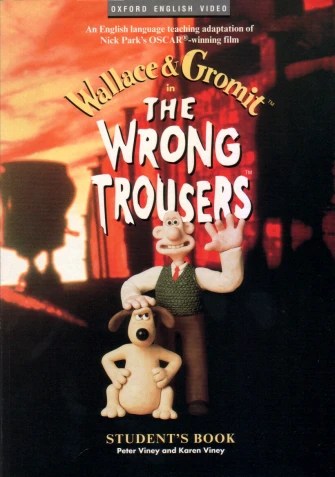
Café Rouge, Bournemouth was the scene of a long lunch during which I, Karen, Rob Maidment and Martyn Hobbs developed the whole storyline for Double Identity, our award winning video. We had paper with us, but stayed all afternoon with coffees. The Video dept was always excellent. When you’re developing comedy, a convivial atmosphere and lots of laughter helps. As do great producers and editors. We even had lunch at the 5 star Chewton Glen with the video department.
OUP New York was a good lunch, and indeed dinner, if you could get past the ten minutes it took to inform the server of the various editorial dietary choices, restrictions and allergies. Once was the Oyster Bar at Grand Central station, when it was my turn to list allergies (I am allergic to shellfish).
Budgets got tighter as years went by. I hasten to add that we weren’t always taking. We had several meetings at our house with sandwiches at a minimum, or a good buffet lunch, at our expense. Authors do that. When I met with Garnet Education and Anna and Terry Phillips at their house, Anna and Terry provided lunch.
By the time OUP had its new canteen there was a change. That canteen had to be used.
At first we’d queue with the editor, who would pay.
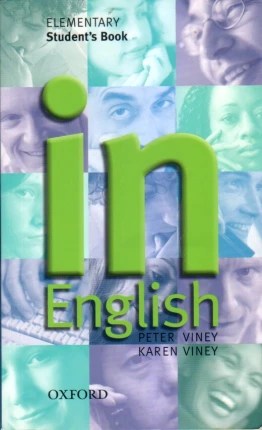
Often we had curled up sandwiches (prepared the day before) and a thermos of lukewarm coffee in the meeting room instead. IN English was design and illustration and photo heavy. We had many meetings. Generally they started at 10 to 10.30 and finished at 4. OUP were on flexitime. Our editors were dropping children and picking up children. For us, it meant two meetings on successive days, Monday and Tuesday. In the early days with OUP, we had started at 9 a.m., had a decent lunch, and ended at 6.30 pm or 7 pm. We had a two and a half hour drive each way. Doing it all on one day saved five hours in the car. I also resented the curled up sandwiches. Karen and I left home about 6.45 a.m., and breakfast was a banana each in the car. We were actively hungry. Also ending at 4.15 often meant nearly an hour in Oxford’s rush hour just to reach the A34 junction. We’d be home at 7 or 7.30. After 6.30 the junction was 5 or 10 minutes away.
On days we used the canteen, it changed from the editor paying to, ‘You are welcome to use our subsidised canteen.’ We remember those lunches badly. I would be speaking with Richard Morris, who designed Streamline and decades later, IN English. The two editors would speak together, totally ignoring Karen, who was fuming. But the textbook department became like that with us. I could say much more and one day will. There was a strong divide between the way marketing and video treated us, always very well, and the way the textbook department began to treat us in the later few years.
The My Oxford English self-study course designed for Spain was an exception. That was always a good lunch in a pleasant restaurant, but then I expect OUP Spain (invariably generous hosts) were paying. But then they refused to put our names on the cover.
BBC was a bad one. We were invited to come for lunch to discuss future ideas. We had a couple of TV (rather than video) ideas and were excited. It turned out lunch was in an office (Cheese, tuna or ham sandwich?) and all they wanted to do was ask us about OUP’s video plans, which we declined to tell them. A totally wasted day.
Later, I always had pleasant lunches with Richard Peacock at Garnet Education for Fast Track and Garnet Oracle Readers. It was always a decent meal too, pub style but proper tables and substantial and yes, we talked shop all the way through. I only had one lunch with Usborne, but it was with Peter Usborne himself, and most enjoyable.
 Peter Viney's Blog
Leave a comment