They are roughly in order from best downward in each star category.
Every play is linked to my original review with a short extract. Every review has many more photos.
This year I’m not doing Best Actor / Best Actress / Best Supporting Actor & Actress. I really can’t remember this many productions well enough to be fair. I will mention some that come to mind.
This year is different. London is right down. Hotel prices and travel are ruling London out. The RSC dominates in classic plays, Chichester dominates in new plays. It’s the natural order.
I include NT Live / NT At Home only if the original is a 2025 production.
Shakespeare and early
BEST & WORST PRODUCTIONS
This has been a great RSC year. More 5 stars than ever before.
5 star
Measure For Measure, RSC
Directed by Emily Burns
It focuses on the main theme, men in power exploiting women, and sets it in the political sphere. The play begins with video projections … Trump and Epstein, Harvey Weinstein, Prince Andrew, Bill Clinton, Matt Hancock, Boris Johnson. (They skipped John Prescott). The programme has an essay on perception of hypocrisy. The public mind a randy politician (JFK, Clinton) far less than a moralising hypocrite. It is directed by Emily Burns, who after last year’s Love’s Labour’s Lost at the RSC, and Jack Absolute Flies Again at the National, is one of the leading current British directors. There are changes in the order of scenes, and some additions. So this might not be for those who need Shakespeare to be totally faithful to the text. I would rate it as the RSC’s “signature production” for 2025. The RSC is on a roll with its new artistic directors, Daniel Evans and Tamara Harvey, and in a year of outstanding productions, this is the one that will define the year for us.
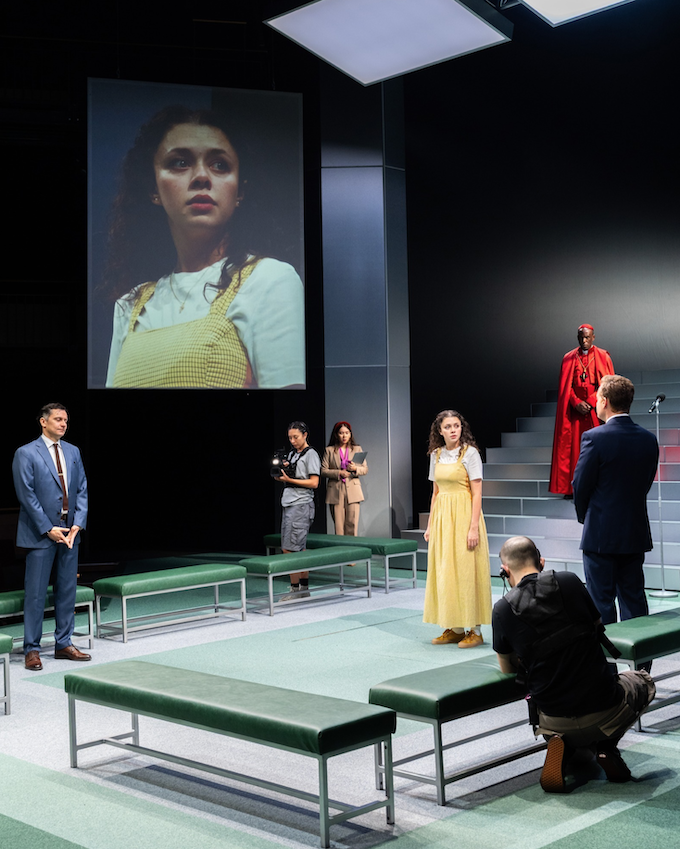
Isis Hainsworth as Isabella is a candidate for best actress of 2025.
Much Ado About Nothing, Jamie Lloyd Company
Directed by Jamie Lloyd, Theatre Royal, Drury Lane
The Ibiza Beats one. Tom Hiddleston and Hayley Atwell as Beatrice and Benedick. The first reaction here is, what? No Dogberry? The original lines creak, but we’ve seen some marvellous added improvisation Dogberry performances. And so no Watch? Isn’t that central to the plot? How are they going to reveal what Don John and Borachio did? The entire soldiers returning from the wars thread has gone too.
Mostly the cast are on all stage throughout, seated on chairs. The first scene is four of them, Leonato, Hero, Beatrice, Margaret, sitting in chairs facing front. In general, longer speeches are declaimed straight out to the audience, not to other actors. The play is thus very dance and beats 2025, yet in acting style, old fashioned. That suits a Star vehicle, which very much it is.

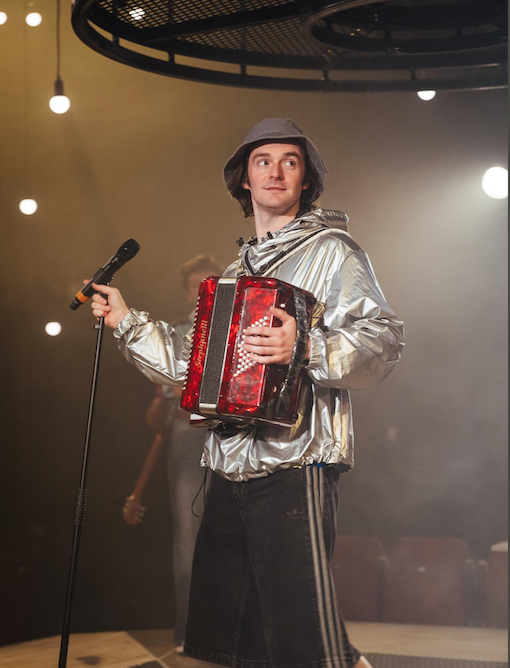
Two Gentlemen of Verona, RSC
The Other Place,
Directed by Joanna Bowman
We loved the two outdoor Garden Theatre RSC short and sharp 80 / 90 minute versions of Comedy of Errors and As You Like It. Now that The Other Place, just along the road, is back to functioning as a third theatre, the concept has moved indoors for The Two Gentlemen of Verona (at 100 minutes). Like the Garden Theatre 90 minute productions, it has no interval and is heavily cut. A better word than ‘cut’ is ‘focussed’ and it brings out the essence of the play with clarity. The dramaturg, if she was responsible for the cutting, deserves major credit. I always founds the play convoluted, and of the three I’ve seen since I started writing these reviews, I thought two were poor. This is outstandingly the best production I’ve seen of the play, which may be Shakespeare’s earliest and among the weaker ones. Yes, the one with the dog. We judge it for what it is as an entertainment designed to popularize Shakespeare, not against the full play.

Hamlet RSC
Directed by Rupert Goold
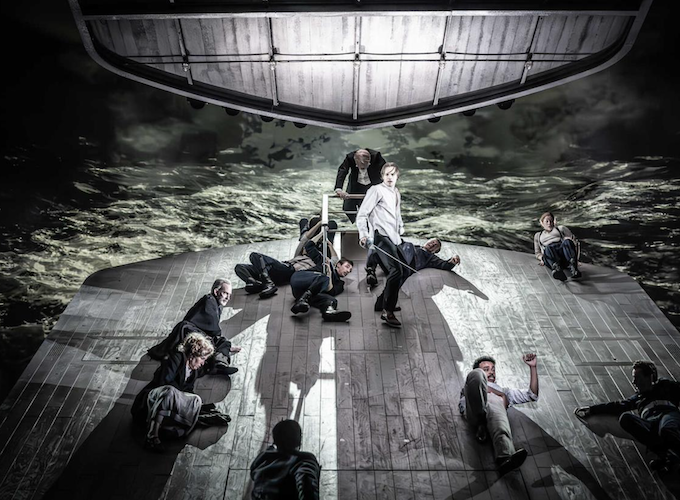
Hamlet is the longest play. Uncut it runs to four hours so it’s never uncut. Here, it is three, including a 20 minute interval. Part one is 95 minutes, part two is 58 minutes. Add a bit for applause. It never seems long. We were told it had started at seven, rather than seven thirty, because in the early planning stages they had assumed it might be three and a half hours overall. It takes place on a royal yacht, the Elsinore, with the set a deck with real water round the edges and projected sea at the rear. The sailors are in military uniform, but we also have dancers and evening dress. It opens with the military burial at sea of old Hamlet, covered wit a Danish flag. Then we fast forward to 50 Days Later. The Titanic reference is writ large. The date is projected 14 April 1912, and a digital clock flashes times up until the interval, 00.00. So part two is 15 April 1912, the day the Titanic sank. I didn’t have to check the date. My father was born the next day. Costume reflects 1912.
The projected background can be calm sea, rough sea, rocks, portholes, larger cabin windows, a map of northern Europe. The engine room deep in the bowels of the ship with moving pistons is where Hamlet confronts his father’s ghost, as if deep in Hell.
Hamlet: Hail To The Thief, RSC
Adapted by Christine Jones with Stephen Hoggett
Music by Radiohead
Orchestrations by Thom Yorke
Co-creators / Co Directors: Stephen Hoggett, Chistine Jones, Thom Yorke
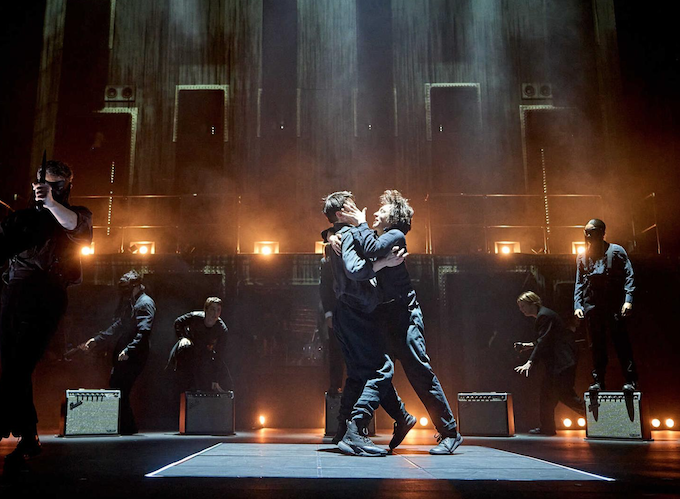
It’s 100 to 110 minutes minutes long with no interval. I don’t usually approve of no interval, but the level of high intensity was such that it could not have had an interval. It never felt long. Most of the discussion is on music and drama, but both of us were bowled over by the choreography and movement. It is heavily abridged for the longest play of them all. The lines are the “greatest hits” and in a different order much of the time. Given music and dance, I doubt there was much more than an hour of the text. It was replaced highly effectively by movement. The movement is angular, stark, enhanced by the music, and in particular a great drummer in Shane Forbes. The programme notes that one inspiration was Egon Schiele’s art with distorted figures. Claudius and Gertrude are cast tall to emphasize that. Polonius fits the pattern too. Looking at the cast bios, it’s hard to believe their general background is acting, not dance centred musicals. You wait years for a 5 star Hamlet, then this year, two of them come along a few months apart. Both at the RSC. You don’t get many standing ovations at the RSC. This did.
A Midsummer Night’s Dream, Wanamaker Playhouse
How do you rate it? It’s a cast of twelve on a small stage. That means you can’t compare it to the really huge productions: John Caird on a rubbish heap in 1989, Emma Rice at The Globe 2016, RSC Play For A Nation 2016, the Bridge in 2019, the RSC 2024 … all five star versions. On comparison to that scale, I’d have to say four stars. Yet if we confine it to compare with small cast / small stage productions which tour, it’s a five.
Read the whole review. It is truly radical.
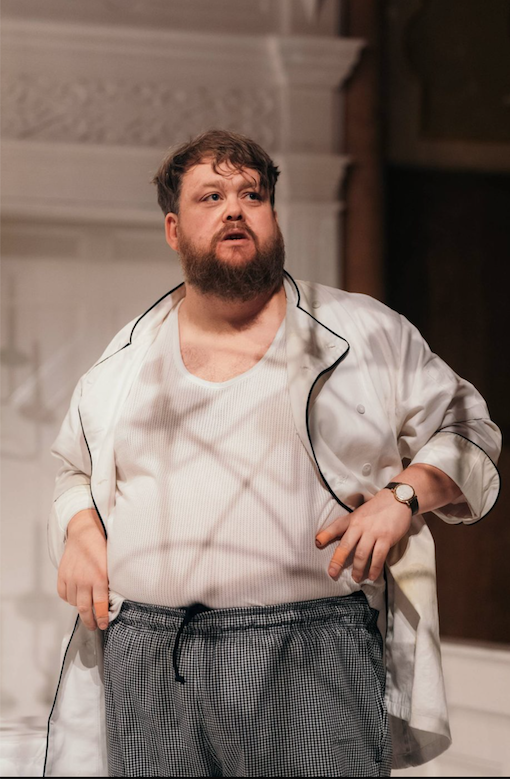
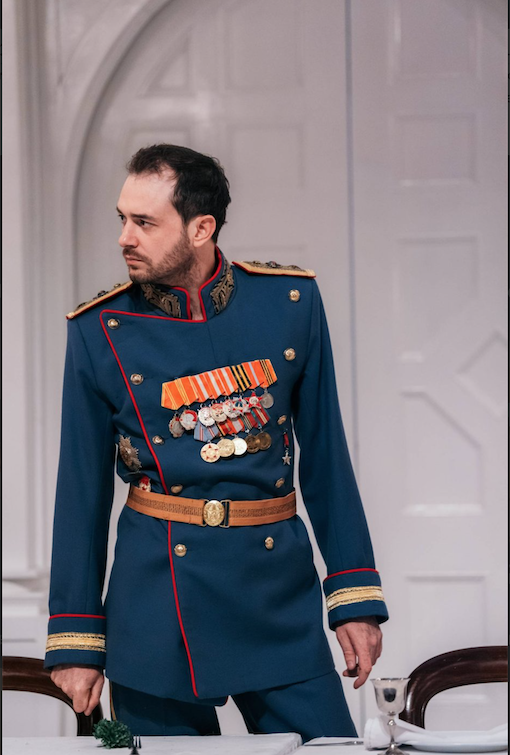
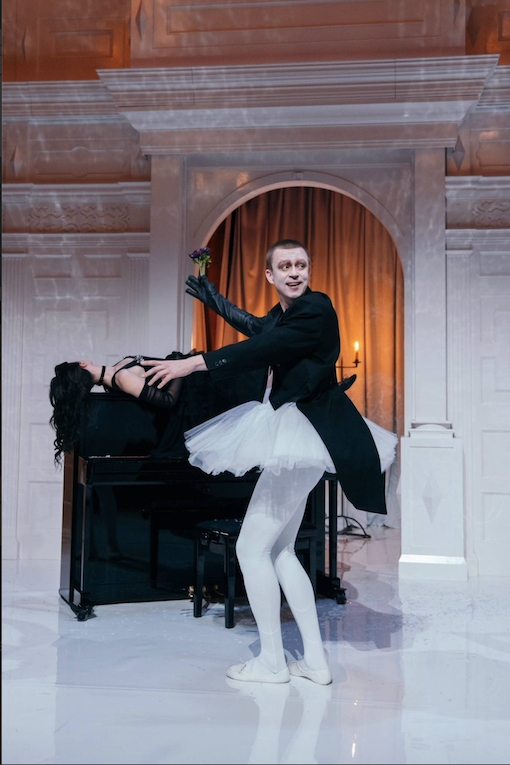
Macbeth, Donmar
Directed by Max Webster
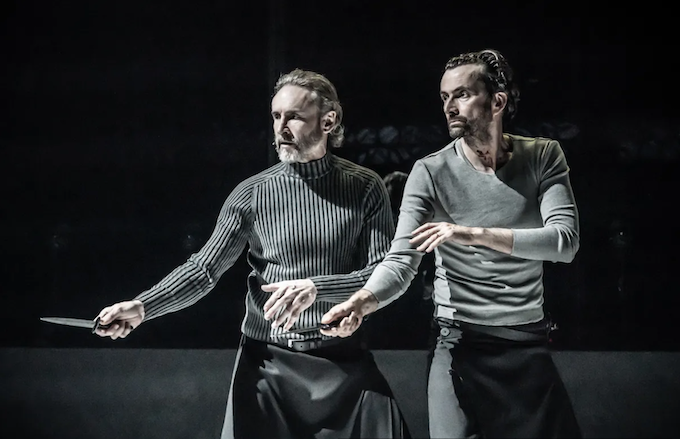
David Tennant as Macbeth. Streamed to cinemas.
There is an emotional distance to it. There’s a creepiness as Macbeth interacts with Fleance and then the Macduff son. It’s Macbeth who watches from afar, and then carries young Macduff off in the Lady Macduff murder scene (which takes place in the daek). The children work better than usual, because the binaural sound means everyone has head mics. You would normally avoid that in a theatre this intimate.
It’s dramatic with a capital D. It is minimalist, and feels contemporary. As Karen added, it exudes maleness, and uses Lady Macbeth’s lines to include her. Violent males strutting about and dominating as in 2025 global politics.
It is a major version. We both agreed we were on the edge of our seats, but admired it more than we liked it. I’m not sure why. It will be on streamed services, but it is so intense that a cinema helps, particularly with a sound plot more complex than a simple sound bar can deal with. You can’t argue its five stars.
Four star plus / Borderline five
Much Ado About Nothing, RSC
Directed by Michael Longhurst
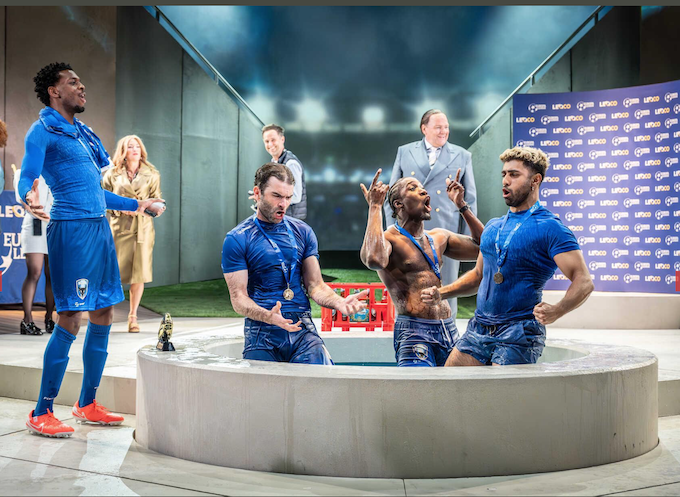
This will be the “Footballers’ Wives” one, or as they’re not married yet, the WAGs one,
I immediately fall for the concept. Instead of soldiers returning from war, we have the modern substitute. The star footballers of Messina FC are returning from their European final victory against Madrid.
When you go in, the projected score is Messina 1. Madrid 2. … then the score changes. They move to Leonato’s villa, where the team have been invited by team owner Leonato. Lines change but fit so instead of Beatrice, now a football reporter, saying ‘How many men did he kill,’ of Benedick, she says, “How many goals did he score?’ And her insult is ‘Signor Own Goal.’ Benedick declines to be interviewed by her. They have previous. I would go further than they did, so instead of addressing Don Pedro (the manager) as ‘my lord’ I would have had the players say ‘guv’ nor.’ Maybe a step too far, and confusing because in the original text, it is Leonato who is Governor. Though the Watch change Leonato to ‘the boss.’
Four star
Romeo & Juliet, The Globe
Directed by Sean Holmes
Romeo & Juliet can take high concept, from West Side story via Baz Luhrmann’s 1996 gangs and gas stations film or Kenneth Branagh’s Cinema Paradiso Italian setting. Often it’s simply modern dress. So this is the Wild West version. I wondered how far they would go in creating two opposing sides. Would it be like the Hatfield- McCoy West Virginia feuding hillbillies, or the range war cattlemen v sheep herders (as in the Netflix series 1923), or the town facing a gang like The Magnificent Seven?
None of the above. There’s a Western backdrop, Western costumes, sometimes guns as well as knives, and some excellent Western music and dancing. That’s it. No American accents, wisely. Even for experienced Shakespearean actors, adding an American accent would be an issue, then extrapolate to a large cast. And yes, I know that many words indicate that Shakespeare’s pronunciation survived in America, but not in Britain. So it’s British accents here. Estuary for Juliet, Northern Ireland for Lord Capulet and a touch of Welsh for Paris. Colm Gormley just does one line in a comic Western drawl.
There’s another thing. Last week we saw the RSC The Winter’s Tale with no comedy. Now we have Romeo & Juliet with no tragedy (at least in the first part, Acts 1-3). It is played for comedy and it works.

The Winter’s Tale, RSC
Directed by Yael Farber
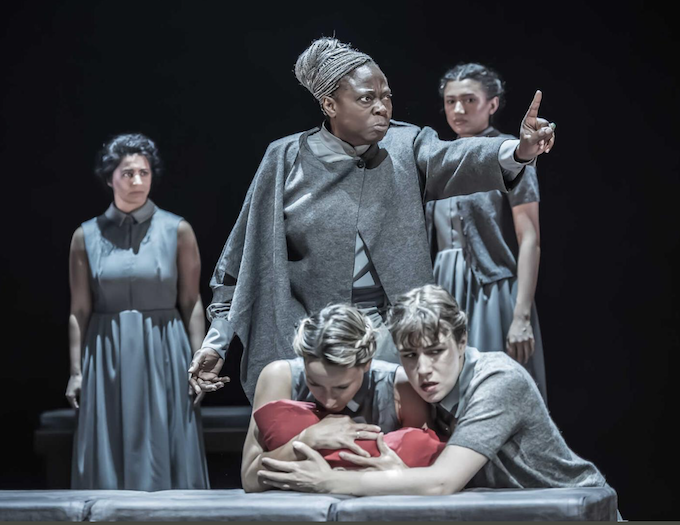
I realised that this production was extremely hard to review or rate. My thoughts swung from one star to five star and back again. I was thinking, this is the heavy, serious Almeida style (where the director Yaël Farber really made her name) rather than the more populist RSC style. They solved the play’s major problem: how do you move from the tragedy in Sicilia to the rustic comedy in Bohemia? Is it a tragicomedy? They solved that by eliminating virtually all the comedy – they had to keep Autolycus picking pockets, but the shepherds weren’t funny. Autocylus doubling as Time wasn’t funny. The rustics weren’t comic at all.
Karen’s instant response was four stars. Mine was three. She found it raw and violent, reflecting today’s world situation, and that the mythic comparison was apposite, especially the air of hope in the ending. (She also thought the programme essay pretentious). I said I could see some giving it five and others two. It kept our attention, threw a new light on the story and had us discussing it at length. In the end, they won me over and I think four stars is about right.
Hamlet, Chichester
Directed by Justin Audibert
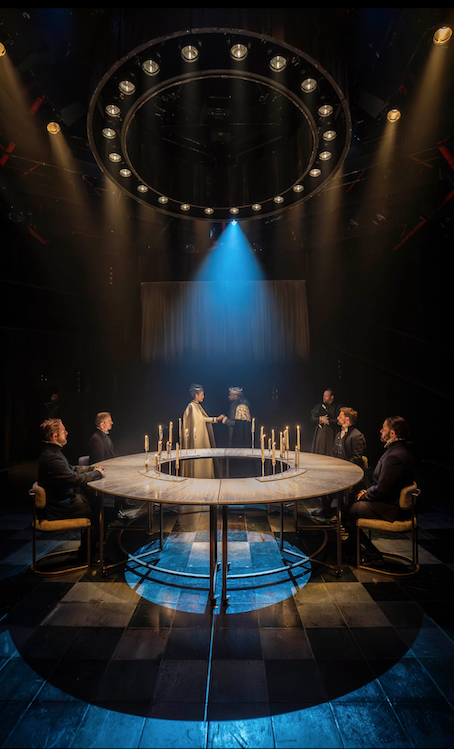
Having decided to do the big one, Hamlet, and with Giles Terera as Hamlet, they have decided to do it properly. All three Hamlets (if we include Fat Ham) this year have been greatly cut versions with a major concept: a Royal Danish Yacht / Titanic version, another set to Radiohead’s music and the third at a North Carolina barbecue. Hamlet gets the major concepts thrust upon it: The West Wing, a lunatic asylum, a boarding school, West Africa, female Hamlet (twice). So what was it going to be this time? Answer: none of the above. No concept is imposed.
Then the main thing, they’ve done nearly all of it. It’s long. A totally uncut Hamlet runs to four hours. Kenneth Branagh’s 1996 film boasted the full text and ran to four hours and two minutes. This is not that long, but it has restored so much that is frequently cut. The length, in spite of a sore bottom, is a virtue, in that so many speeches seemed to come fresh, because cutting them is standard.
Titus Andronicus, RSC
Directed by Max Webster
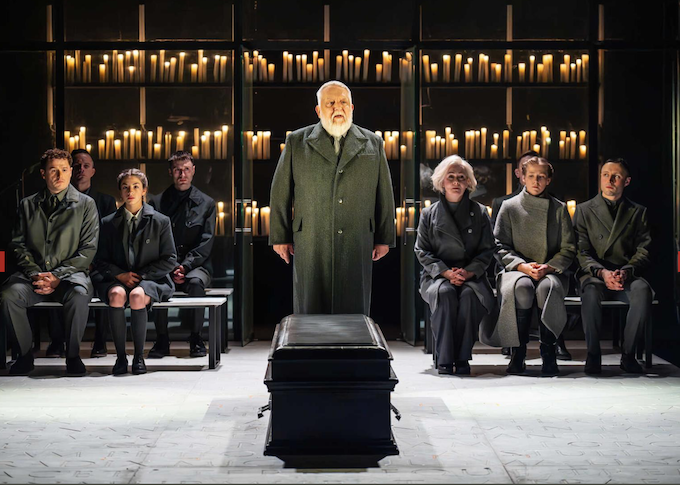
For director Max Webster the leap from a hilarious Importance of Being Earnest at the National last year, to the bloodiest play of all, Titus Andronicus, at the RSC (via Macbeth at the Donmar) is a major change. Simon Russell Beale’s speciality is Shakespeare in modern dress. Because it’s stripped so bare, this really is an actors and lines version. When you’ve cast Simon Russell Beale as Timon, Joshua James as histrionic Emperor Saturnius and Natey Jones as Aaron, stressing quality of performance is the way to go. These are three towering performances. Wendy Kweh delivered Tamara extremely well, but given Saturnius’s instant attraction to her when she is delivered as a prisoner, I would expect her to look more exotic, more voluptuous.
Modern dress? The best production I’ve seen was Lucy Bailey’s direction at The Globe in 2006, repeated in 2014. It still is. That’s the full Roman version. Exotic Goths. Brass trumpets, smoke and fire. To a degree, it’s a cop out setting it in Roman times, suggesting how savage life was but confining it to the distant past.
Three star
The Merry Wives of Windsor, The Globe
Directed by Sean Holmes
The set puzzles me. The Globe has covered the fabric of the building before, and two Sean Holmes directed plays stand out, Much Ado About Nothing set on a Mexican revolution era train, and Romeo & Juliet set in the Wild West. They both had solid reasons. Here? I can’t see that covering the basic Globe walls has any purpose at all. One review calls it a Liberty print – it’s not. Another calls it a William Morris design. It’s not. A third says specifically it’s Thibaut Windsor Spa wallpaper. That’s certainly very close indeed, though I can’t find the exact colour-way They may have done it for this. It’s a wallpaper pattern and costs £240 per roll. So what do the curtains behind the musicians cost? It’s echoed in the costumes which are colour coded, a good idea. The Pages have yellow, the Fords have light blue, others have green and Falstaff and his supporters and page boy have red. I didn’t like the silly hats on the Pages. However as the costumes are faux-Elizabethan (but much shinier and more subtle colours), I can’t see why they needed to cover the existing building. There is no furniture apart from Dr Caius’ closet (same pattern) and the laundry basket in blue.
I thought Danielle Phillips as Anne Page stole the show as a very funny, very minor part as the page boy. She excelled. The bit where Mistress Page cuddled her to her breast had the audiences roaring with laughter.
Having seen the 80 minute Shakespeare at the RSC just days before, I was thinking how the RSC could cut this play. The Germans can go right away. Nothing to do with it, probably added for a particular court appearance at Windsor itself. So can the scene where the Welsh Parson tests William Page on Latin. Both did it very well, but juveniles require extra work backstage, and you need two. I suspect it was there to cover costume changes. Losing ten minutes would improve the production

Macbeth, RSC
The Other Place
Directed by Daniel Raggett
The major thing is casting Sam “Jamie Fraser” Heughan as Macbeth. I’m amazed they put it in The Other Place, the third venue, rather than the larger Royal Shakespeare Theatre, although it was the venue for the 1979 Ian McKellen version. Tickets sold very fast to see the star of the Outlander TV series. This Macbeth is modern dress. There’s nothing unusual in that. The majority of productions are modern dress, or 1930s or future dystopias. But Sam Heughan is known for striding around in a kilt waving a claymore. Being bare chested and having sex scenes in most episodes (for good or bad) is also expected of Outlander, I guess that’s what the audience would have preferred. So here it’s a Glaswegian pub. Funny, when the BBC did the four play Shakespeare Re-told series (2005) their Macbeth was set in a Glaswegian restaurant kitchen. Accent surveys of the UK come out with Glasgow as the hardest accent of all for people from the rest of the UK. Nobody does the full ‘You looking at me, Jimmy?’ But it is a lighter version, so not as difficult as phoning a Glasgow call centre and getting an operator who declines to modify their accent. We still found it hard. Duncan was Scots as a local gangster, but when he was Siward later he switched to London gangster. The priest was light Irish. Lady Macbeth is English.
The programme has notes on Glasgow’s gangland, which competed with London’s Krays. It was at its peak with blood feuds in the 1980s.
It is played in the round, but to us that was an error with sight lines. Sam Heughan has enormous physical presence, and tremendous physique. I like to see Macbeth as a powerful warrior. We liked the ‘everything in a pub’ concept. It is high concept indeed. The action never leaves the room. So Lady MacDuff has to come and visit the pub with her daughter. I wondered how they could manage the Burnham Woods moving to Dunsinane, but they make do with a report. I can’t see any other way. No soldiers carrying branches.
Edward II, Marlowe, RSC
Directed by Daniel Raggett
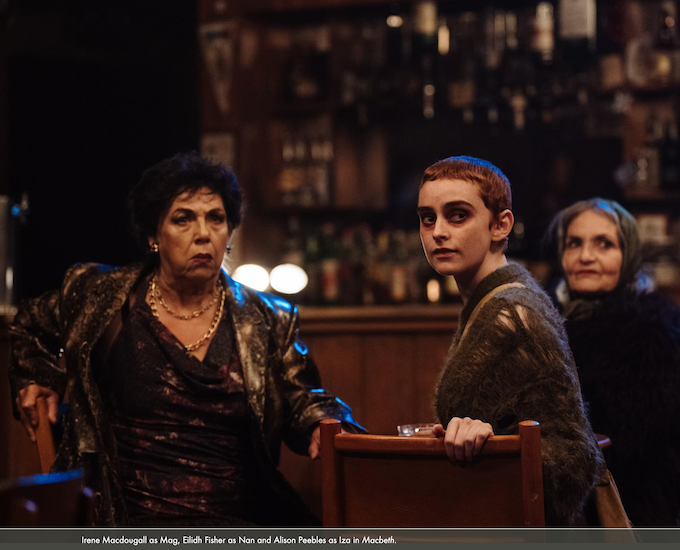
RSC artistic director Daniel Evans as Edward II. The programme would have benefitted from the Bridge Theatre’s programme for Richard II (only a week ago, and as noted, a similar story) in having a noble family tree with photos of the cast. Early on they are well differentiated by the different gilt, medal rows and garter adorned coats. Later they switch to white shirts with red braces and it is confusing. In the Sunday Times, it notes that this references both 1930s Fascism and the Bullingdon Club at Oxford, beloved of future Tory politicians (Cameron, Johnson, Osborne) as well as King Edward VII and Edward VIII. I hadn’t made the connection.
Part of the confusion is that it’s pretty dark and the white shirts stand out strongly. Given that though, the lighting design is superb, picking out the characters against black backgrounds. They utilise the now common LED lighting frame for changes – take the main lights off, leave the bright frame lit and you effectively have a blackout from the audience points of view.
Karen really disliked the Marlowe play while admiring the great production qualities and the acting. As she said, it’s a load of violent men with just one female role, and one which is particularly feeble. I’m not fond of Marlowe. There’s none of Shakespeare’s light and shade. However, by eliminating many roles and drastically cutting Marlowe’s long, long speeches, this is a dramatic and exciting version.
Richard II, Bridge Theatre
Directed by Nicholas Hytner
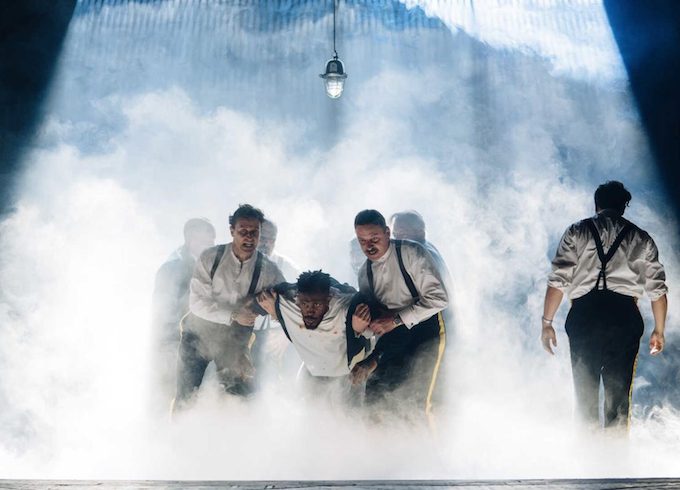
Nicholas Hytner is rightly renowned for Shakespeare in modern guise: A Midsummer Night’s Dream, Timon of Athens with stock exchange dealers, the ‘West Wing’ Hamlet, the Gulf war Othello. Does it run for the histories? Richard III always works well in modern guise. The others? Not so. They’re too tied to their time frame. In Richard II, when Richard is an autistic narcissist, kicking away John of Gaunt’s Zimmer frame to propel him to the floor, scoffing his bedside grapes after his death, just before seizing his lands, you think this is going somewhere with reference to narcissistic and grasping dictators like Putin and Trump, but it then ceases to work. OK, the trial scene replacing courtly discussion in Part Two is excellent, the Duke and Duchess of York in rural welly boot and Barbour mode, very fine. They look like aristocrats in their country seat.
Twelfth Night, RSC
Directed by Prasanna Puwanarajah
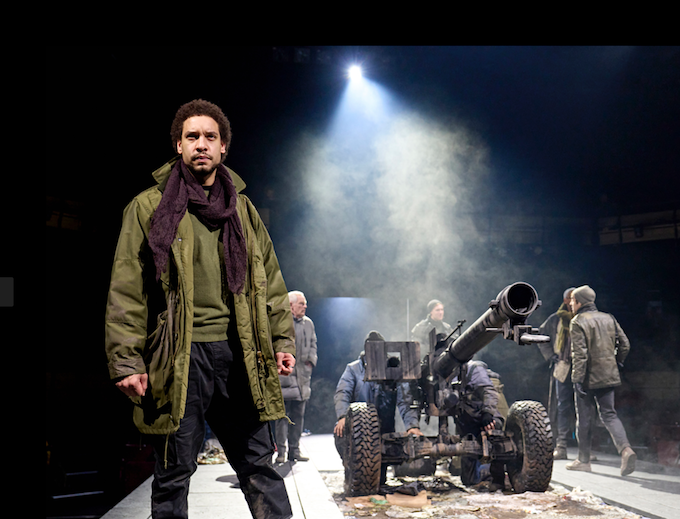
It’s different. The photos show it is dark. Dark costumes, dark sets. Maybe that befits a January plya, but it doesn’t promote a comedy feeling. It’s original, and has several good new line readings / interpretations. Why has no one thought of the reading aloud of our souls / assholes possibility before? There is line freedom to add comment, and well and they do. For our souls / assholes the added comment “it’s American’ helped.
Rating is difficult. I thought a strong four stars at first. Karen thought the deliberate dark side failed to do the play justice, and while admiring acting and stagecraft, disliked the interpretation, and thought they didn’t get the Sir Toby / Maria / Malvolio balance at all. It was a depressing ending swamping the joy of the twins finding each other. Karen is a bare 3 star. After much discussion (it is a three hour drive home), I think she’s right.
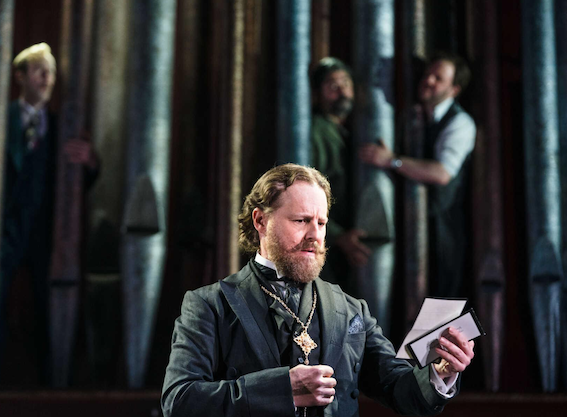
Two star
As You Like It, Bath
The Ralph Fiennes Season
Directed by Ralph Fiennes
We both thought the normal cuts could have shaved 15 dull minutes, and that as it was presented, we found it academic and dry. There were some excellent performances in there … Rosalind, Celia, Phebe, Audrey stand out. However, the versions that work best are those which go straight for comedy. Are great actors necessarily going to be great directors? All great directors HAVE acted, but then they see directing as their main path. Branagh is the best example of being able to do both. Mark Rylance, to me the finest actor of his generation, fell flat on his face directing Much Ado About Nothing. Sadly, I think this As You Like It displays the hallmark of actor as director: full attention on lines and delivery. Not so good on the overall picture, nor interaction, nor on visuals. We actively disliked set, lighting and most costume.
The acting was (mostly) so good I can’t give it two star, though I was sorely tempted. But in retrospect, I can. So **
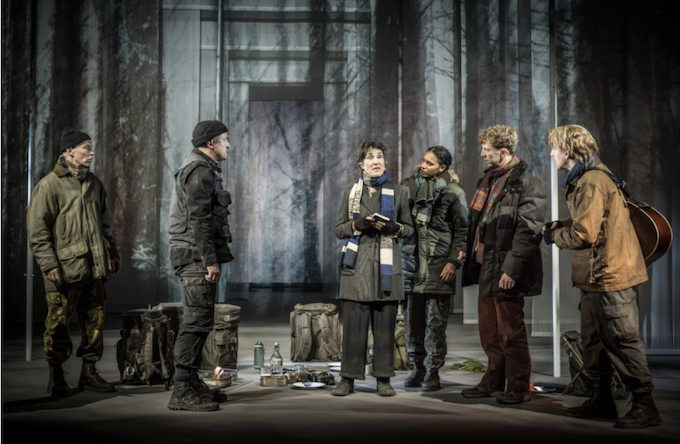
Classics, 1660 onward
5 star
Cyrano de Bergerac, RSC
By Edmund Rostand
In a new version by Simon Evans & Debris Stevenson
Directed by Simon Evans
The concept was from Simon Evans and Adrian Lester from the outset. Debris Stevenson was brought in a year ago to work on the verse (and more), and came up with the idea that each major character should have their own style. So Christian uses no Latinate words. Ragueneau has simple ABAB rhymes.
It is an adaptation, not a direct translation. It follows the plot but omits some characters and several events. It’s cut and sharpened compared to the full Wiki synopsis.
A change in this version is that in the original play, Cyrano says he’s won a band for the day. They just cut ‘for the day’ so we have Cyrano’s band: accordion, cello, violin, throughout. That’s as well as the four musicians in the gallery. The music is sublime. So is the sound. It is surround sound with cannon, knocking on doors all around you.
Acting, lighting, set, direction, text. It scores full points at every level. The play now fascinates me because of the range of mood it runs through over the five acts. I’ll have to see another version. The three leads, Adrian Lester, Susannah Fielding and Levi Brown will all compete for best actor of the year.
The RSC has done more 5 star plays this year than any year I remember. Here’s another. No question. Five stars

4 Star plus / borderline 5
The Constant Wife, RSC
Originating Playwright W. Somerset Maugham
Writer Laura Wade
Directed by Tamara Harvey
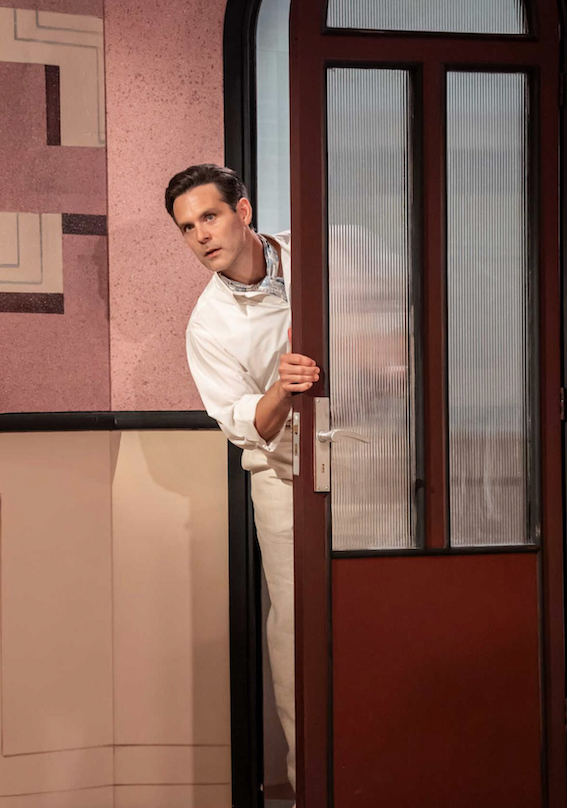
This is a surprise. The RSC strenuously avoids plays from the ‘proscenium stage with windows / French windows at the back’ era. They did Oscar Wilde’s Salomé in 2017, but that’s not a drawing room piece. Then it’s directed by co-artistic director Tamara Harvey. Note the credits. Somerset Maugham is relegated to ‘Originating playwright’ and Laura Wade is listed simply as ‘Writer.’ Or on the fliers ‘By Laura Wade. Based on the play by W. Somerset Maugham.’ Laura Wade wrote and Tamara Harvey directed Home, I’m Darling at the National Theatre.
Laura Wade said she didn’t know the play at all when she was asked to adapt it. The changes are radical at top level. There is an entire flashback scene, set one year earlier, where Constance discovers that her surgeon husband, John, is having the affair with her best friend, Marie Louise. She sees them at it, and steamily too, but they don’t see her, or know that she knows. None of that is in Maugham.
It’s an easy four star. Performances, set, costume, lighting, stage direction are all worthy of a five. We both enjoyed it greatly. I don’t think they were totally able to eradicate every last trace of Maugham’s stiffness, but the themes still work. Four plus?

4 star
Blithe Spirit, Salisbury
By Noël Coward
Directed by Anthony Banks
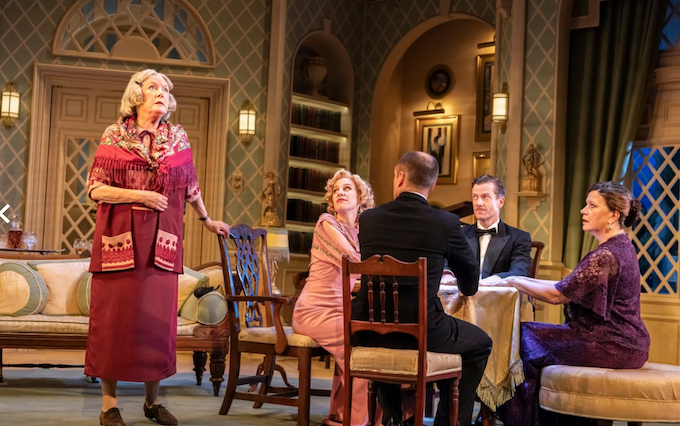
Blithe Spirit, like Private Lives and Present Laughter is a play so carefully constructed that it works on stage whatever you do with it, though the 2021 filmed version was a disaster. A little lecture first. Salisbury Playhouse seats were just over a third of the price of Bath Theatre Royal with Ralph Fiennes a couple of weeks ago. Are you getting a lesser production? Not at all. Lesser actors? Not at all. What you’re not getting is a big star bums-on-seats name.
The set is beautiful. The costumes even more so. They even follow Coward’s stage note: There is a wood fire burning in scene one (which shows this is not a production photo!). Where they don’t follow him is on the number of ashtrays adorning the set. The Acting Edition lists five cigarette boxes.
A great classic play. A great production. A comfortable four star.
Hedda, Bath Ustinov
A re-imaging of Henrik Ibsen’s Hedda Gabler
Adapted and Directed by Matthew Dunster
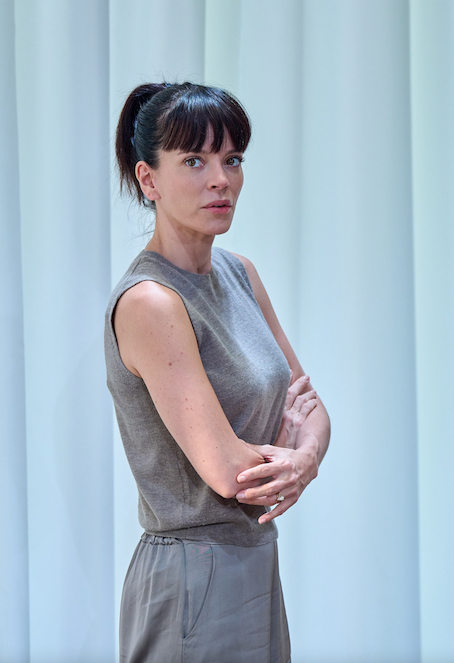
Dunster has changed it to now, and Hedda is the daughter of a deceased record label boss. Brack is not a middle-aged judge, but the wealthy local MP. MPs can manipulate better now than judges could in the past. The role of Hedda is often seen as a career peak for female actors, and is played by Lilly Allen, who looks the part of a rich record business daughter, catwalk thin, hard as nails. Where it differs from the Ibsen is that in Act Two, Hedda is so evil and manipulative that you hate her.
Every performance is powerful, the story is harrowing raw emotion, especially from Tom Austen as Jasper. Dramatic with a capital 48 point D. It can only be four star minimum. I could be persuaded to five.
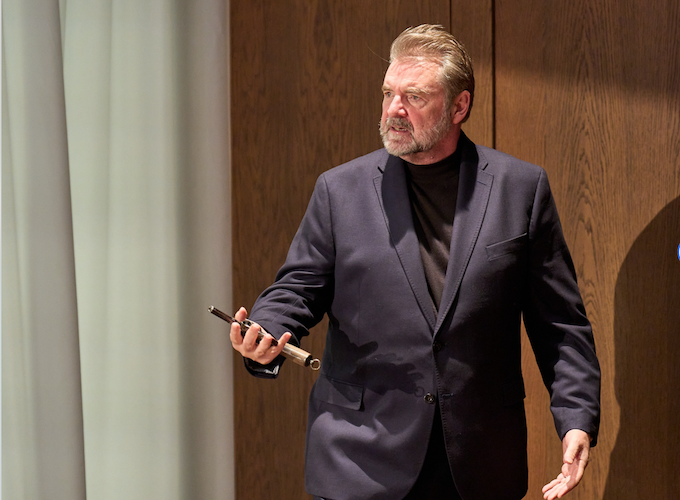
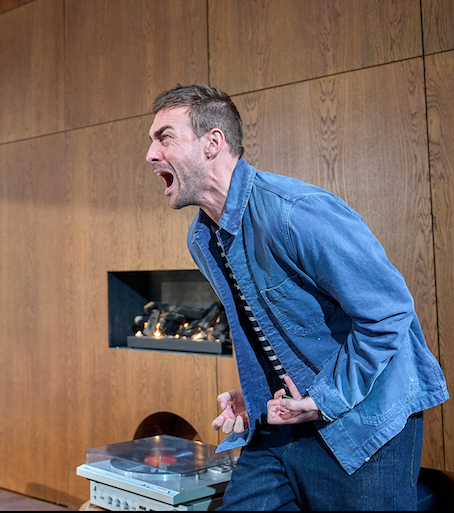
Anna Karenina, Chichester
By Leo Tolstoy
A new adaptation by Phillip Breen
Directed by Phillip Breen
Like Hedda above you can argue that this is a new and contemporary play. The original puts it in classics, I guess.
The 2012 film of Anna Karenina starring Keira Knightley and Jude Law (linked) was the most read review on this site for several years. I never worked out why. We would have chosen this stage version on the basis of Phillip Breen directing and writing, and Jonnie Broadbent acting. After the Garden Theatre version of a Comedy of Errors, we said the RSC should give Breen the Garden Theatre every year, with Jonnie Broadbent taking the lead comedy role. Naomi Sheldon (Dolly) took over as Adriana in that, but not the day we saw it. Here they play husband and wife. Then we have the lead role of Anna played by Natalie Dormer, one of the main actors in Game of Thrones for several seasons.
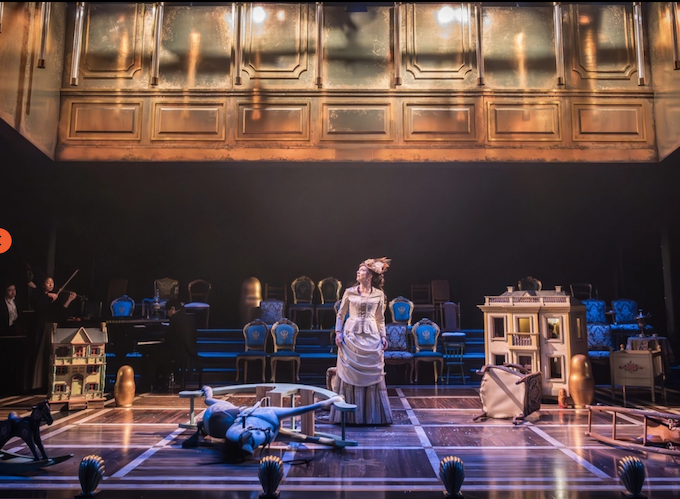
Anna Karenina is a big one to take on, around 800 pages of it. The 2012 film set it in a theatre and moved out. Here it’s like a children’s nursery with dolls houses, a cot, rocking horses in part one. When we move to Levin’s country estate, the black back wall drops to reveal an orange sky. The stage loses its usual half moon front, so has an acting area flat with the auditorium which is used. We were in the front row (I went to this one early on Theatre Friends Booking online) and I was terrified of extending my feet for fear of tripping cast members in the blackouts. They make much use of the two entrances / exits in the auditorium, which means it’s very much like the Royal Shakespeare Theatre lay out.
There is so much stagecraft and fine acting, plus so much movement. It’s not a “5” and I’m not sure why. I enjoyed reading the text afterwards too.
The Seagull, Chichester
By Anton Chekhov
Adapted by Mike Poulton
Directed by James Brining
The enduring appeal of The Seagull is the blend of comedy, romance and tragedy, together with its comments on theatricality. Add the parallel Hamlet theme. The tortured Konstantin as Hamlet, Irina as Gertrude, Trigorin as Claudius. Then add Shakespeare quotes.
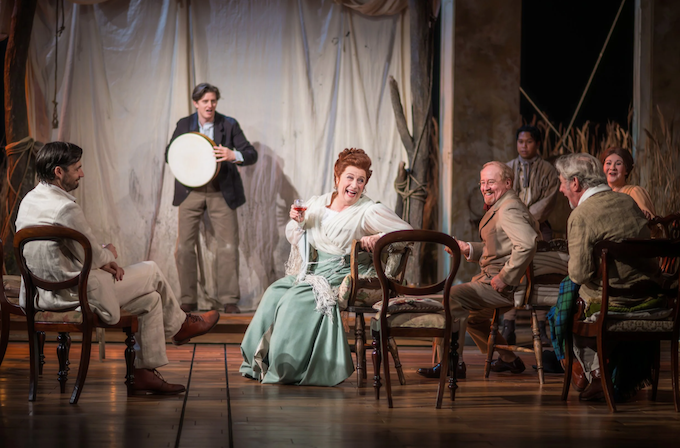
Caroline Quentin’s interpretation is the key to the production. No one does aside facial expressions and grimaces like Caroline Quentin. She is the perfect Arkadina. Other productions have had her as operatically superior, a prima donna. Not Caroline. She plays it as self-absorbed but above all, a very popular ‘salt of the Earth’ showbiz star. It brings out the comedy better this way.
The mood changes in Act 4 to tragedy, and it’s depressing. As I said in previous reviews, one welcomes the final gunshot. The gunshot itself was a disappointment. The text has Dr Dorn explain it away by saying a bottle exploded in his medicine chest and goes to check. So it’s realistic, but basically you get a plop rather than a dramatic gunshot.
3 Star
The Government Inspector, Chichester
By Nikolai Gogol
Adapted by Phil Porter
Directed By Gregory Doran
This is Gregory Doran’s first production outside Stratford after his illustrious and highly productive decade as artistic director of the Royal Shakespeare Company. This is a plus for Chichester, and there are close connections, almost an exchange as Chichester’s artistic director, Daniel Evans, became his RSC successor, and Justin Audibert, Chichesters current incumbent worked with Doran at the RSC. The other connection being that the RSC and CFT are the two best producing theatres in the country.
The play features in The Telegraph’s fifteen best plays of all time, as well as Michael Billington’s 101 Greatest Plays. I hadn’t seen it before though it did feature in ‘production history’ in Drama as it has been played variously as farce, satire, surrealistic, and realistic. That is a sign of a great play, though here it’s ‘comedy.’ The production I want to see is the 1958 BBC TV with Tony Hancock in the starring role.
The play centres on a small remote Russian town where all the officials are corrupt. It’s an unusual play in that the supposed Government Inspector, Khlestakov, is seen as the lead role, but only appears in Acts two, three and four. I’d say the Mayor has the most lines and appears throughout.
We spent the journey home trying to analyse why the laughs weren’t coming in gales – except for some moments. (Our years of writing ELT video comedy means we have spent hours analysing the laugh points in sitcoms.) Was it simply a midweek matinee audience? Older and more jaded? Did it play better in the evening? We have noticed Saturday matinee audiences are far livelier than midweek. The reviewers were there in the evening, and both The Guardian and The Telegraph rated it at three stars, and they’re the normal benchmarks. Good applause, but no standing ovations on our Thursday afternoon.
I’d conclude that it’s the play itself. It is one of Michael Billington’s 101 Greatest Plays, and it comes at a time, 1836, when nothing was happening in British drama. Interestingly, there is a point where a drunken Khlestakov claims to be the writer of great works from the Marriage of Figaro, through Don Quixote, Faust, Candide to the Merry Wives of Windsor. (A good adaptation from the originals, which are now obscure apart from The Marriage of Figaro), The Merry Wives is not one of Billington’s 101 Greatest Plays, but it’s way funnier than this one, and when we saw it at the RSC in 2012, Sylvestra le Touzel, the mayor’s wife here, was a great Mistress Page. The Merry Wives has characters. The Government Inspector instead has STOCK characters, cardboard cut outs. In spite of great efforts to give visual characteristics and differentiation, a very funny walk for the judge, a Tweedledum & Tweedledee duo in Dobchinsky and Bobchinsky, an over enthusiastic police constable, accents, lots of clever business, the characters are two dimensional.
In the end, five stars in so many areas, but overall:
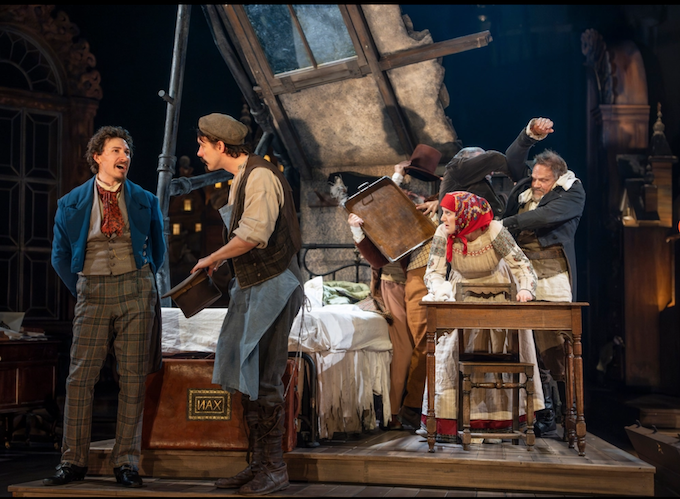
Mrs Warren’s Profession, NT stream
By George Bernard Shaw
Directed by Dominic Cooke
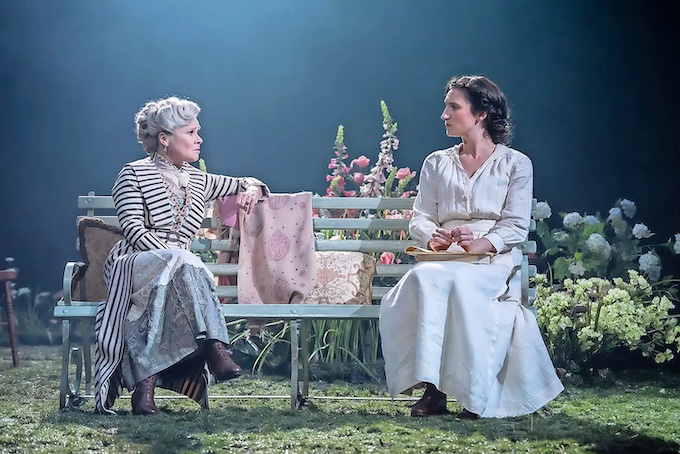
The stage is a circular revolve, with a large round / oval light above. Yet it’s on a proscenium stage. There is no set in Acts 1 to 3, just a bench and chairs with grass and a flower bed. Much needed humour is injected in assembling the garden chairs. Shaw wrote it in four acts, ignoring the fact that Shakespeare is five acts, and most plays of his era were three acts. That’s Shaw. He knew better. After Act 3, the lawn is rolled up. In Act 4, a curved back set drops down from above. It all works smoothly, but it leaves the lit stage surrounded by dusty black, and the cottage where they have dinner and the church are imagined off stage in the murky gloom.
All the acting is excellent. Both Imelda Staunton and Betsy Carter (real life mother and daughter) give five star performances. However, the set didn’t impress me. I thought the hovering tarts unnecessary. I thought the full focus on Kitty and Vivie diminished other roles. The production photos say it all: there are no photos of the Frank / Vivie interactions nor the long Vivie / Sir George scene. It’s all about the two women.
Overall? Same as last time: Acting: ***** / Production *** / G.B. Shaw **
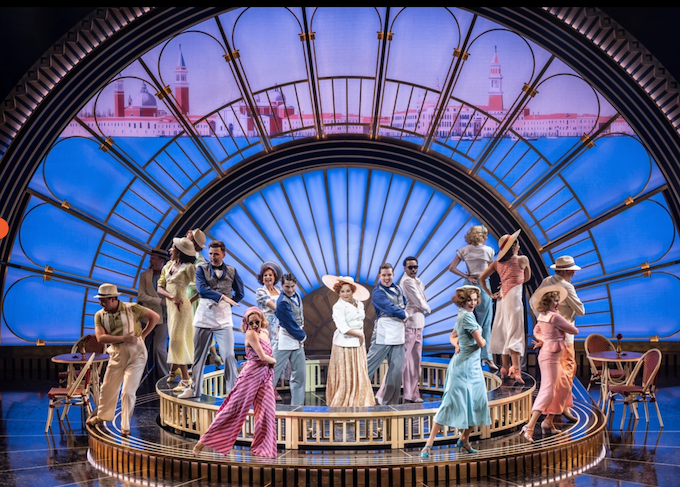
Top Hat, Chichester
Music and Lyrics by Irving Berlin
Based on RKO’s motion picture
Adapted for the stage by Matthew White & Howard Jacques
Director and choreographer Kathleen Marshall
It was a Fred Astaire (Jerry Travers) and Ginger Rogers (Dale Tremont) vehicle in its first incarnation with RKO Pictures. A 1935 musical is pushing back from the classic musicals (50s and 60s) to an earlier era. This is a NINETY years old musical. The Arts Desk review suggests the elderly Chichester audience might remember the original. Stop and think about it, of course they won’t.
Five star performances and music, it looks superb in full colour rather than black and white. The live music is crisper, dare I say better? There are four of Irving Berlin’s Great American Songbook songs in here; Cheek to Cheek, Let’s Face the Music and Dance, Top Hat, White Tie and Tails, and Puttin’ on the Ritz. But not all the songs are that standard (or indeed, standards). Still four earworms is the most you expect from a musical and I woke humming putting on my top hat.
I’d go and see it again tomorrow with glee, and if it’s near you, I’m sure you’ll enjoy the show enormously, but I must compare it with Chichester’s magnificent run of five star summer musicals in recent years. This one, even if done as well as it possibly could be, betrays its earlier origins. There were better choices of musical: simply 50s and 60s musicals introduced more variety, in dance, in settings, in musical styles, so with regret, I’m going for three stars. Much is the fault of the original.
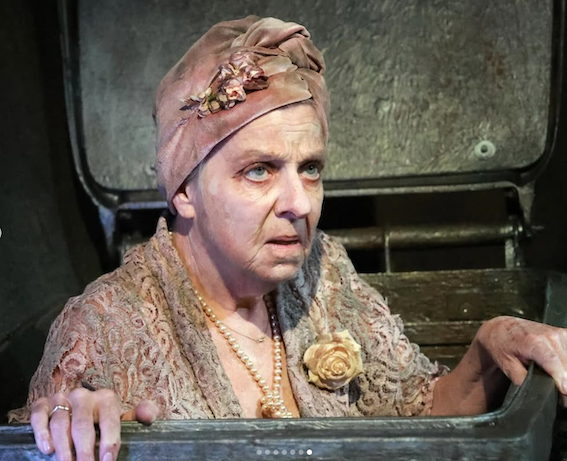
Endgame, Bath Ustinov
By Samuel Beckett
Directed by Lindsay Posner
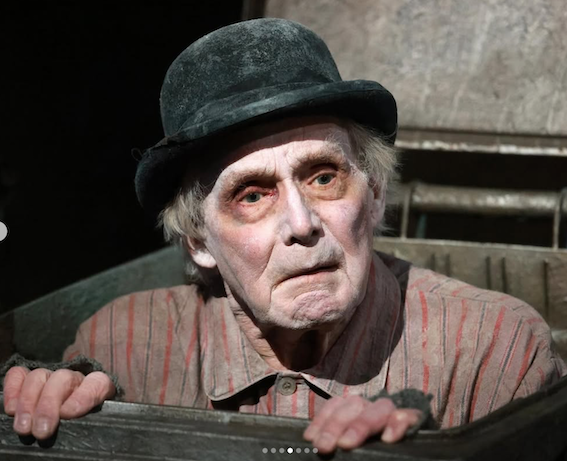
The set is angled, including the now popular lighted frame around the stage. Everything is skew-whiff, : crooked, tilted. The audience came in about ten minutes before the start. When it starts Clov (Matthew Horne) spends a few minutes messing around on a stepladder then uncovering the figure in the centre which is Douglas Hodge as Hamm. Then he had to sit motionless until his face cover, a blood spattered handkerchief, was removed. As well as never moving his legs for 90 minutes, he had to sit all over motionless for all that time. He might even have managed the dreadful Ustinov seats without squirming, which I didn’t. I was lost in admiration.
The deliberately irritating thing about the play is that Beckett seems to be teasing the audience with so many lines about Isn’t this enough? I can’t take any more of this as well as theatrical mentions This is dialogue, that’s an aside. This is what we call making an exit. He apparently wanted it played in a monotone to a metronome and I’m delighted that no one takes any notice of that whatsoever. I thought it worked much better this time than in 2020, enriched by the set and lighting too. They angled to the black comedy aspect a little more.
All four performances, lighting, direction, set warrant four to even five stars. However, I know it is considered Beckett’s masterpiece (or one of them) but for me the play struggles to get to a three, and it was a two last time. Add that the theatre in the circle (this doesn’t bother press night reviewers) is excruciatingly uncomfortable. *** (and I’m judging the play rather than the production).

Contemporary / New plays
Chichester completely dominates this category, as ever.
5 star
The Unlikely Pilgrimage of Harold Fry, Chichester
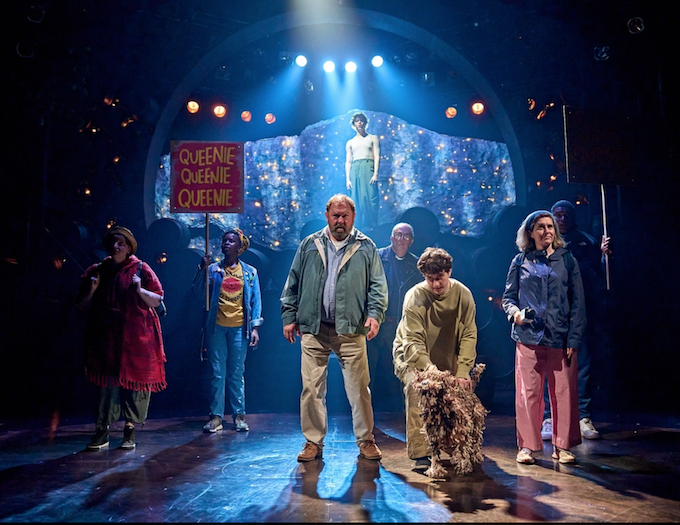
The novel won the Booker Prize in 2012. I never read it, and I vaguely knew that there were a lot of copies around in bookshops and charity shops. Then I heard Rachel Joyce on Radio Four ahead of this production. It has been translated into 37 languages. It has sold millions. It was a major seller in translation throughout East Asia. At Chichester, we booked because we trust everything Chichester does is worth seeing. I didn’t read ahead.
Harold Fry (Mark Addy) in South Devon receives a letter from Queenie (Amy Booth-Steel), an old friend. She is in a hospice in Berwick-Upon-Tweed, just below the Scottish border. He goes out to post a condolence letter, and keeps walking for 500 miles after the girl in the garage encourages him, telling her about her auntie who was dying of cancer and the importance of hope and belief.
Mark Addy inhabits the character, innocent, bemused, quietly stubborn, non-judgemental. But then he will have to wrestle with inner demons. This masterly central performance is vital.
An instant and long standing ovation. It had that buzz. Driving home we tried to think if there was just the one little thing we could fault. Not a one. We just downloaded the audiobook of the novel for our next drives. Several million readers can’t be wrong. A definitive five stars.
Fat Ham, RSC
By James ljames
Original New York direction Saheem Ali
Director Sideeq Heard
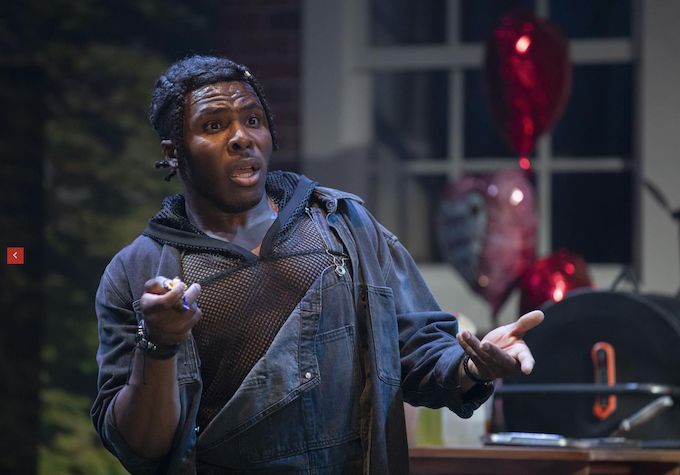
It’s a retelling of the base Hamlet theme. It won the Pulitzer Prize for drama in 2022. The RSC production has a mainly British cast, and the setting is a house in North Carolina. The writer notes it could be Virginia, Maryland or Tennessee, but it is not Mississippi, Alabama or Florida, James IJames is from Mississippi, and what he is saying is “south, but not Deep South.’ I don’t see how Florida fits. The furthest South but atypical of the Deep South.
The detail of the set is incredible, right down to the outside wiring on the house, something I always notice in America, along with the outside air conditioning unit. We can see an illusory corridor, as well as into the kitchen. The set has all sorts of party stuff- Valentines Day, Christmas, Birthdays. The projected trees can turn to bright red. Lighting is excellent.
From the RSC page:
Juicy is a queer, Southern college kid, already grappling with some serious questions of identity, when the ghost of his father shows up in their backyard, demanding that Juicy avenge his murder. The story is familiar, but what’s different is Juicy himself, a sensitive and self-aware young Black man trying to break the cycles of trauma and violence in service of his own liberation. From an uproarious family barbecue emerges a compelling examination of love and loss, pain and joy.
This is the year of Hamlet, with the RSC doing Hamlet plus Hamlet: Hail to The Thief, and now this third one (which is an extreme riff on the tale). Chichester’s doing it. The National’s doing it.
We get a couple of spotlit soliloquies from Hamlet, plus odd lines. I loved the line where Rev is starting the barbecue, and Juicy picks up a jar and says, ‘There’s the rub.’ Yorik gets referenced as an old friend who O’D’d. Juicy admits to quoting Shakespeare to the horror of all.
They close on a song from a transformed Larry and dance.It is joyous, very funny, flat out acting, first date set, even better lighting, some great tricks of theatre, without plot spoilers. It’s a straight 90 minutes with no interval. It flew by.
No doubts. Five star.


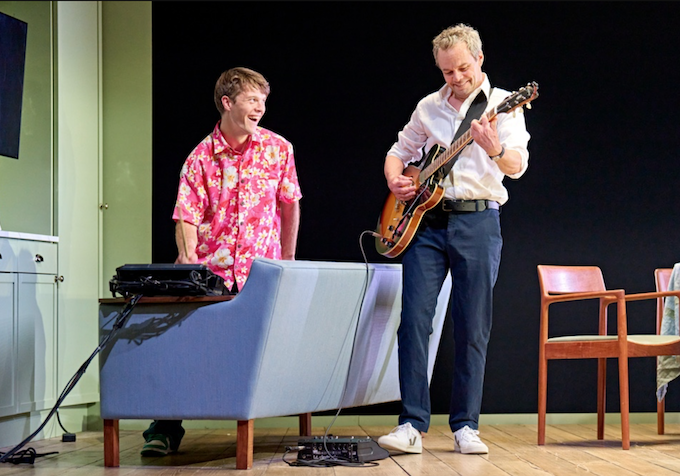
Inter Alia, NT Live stream
By Suzie Miller
Directed by Justin Martin
Well, not actually ‘live’ in that Poole had three streamings this month. They had to keep adding more. This is the same writer, Suzie Miller, and director, Justin Martin, as Prima Facie which we haven’t seen yet. Tickets for both were near impossible to get and even the first two local streamings sold out right away. Tonight was full.
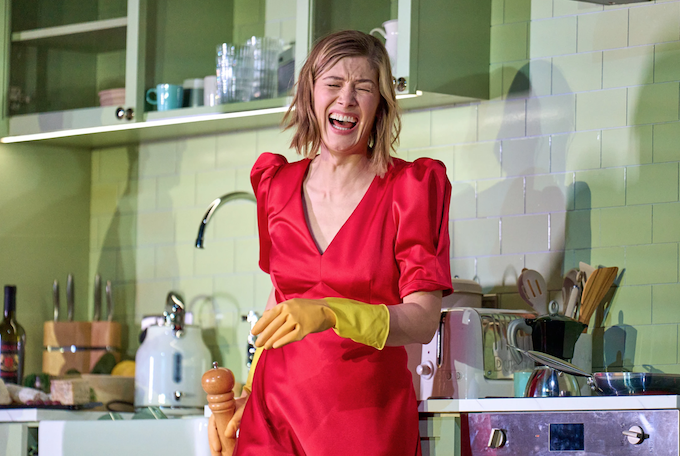
Rosamund Pike plays Jessica Parks, a judge married to a barrister. They have an 18 year old son. How do you describe this play? The set changes are seamless and unnoticeable with no breaks or jumps. They just happen. Court room, living room, forest. Rosamund Pike never pauses. She is full on for 105 minutes. The many costume changes are all on stage while speaking. She moves props around continually. She is so fast, she leaps on and off tables too.
Jessica is a judge, a female judge, who handles many rape and child abuse and abuse of women cases. She explains that she is a martinet to the posh pompous and arrogant male counsels. She protects the traumatised female victims from their attacks in court. We open with a rape case. Notably the accused and accuser are early twenties, but it happened when they were eighteen. Such are the wheels of justice grinding slowly on. The case rests on consent, and the defence argue she consented, regretted and changed her mind. She says she had passed out drunk and came round to find him on top of her. The man is sentenced to seven years. The theme is that she is a judge, sitting in judgement of others, but throughout she is being judged. The main one is as a mother.
We came out feeling sorry for a whole generation. The play is complex, and thought provoking. ‘Harrowing’ was the first word that came to mind. We felt too old for it. It should be compulsory viewing in sixth forms.
4 star
The Red Shoes, RSC
Hans Christian Andersen
New Version by Nancy Harris
Directed & Choreographed by Kimberley Rampersand
Expect the unexpected. When we saw the RSC season list, we hadn’t thought about this. We assumed it was a Christmas children-oriented production. We wanted to see Twelfth Night and at this time of year, a Poole-Stratford and back in a day 300 mile round trip in potential bad weather is daunting so we decided to see Twelfth Night on Friday evening and stay over, Having decided that, we might as well see a matinee the next day and this was it. An add on. At 12 o’clock, an hour before the start we gazed at the freezing fog and wondered whether it would be wiser to head home in daylight and skip it. No, it should be OK. We’ll watch it.
So first, it is NOT a children’s production. It’s the adult dark side of Hans Christian Anderson – we were reminded of A Very Very Very Dark Matter by Martin McDonagh at the Bridge Theatre in 2018 (but it’s not THAT dark). Then which section does it go in here? It’s not a musical, though it has an outstanding song. It’s not dance theatre, although it’s about dancing and has some superb dancing from Nikki Cheung.
The pictures don’t show the darker dancing senes nor the magical branches descending from on high above. It’s a visual feast with music to match. Beautiful set and costumes. If it goes to London, see it. It’s much better than a description would lead you to believe. All credit to Artistic Directors Daniel Evans and Tamara Harvey for choosing such an unusual (and unclassifiable) production. It is directed & choreographed by Kimberley Rampersand from the Canadian Shakespeare equivalent in Stratford, Ontario. Let’s hope for more collaboration.
Nearly a five. Not quite. A high four. We bought the play text which means we loved it.


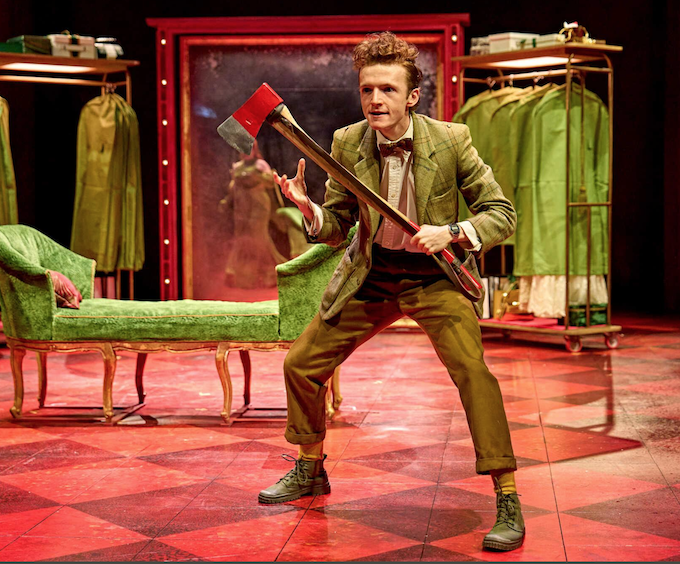
Choir, Chichester
By Gurpreet Kaur Bhatti
Directed by Hannah Joss
Our policy is that if Chichester puts on a new play by a writer you’ve never heard of, just trust them. We almost never go wrong in doing so. This is yet another success. Is it a musical or a play with / about music? Chichester is carving a successful path with ‘Is it a musical or not?’ productions. These are very well-known found songs. However, they are not performed to a live backing group. They use a pre-recorded version, maybe the original with vocals removed, probably the karaoke versions.
The setting is a room above a pub. It’s about a community choir who meet regularly in the room, and do choral versions of popular songs. It’s run by Morgan (Laura Checkley), and she is a college lecturer. The choir was started by her and Paul (James Gillan) and they used to be in a rock band together a decade earlier. Morgan is the teacher, and there are hilarious sections where she tries to improve their performance by getting them to think about lyrics.
As a comedy with music, it is a first class evening or afternoon out. There was lots of laughter, massive applause after versions of songs and a standing ovation at the knockout ending plus reprise song, which is the one Paul’s been wanting to do all the way through, Primal Scream’s Movin’ On Up. Within its genre you won’t find much better, but I’m inclined to four stars rather than five. This may simply be we had less than usual to discuss afterwards except ‘fabulous entertainment and performances.’
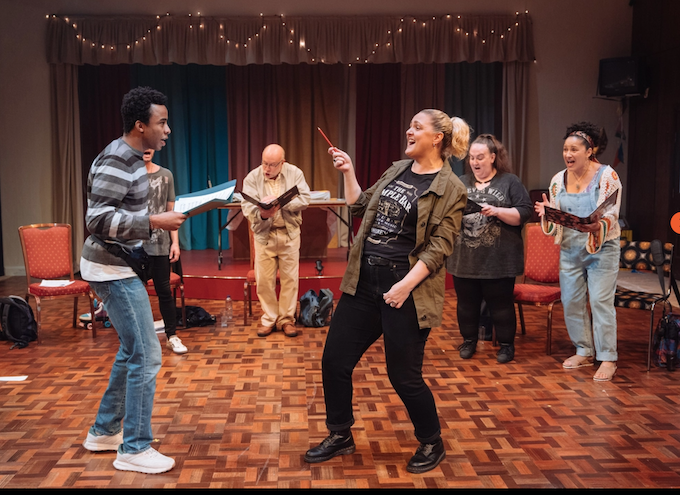
Dear England, Chichester
By James Graham
Directed by Rupert Goold
The play was a National Theatre success in 2023, and awarded ‘Best New Play’ for 2024. Then it was revived in 2025 at the National, with a mainly new cast. It’s on a tour that stretches well into 2026 and across the country.
At the end of the day, it’s a game of two halves, both equal, at 75 minutes plus an interval. The best goal was in added time, during the curtain call when they danced to Sweet Caroline. I was sick as a parrot that … (No more football references, please. Ed.)
The best thing is the activity with the players, training and running on the spot in high tempo, running around and between each other, expertly choreographed, taking the penalties in mime at tournaments, being made to dance (led by Harry Kane). This is all great stuff. There are no easy games at this level (absolutely not. Ed) They managed to make the mimed penalties, both the takers and Pickford facing the strikers, genuinely exciting. Then there’s the characters, and in this, the stars are the players, as in real life. OK, a deserved standing ovation. Extremely good ensemble work, with several taking five or more roles. Constant costume changes. The players are great. The best part. Some of the inserted comedy cameos fall flat. Yet the players and back room team have good funny lines.
At the end of the day (not again!) It’s not a five for me. I think four is fair.
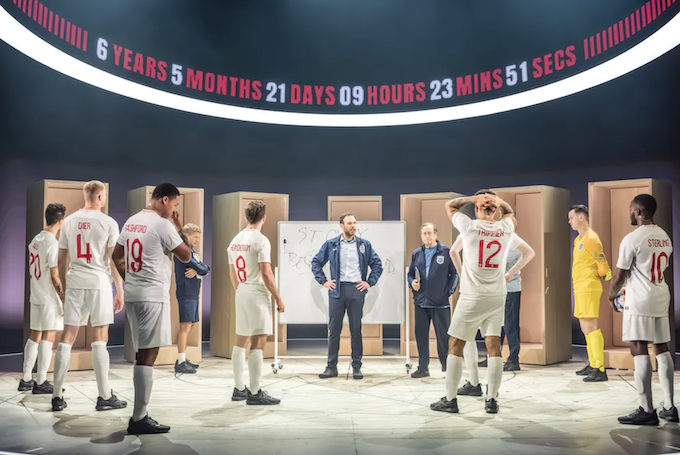
Marie & Rosetta, Chichester
By George Brant
Directed by Monique Touko
From the Chichester website:
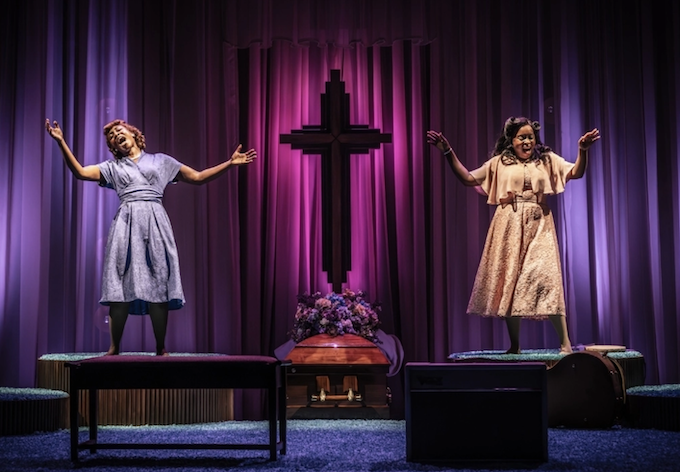
Mississippi, 1946. Sister Rosetta has changed the face of gospel music with her exuberant, electric guitar-playing style. Shunned by straitlaced church folk for performing in nightclubs and glorying in rhythm and blues, she’s persuaded the saintly young singer Marie to join her on a tour of the segregated southern States. But first she has to convert Marie’s pure Sunday sound into something that has just a little more swing…
The play is American dating from 2016. You might guess it’s US origins because it has a major star, a tiny cast and just the one set. Being the UK, the single set is superb with different circular platforms for different parts of the performance. It is quite different from the notes in the play text too. Basically, it’s a funeral parlour which has allowed the travelling African-American group to use its premises overnight. The pianist and guitarist have booths either side of the stage.
Is it a musical? A play with music? A play about musicians? All the songs are found songs, illustrating the careers of the singers, not telling another story. They list the songs in the programme, as in a musical, though I must have blinked and missed Amazing Grace. I’d class it as a play.
Beverley Knight is simply one of the best female singers I have ever seen, up there with Natalie Merchant, Norah Jones, P.P. Arnold. Ntombizodwa Ndlovu as Marie Knight can keep up with her and is also an astonishing singer. Both act so well too, Beverley Knight as the older, road-hardened and experienced star,
Performance? Music and acting 5 star.
Overall? I’ll drop it to four. I liked the shift / twist at the end very much. I didn’t find it too wordy, and set was excellent. It’s just the American small cast / one set concept rarely allows a fifth star.
Grace Pervades, Bath
By David Hare
Directed by Jeremy Herrin
Ralph Fiennes Season
Currently playing in London too.
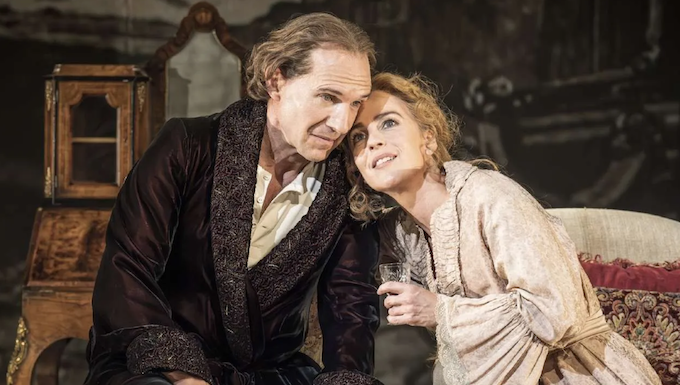
David Hare’s latest play is a homage to theatre and a discussion on theatre. It’s the story of Henry Irving and Ellen Terry, the two greatest actors of their day, and Ellen’s two children, born out of wedlock, Edward Gordon Craig and Edith Craig and covers the period from 1878, when Irving invited Terry to join his Lyceum company, and 1966 when Edward Gordon Craig died, taking in Irving’s death in 1905. It’s not chronological but switches between 1878 to 1905 and aspects of Edward Gordon and Edith’s careers later. The enigmatic title comes from a contemporary review of Ellen Terry:
Whether in movement or in repose,
Grace pervades the hussy
Charles Reade
I wonder how collaborative the writing of the play was. i.e. Was it designed for Ralph Fiennes? It opens the ‘Ralph Fiennes Season’ at Bath. There are two references to Ellen Terry’s desire to play Rosalind in As You like It, a desire Irving avoided for twenty-five years. Yet the second play in the season will be As You Like It, directed by Ralph Fiennes. Then we end seeing Fiennes in red Cardinal’s robes as Cardinal Wolseley, surely a nod to his recent Oscar-nominated starring role in the film Conclave. He received the Critics Choice Award for best actor. If you are writing a play about Henry Irving, an actor with similar stage presence is essential. Given that age excludes Ian McKellen, the obvious choices would be Ralph Fiennes, Mark Gattis or Kenneth Branagh, and Branagh’s already channelled Olivier twice and Gattis has done Geilgud.
I thought it a very good play indeed. I thought there were too many scenes with just two on stage and dialogue and it leapt a little when we had more on stage. I feared that perhaps the asides and references were a little too “Theatre Studies” for a general audience. Indeed the most experienced theatre critics (who know this stuff), Mark Lawson and Domenic Cavendish, both gave it four stars. So shall I.
Safe Space, Chichester
By Jamie Boygo
Directed by Roy Alexander Weise
The first point is that the playwright also acts in his own play AND that he is a Yale graduate. It’s set in the American university, with a debate about statues and slavery. The play is inspired by real events at Yale in 2016 and 2017 when students protested about the name of their college. Calhoun College was named after Vice-President John C. Calhoun (in office 1825-1832). Calhoun was senator for South Carolina and served under John Quincy Adams until 1829 and Andrew Jackson 1829-1832. He was not just a slaveholder, but a vigorous and extreme defender of slavery, which he believed to be a positive good. The play is not actually greatly interested in Calhoun, you could have slotted any slaveholder into it. Calhoun and renaming the college is just one of many actual examples of rewriting history.
The programme has an extensive and erudite note on a cappella singing groups in American universities. Yale’s Whiffenpoofs are still going. Cole Porter was a member of the 1913 version. The play is bookended with a cappella. It starts with a spotlit song with lead vocal by Isaiah (Ernest Kingsley Jr) in full white tie and tails, accompanied by the other four on high platforms either side of the stage, backs to us. This runs through. As he stares at the white gloves, my mind went to minstrelsy, or the Black & White Minstrels.
The acting and singing are superb, we were engaged. It’s an excellent set. I feel sorry for the cast with the sex scenes and references, and the dance, playing to an elderly afternoon audience rather than their peer group. I mean. I’m old, but at least half were older than me. That’s a matinee given. I don’t notice it with Coward or Rattigan, but i do with young actors in a play about being young.

The Brightening Air, Old Vic / NT live
By Conor McPherson
Directed by Conor McPherson
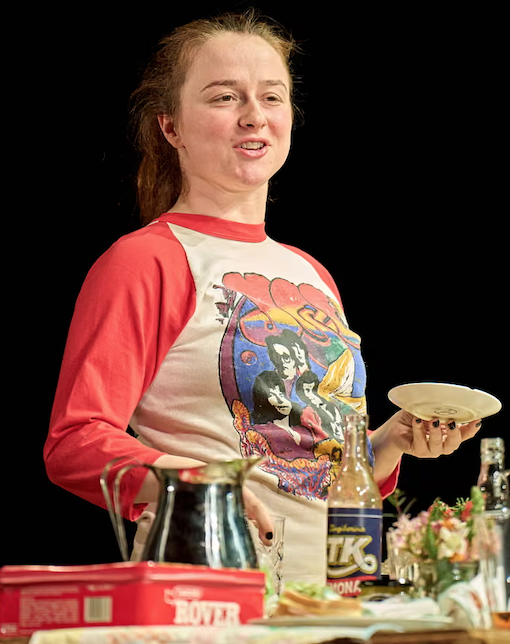
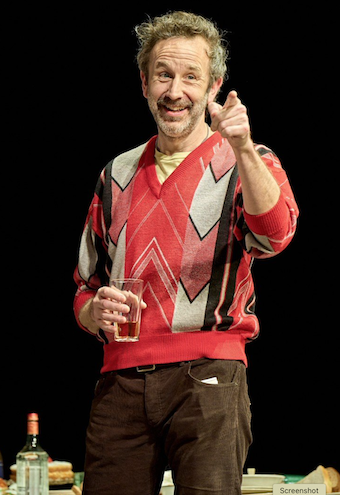
It couldn’t be more stereotypically an Irish play. I’d even say clichéd. It’s set in County Sligo in rural North West Ireland in the 1980s (reviews say 1981, which might be in the programme), so just before the roads became clogged with farmers’ Range Rovers and there was still an air of downtrodden poverty. The play’s title comes from Yeats (Song of Wandering Aengus) and Sligo is known as ‘Yeats country.’
It has echoes of Brian Friel, especially Dancing At Lughnasa (a returning disgraced priest), of McPherson’s own The Weir, and more his adaptation of Uncle Vanya (family feud over inheritance), then of Martin McDonagh and J.M. Synge. Uncle Vanya succumbed to Covid shutdown, but then got a bluray / DVD release. McPherson has said he had unfinished business with the theme, and the mood emerges in this play. It focuses on the run-down family home, now inhabited by Stephen (Brian Gleeson) and his younger sister, Billie (Rosie Sheehy). They farm cows and chickens. This is another Irish play given. A bachelor and a spinster. Unmarried. Out there in deep country there isn’t a lot of possibility of meeting anyone you’re not related to.
Rosie Sheehy as Billie steals the show. Chris O’Dowd and Brian Gleeson also excel. As you expect from the writer of Girl From The North Country, music features well throughout. I wish it was credited on the rolling credits. The ending goes for the serious comment. Throughout dialogue sparkles, and there is not a single appearance of ‘craic’ in the text which is rare in an Irish play. It’s very good. The ambience of the proscenium stage, dark lighting and shabby set fit the play.
I will take issue with “The Finest Play of The Year” in publicity, a judgement made in April with eight months to go. “So far” might have been added. I still wouldn’t agree.
3 star
What? No new plays in this category. They’re 4 star or 2 star.
2 star
Alfred Hitchcock Presents: The Musical, Bath
Book by Jan Dyer
Original Score Steven Lutvak
Directed by John Doyle
Hmm. Bath’s getting all the low ratings. Maybe the age and discomfort of the Theatre Royal doesn’t help.
The original TV series started in 1955 and ran for seven series and 268 episodes until 1962, with the lugubrious Alfred Hitchcock introducing the half hour (or rather 25 minutes) long stories. Then they added 93 hour long episodes. This production is only referencing the short ones. Hitchcock directed seventeen out of the 268. The stage has a retro TV frame. The costume colour palette reflects black and white TV. Of the 268 tales, the musical presents eight of them. Far too many, said the reviews. I had read the almost universally negative reviews. Was it going to be worth the journey? I had my doubts.
Do we start with the positives or the negatives? Because I’d read that there were too many intertwined stories, which rendered it incoherent, confusing, I focussed hard and so I managed mainly to follow the various mixed up threads. The bad reviews helped me follow it. There’s a cast of fourteen, they work non-stop performing stage hand roles too, manipulating set, lights and camera. The stage direction of fourteen constantly moving actors is superb. Actors do not leave the stage when they’re not up front, we are always in a TV studio.
Overall, it’s not as bad as the reviews suggest. I actively enjoyed the performances. But if the songs don’t make it, the musical doesn’t make it. The reviews with the universal two star rating seem harsh. Maybe they saw it early, and it gelled more as time passed. Maybe they tweaked it. I’m almost inclined to a three. I was never bored, I’m glad I went, but no, the plot incoherence and far more the out-of-date music really do deserve a 2 star.
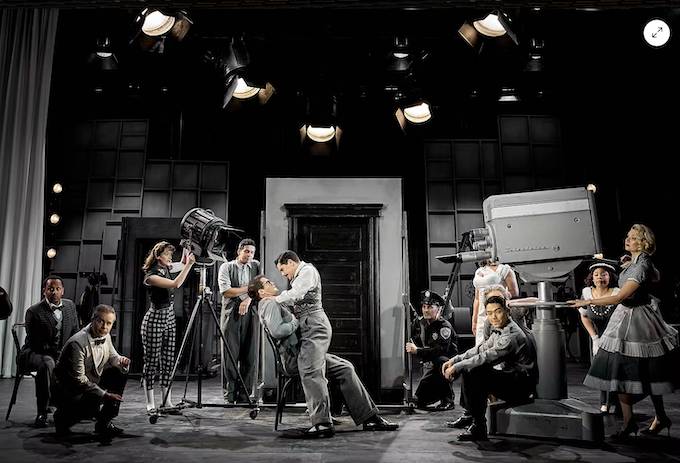
Alfred Hitchcock’s North by Northwest, Bath
Alfred Hitchcock’s North by Northwest
Adapted and Directed by Emma Rice
North by Northwest is a logistical challenge on stage, but no more than Around The World in 80 Days, which worked as a stage play. I hope they don’t attempt Stagecoach or Charge of The Light Brigade though.
The joy of Emma Rice plays is the sheer theatricality. We are fans (or were until today). This one was a challenge too far. The stage has four revolving towers, looking like hotel bars, which can be moved around, assembled in different configurations and opened and closed. The rear of the stage is a row of men’s jackets, like the world’s biggest dry cleaners. I didn’t get that at all. Yes, that’s a great idea if the cast use it as a costume rail, enhancing the theatricality, but they didn’t use it. So what did it say? I didn’t like the lighting plot. Lights were harsh and too often pointing up at characters.
The great positive is movement and music. They dance through most scenes, to a 50s jazz swinging soundtrack. It is highly effective. Ewan Wardrop as Roger Thornhill does his entrances and exits in dance, and he started his career as a dancer. It shows.
Our comic villains, Mirabelle Gremaud as Anna and Simon Oskarsson as Valerian, present props like wine glasses with a funny walk, and dance along. Mirabelle Gremaud got applause for onstage somersaults and a spectacular splits.
Then a special thing is miming to great classic renditions of songs by Ella Fitzgerald, Peggy Lee, Jackie Wilson and Nina Simone. This is often mismatched to the gender of the recording by a famous singer, funny and well executed.
This is the issue, the role of the narrator as ‘The Professor’ the CIA guy behind it. I think the role is a basic error. It’s an interactive pantomime role. This is a very special skill, and Katy Owen does not hack it. I’m afraid I made the same comment on her in Blue Beard last year. She is now hampered with a silly Advanced RP British accent. This sort of pally interaction with an audience needs to be relaxed and in the natural voice. You can’t do it in a daft voice. It has too look spontaneous, and it looked scripted and forced, which it was. I’ve seen people do this and appear spontaneous twice a night for six days a week. Director at fault. Yes, I’m hyper-critical.
It got good applause at the end.People left happily. Many laughed at the Professor’s antics whilst I grimaced. I’d say it went down well.
OK, I’m usually with the consensus or higher rating than the consensus. This time, I’m out on a limb.

Unicorn, West End
By Mike Bartlett
Directed by James Macdonald
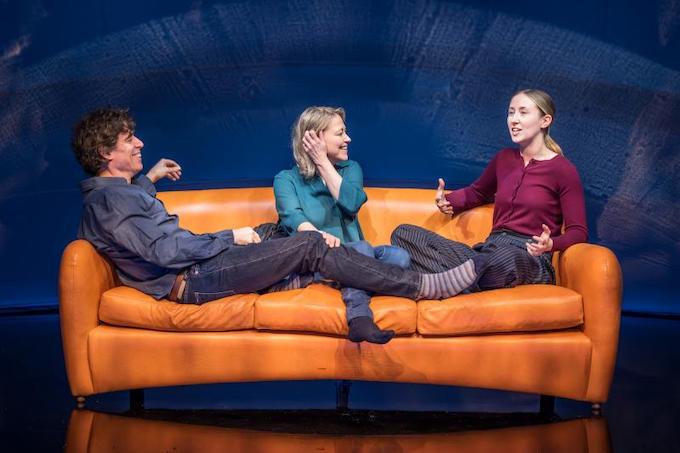
The first attraction was the pairing of Stephen Mangan and Nicola Walker from the TV Series The Split, where they play a husband and wife who are lawyers. Add Eric Doherty, who was Princess Anne in The Crown and she was Abigail Williams in the National Theatre The Crucible. Stephen Mangan is a great favourite with us and Episodes is one of our favourite sit coms ever. Less attractive were such high ticket prices for a three parter with a minimal set in one of those uncomfortable well past-their-sell-by date West End theatres. The Broadway style, tiny cast, at least two major stars, talking taking precedence over action, is an unwelcome US import. Well, this month any US imports are unwelcome. The programme points out it’s a rare new play in commercial (aka overpriced) West End Theatre and repeats three times that SUBSIDISED theatre normally breaks new plays.
We had no idea what the title (Unicorn) meant. We’d never heard it before. It’s the third person joining a couple in a throuple (also a new word, but in several of the reviews), and the third or extra one is female. In this case, the married couple are Polly and Nick. Polly (Nicola Walker) is a university lecturer and published poet. Nick (Stephen Mangan) is a doctor and “ENT specialist.” ENT? Ear, Nose and Throat. That means he’s a consultant.
The mature student who is the third person is Kate (Erin Doherty). She is 28 at the start, 30 at the end. Polly is her teacher and we start with them having a drink on bar stools. Kate rates Polly’s poetry too. Polly realises she fancies Kate. Polly makes the moves to recruit her, Nick is diffident and reluctant. The play consists of talking about their potential then actual three way relationship. Though there is much explicit dialogue on sex, lubricants, positions, preferences and bodily fluids, there is absolutely no sex beyond kissing on stage. No one disrobes.
Before we saw it, we assumed the 4 star brigade would be the ones we’d identify with. We more often agree with Domenic Cavendish in The Telegraph, and disagree with Arif Akbar in The Guardian, Clive Davis in The Times and Dominic Maxwell in the Sunday Times. I discount Time Out‘s opinion because it is nearly always 3 stars. This time we thought Arif Akbar is the one who got it right. It is a static two star play enacted by superb actors. There is no theatricality. The last 10-15% of the play is clichéd writing. The play’s ending is a damp squib.
Small Hotel, Bath
Ralph Fiennes Season
by Rebecca Lenkiewicz
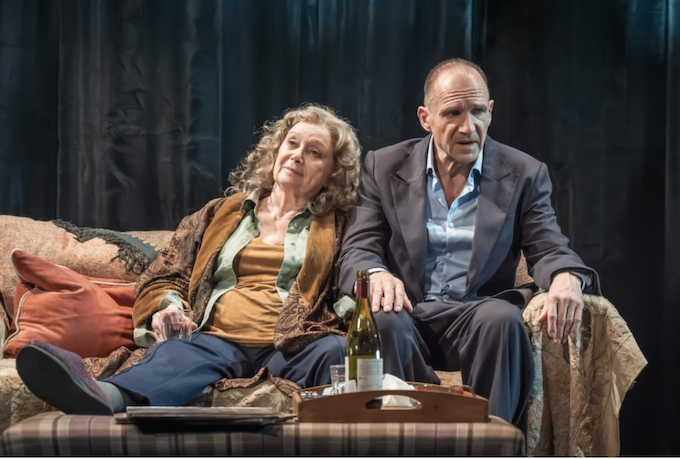
The first two minutes. Flashing video. A bar. He doesn’t have a credit card. Only Reward cards. Can’t get a drink. Ralph Fiennes with a shirt with a big blob of red plastic affixed to represent blood. A figure in black with a black eye patch. Is this Charon? The boatman across the River Styx. Stage revolve. Is he in Limbo? Fiennes changes blood blob shirt to identical blue one. They do a slow motion tap dance. The stage revolves, a pianist comes on with grand piano for thirty seconds (the pianist will not be seen or heard again until the curtain call) while Rachel Tucker (as the woman in black) sings the Rodgers and Hart song There’s A Small Hotel. It all looks confusing and a bit deeply meaningful. I shuffle in my seat. Hmm, I thought. I bet we’re seeing the end at the beginning, we’ll go through and get back here …
I wish I’d read Domenic Cavendish’s review in The Telegraph before I saw it. He points out the biographical references to Fiennes, which if I’d known them would have made more sense of it. Rebecca Lenkiewicz points out in the programme that Fiennes commissioned her to write the play for the season. Once Cavendish led me to look up his biography on Wiki, I imagine he gave her a plot outline first and asked her to write it. Is the play an exercise in exorcising personal demons? Is it based on opposites? A play about a fading star, featuring a man with three Academy Award nominations, the most recent just in the last year for Conclave (he should have won). At the height of success, everyone fears the downturn.
I thought with the biography added, ‘Up itself’ was a two word review. It gets two stars because all the actors perform well (as you would expect) and some comedy lines are good, mainly emanating from Francesca Annis.
 Peter Viney's Blog
Leave a comment