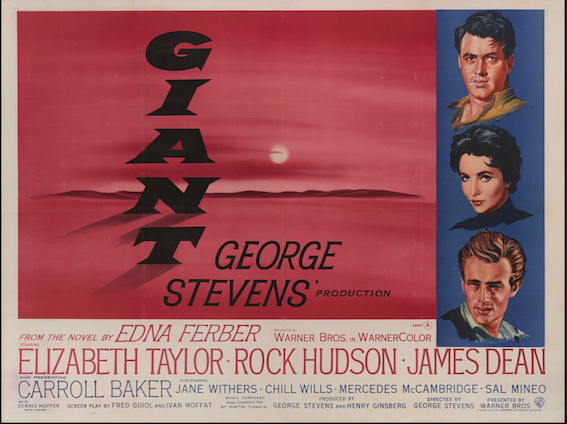
1956
Directed by George Stevens
Screenplay by Fred Guoil and Ivan Moffat
Based on “Giant” the novel by Edna Ferber, 1952.
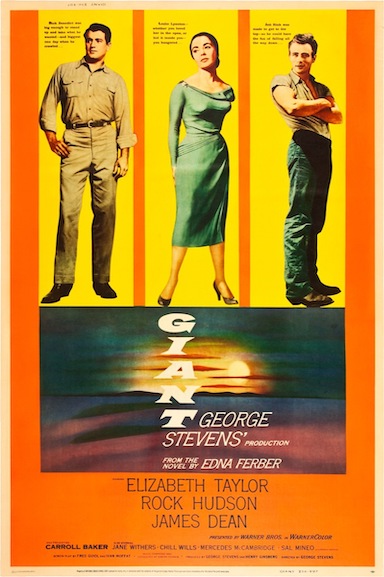
Elizabeth Taylor – Leslie Benedict
Rock Hudson – Jordan ‘Bick’ Benedict
James Dean – Jett Rink
Mercedes McCambridge- Luz Benedict, Bink’s sister
Caroll Baker- Luz Benedict II, the younger daughter
Jane Withers – Vashti Snythe
Chill Wills- Uncle Bawley
Dennis Hopper – Jordan Benedict III
Rod Taylor – Sir David Karfrey
Sal Mineo – Angel Obregon II
Earl Holliman – Bob Dace
Charles Watts – Judge Whiteside
Elsa Cardenas – Juana Guerra Benedict
My 1960s retrospective series took off during Lockdown, and afternoons spent watching old films. November 2023 and a bout of Covid leads to the same.

Just last week I saw the 4K UHD reissue of Giant on a “Two for £25” deal and bought it. I knew a fair bit about the film, but the only time I saw it was in the 70s on a (70s) TV set, which does not do a widescreen pic justice. The reissue thanks ‘Martin Scorsese and Steven Spielberg’ for their help. George Stevens won the best director Academy Award for the original, which Martin Scorsese says he has watched more than forty times. This might be why Scorsese does such long films nowadays. It’s 198 minutes long.
It was based on Edna Ferber’s best-selling novel. It’s famed as James Dean’s last film, and he died just after finishing it. Warner had banned Dean from racing driving for the duration of the filming, and he resumed as soon as it finished. He died in a road accident, driving too fast to stop when a car turned in front of his Porsche. His drunken mumble in the character of Jett Rink in the final scene was done so realistically, that in his absence, it had to be over-dubbed post production by Nick Adams. There was a lot of overdubbing, and both Hudson and Taylor were devastated by Dean’s death. Hudson said of Elizabeth Taylor:
Rock Hudson: George (Stevens) forced her to come to work after Dean’s death. He hadn’t finished the film. And she could not stop crying.
Dennis Hopper: Jimmy was not only an internal actor, but an expressionist, which came partly from his studying dance. He would physicalize actions, such as the way he lifted himself up on the windmill in Giant, or goose-stepped measuring off the land, or his sleight-of-hand gesture as Jett Rink. He had the amazing capacity to pick up and learn a new trick almost immediately, tossing a rope and making a knot, a card trick from a magician, coin tricks, racing a car.
William C. Mellor: While we were making Giant, I think we all knew that young Jimmy Dean was giving a performance that not even the extreme adjectives of Hollywood could adequately sum up. It’s not often a unit gets a feeling like that.
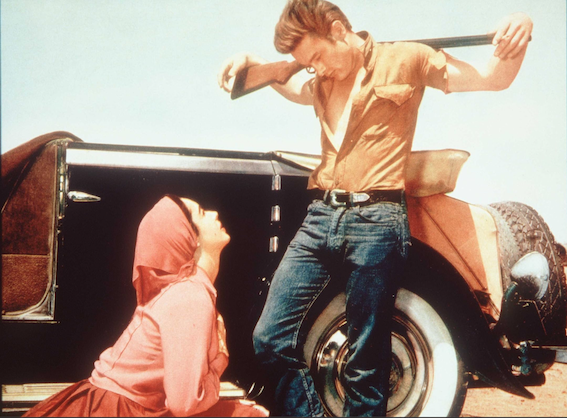
The James Dean cult means that he features heavily on the various VHS and DVD cases on IMDB. The publicity ‘crucifixion’ picture above looks posed, though if you don’t blink they might be in that position in the movie for a frame or two. This focus on Dean seems unfair on Hudson who is a convincing beefy Texan millionaire and on Taylor, who ages gracefully from beautiful girl to mature matriarch.
It’s also the film where Rock Hudson was allowed to choose the leading lady, and chose Elizabeth Taylor over Grace Kelly. Filming took place in 1955, and Taylor and Hudson became close friends which lasted until Hudson’s death in 1985. After he died, she devoted much effort raise awareness of AIDS. Taylor also knew he was gay in 1955, a closely guarded Hollywood secret. I noted that when her character, Leslie, first meets his character, Bink, in the film, she has to ask, ‘Why aren’t you married?’ and she seems to be trying hard to avoid laughing.
At the end Jett Rink, as a Texas oil baron, has huge JR symbols everywhere. This is not the film’s only influence on the TV series, Dallas.
It’s a saga, a family saga, running (according to a line early on, and near the end) twenty-five years. It appears to start in the early 1920s, and the end of World War II is nearly an hour from the end. It looks more like thirty. The TWA plane in the airport sequence came into service in 1950.
The whole plot is on Wikipedia. I’ll comment rather than tell the whole story.
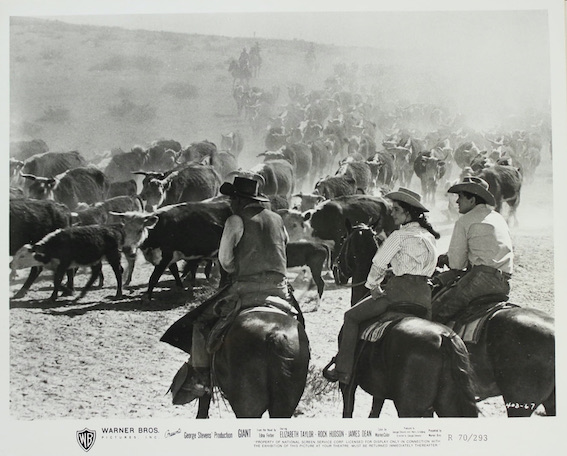
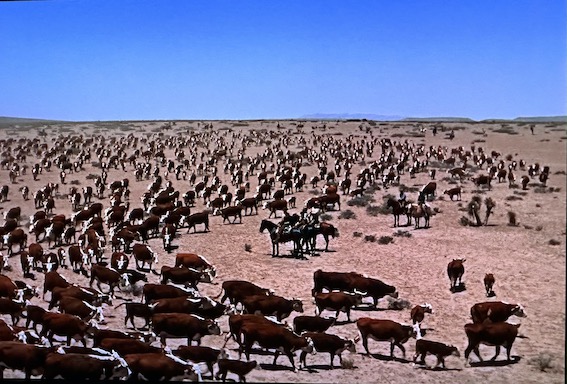
In a nod to her beginning in National Velvet Elizabeth Taylor plays Leslie, a horse-mad young girl in verdant Maryland, engaged to a British diplomat. Jordan ‘Bink’ Benedict arrives to buy her horse, War Winds, as breeding stock. He ownes a half million acre cattle ranch in Texas. They instantly fall in love after a little requisite argument, and we next meet her on their honeymoon train to Texas. She asks when they’ll reach Texas, and discovers they’ve been crossing it for eight hours already.
That little requisite argument is a key to the film’s intent. She’s spent the night reading about Texas and The Alamo, and suggests it was stolen from the Mexicans to Bink’s fury. Mexico had encouraged American immigrants to help against the Comanches. By 1834, Americans outnumbered Mexicans 3 to 1, and that had happened in a decade. They also imported slavery, against Mexican law. In 1836 they declared independence as the Republic of Texas. Texas joined the USA in 1845. As any Texan will inform you, Texans were NOT rebels in the Civil War. They had joined the USA by treaty and retained the right to leave. By the Civil War, almost 30% of the population were slaves.
The thing is, Leslie had a point.
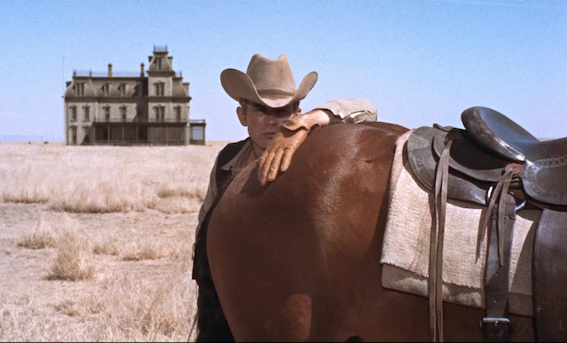
They arrive at the gothic pile in the middle of nowhere. It always seems odd to see these mansions built far away from trees or water in films. In reality, while trees might be cleared elsewhere, they valued the shade. A watercourse helps.
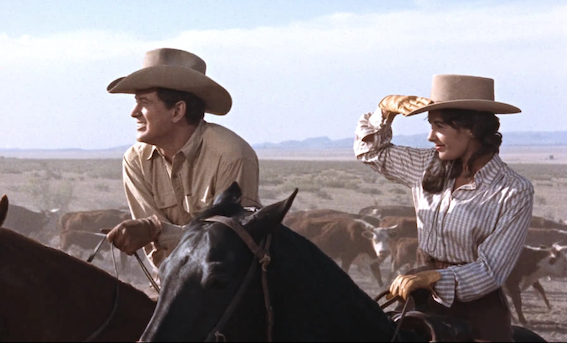
Luz, Bink’s sister runs the place, and instantly resents Leslie. Jett Rink is a farmhand, hanging around, face covered with a hat, practising his Method acting mumbling (James Dean). Bink always wanted to sack him, but Luz is his protector. Luz decides to “break” the stallion War Winds, and is thrown and dies soon after. This is where Martin Scorsese comes in:
I don’t like the obvious romanticism, and it’s very studied, but there’s more here than people have seen. It has to do with the depiction of a life style through the passage of so many years. You see people grow. I like James Dean; I like the use of music, even though Dimitri Tiomkin did it; I like Boris Leven’s image of the house, and the changes in the house; I like the wide image of Mercedes McCambridge riding the bronco, then cut to an extreme closeup of her hitting the bronc with her spur, then back to the wide image. As far as filmmaking goes, Giant is an inspiring film. I don’t mean morally, but visually. It’s all visual.
Martin Scorsese’s Guilty Pleasures, 1978
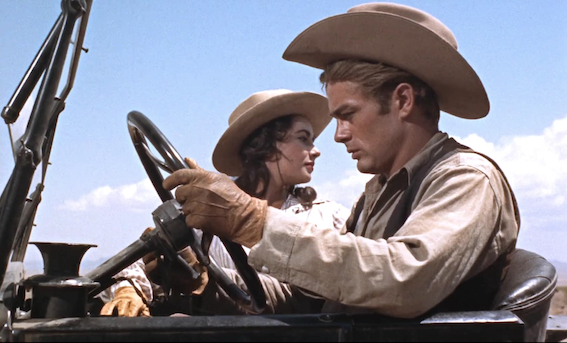
Meanwhile, Leslie has discovered the squalor of the village where Bink’s Mexican workers live. Jett is driving her back and spewing out his resentment of the wealthy Benedicks and she asks to stop at the village. She visits a very sick mother, cares for the ailing child, Angel, and has a doctor sent to care for him. Jett is callous disregard.

We begin to note the distaste and contempt Bink and all his fellow Texans have for Hispanics and Native Americans. Their vocabulary is littered with ‘wetbacks,’ ‘these people,’ ‘squaw’ and ‘papoose.’ I begin to think it is morally inspiring as the story develops.

Jeff Rink is as racist, or more racist, than the rest of them. He is also an alcoholic. Luz has left him a parcel of land which he refuses to sell. He discovers oil on it. He turns up covered with oil at the ranch and makes a clumsy pass at Leslie. Bink gives him the old one-two.
We time the film on the growing children who have multiple incarnations. Leslie and Bink have twins, a boy Jordy, and a girl, Judy, then another daughter Luz II. The boy, Jordy, is given a colt for his birthday, but is terrified of horses, but the young Angel (who Leslie saved) shows himself to be a proficient and bold rider. On kids being terrified and in tears in films, this makes Karen incredibly angry. If Stevens, the director were alive today, he would not want to be around while she was watching it.
I keep seeing those Mexican / Native American references. At Thanksgiving the kids are dressed up in toy shop Indian (sorry, that was the word then) headdresses. They’re distressed to find they’re eating the turkey they used to feed. I had similar memories.
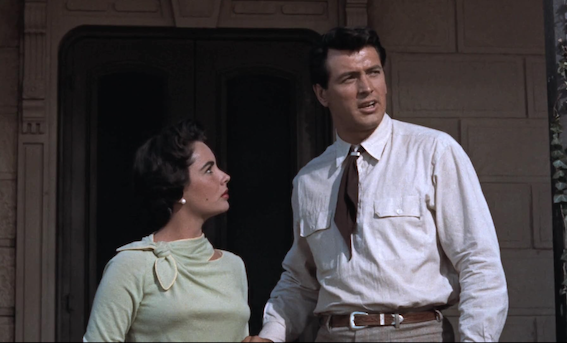
Jeff Rink is becoming wealthy and Bink resists oil wells on his land – he is a rancher. War comes. Jordy is off to medical school. Judy’s new husband, Bob Dace, is Bink’s choice to run the ranch, but he has been drafted, as has Angel, the first in uniform on the whole estate. It’s the war, Bink succumbs to oil drilling. They become even richer, with a swimming pool complex.
1945- we have a long sequence at Angel’s funeral, when the body is returned. Angel was the most heroic and patriotic. As tradition dictates, the family are given the US flag from his coffin. Bink adds a Texas flag, which he gives to Angel’s mother. These Mexicans are the true Texan patriots then.
Jordy returns from medical school and marries Juana, who is the daughter of Dr Guerra, who Leslie had employed to care for the Mexicans on the huge ranch.
Jett Rink is now mega-rich, perpetually drunk, has grown a moustache and taken to smart suits. James Dean revelled in playing an extreme baddie. He decides to build an airport with luxury hotel and everyone is invited to the opening. He is also making moves on Luz II, who is infatuated. Everyone gets to the hotel, and in the words of Peanuts, it is a dark and stormy night. JR (Jett Rink) has ordered that no Mexicans be catered for. Juana can’t get into the beauty salon. Jordy (Dennis Hopper!) confronts him, there’s a fight and two goons hold Jordy’s arms while Jett hits him. Bink has to exact revenge for this but realizes Jett is too drunk and pathetic and scared. They leave, the party is a disaster, Luz hears Jett muttering about his fantasies about Leslie. That’s the end of that one.
Driving back, Bink, Leslie, Juana and their toddler grandchild, Jordy IV stop at a diner. There is a huge fight when Juana is insulted with racist comments, then an arriving Mexican family is insulted. Bink takes exception, and is beaten in a fight with the owner, Sarge, (Rock Hudson does brilliant fight sequences), but is Leslie’s hero – he has changed 180 degrees on Hispanics. They finish with gazing at their grandchildren, one white and one Hispanic.
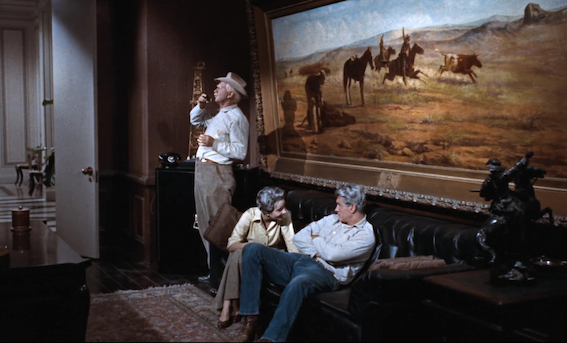
Elizabeth Taylor and Rock Hudson have to age considerably with grey wigs, though given the timeline they might only be fifty. That was a lot older in the late 1940s than it seems now. Leslie becomes a calm matriarch, whereas given the age, you’d have expected Elizabeth Taylor to have insisted on still being glamorous and sexy. She didn’t at all. Just sophisticated and wise.
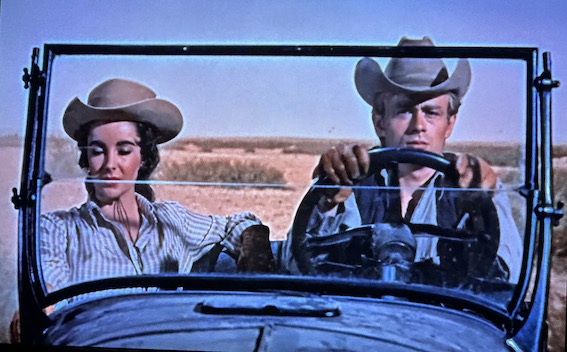
The face-on driving sequences stand out among the epic grandeur as weedy static sets with projected road behind them. Hadn’t they thought of low loaders with a camera and car on, actually moving? I suppose sound was the issue, and they used these sequences for clear dialogue.
Overall, for 1956 this is strong on racism in the USA.
 Peter Viney's Blog
Leave a comment