2022
Written by Julian Fellowes
Directed by Simon Curtis

On Netflix
It started like this. We were having dinner on Easter Monday, and bemoaning the lack of the original drama that the main channels used to pride themselves on. Bank holidays in the 1960s invariably meant a Brian Rix farce from the Whitehall Theatre. We’d make a point of staying in to watch them on tiny black and white TVs. Then in the 70s and 80s, a lavish Terence Rattigan or Noël Coward classic might be revived. Then it would be a feature length Miss Marple or Poirot. We are halfway through the series 3 Body Problem but Easter Monday is not the time for intricate plots and sudden flashes of violence and I was mellow after a good white Rioja and risotto made with wild garlic from the garden. I flicked on Netflix, and there it was! Downton Abbey: A New Era. Perfect. We had declined to pay to stream it some time ago, or buy the DVD, so were waiting for it to turn up outside the paywall. Comfort viewing.
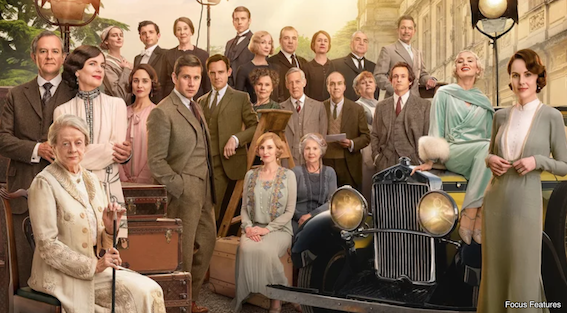
The main issue is exactly the same as its 2019 predecessor. In the TV series, an episode would focus on a few of them and the others would flit past or not be seen. Now you’re getting the lot. Everyone piles into a somewhat indigestible feast. I’d forgotten that Lucy (Tuppence Middleton) is the illegitimate daughter of Maud (Imelda Staunton). Maud arrived in the last one as Queen Mary’s Lady-in-Waiting and is a cousin of the Dowager Countess, Violet (Maggie Smith). I had to think who was who. Lucy has married Tom Branson, the Irish ex-chauffeur, who was previously married to the Grantham daughter, Sibyl, and they had a child, also called Sibyl. Phew! I’ll go thinly on this sort of thing.
The trouble is, apart from money, you need an incentive to lure all of the cast back, so everyone has to have a reasonable cameo written in, so there’s a plethora of sub plots. I’m not going to plot spoil, but I think everyone knows how it ends. Maggie Smith will not be in a sequel. It was filmed during COVID. They all got vaccinated so would have been locked up together.

It is 1928. That’s important. There are two major plots, which meant two halves of the cast in different places. The one that took my attention was the ‘home’ one. Because the roof is leaking, they are persuaded to allow a film crew to use Downton as a location. Oh, dear. We’ve had two film crews round asking us about locations. The answer is “No.” I’ve done many videos on location, in ordinary houses, doctors’ surgeries, Oxford colleges, museums and grand houses We take off doors. We change light switches. We drive across lawns. We tape stuff to wallpaper. The lights set off heat alarms. We draw too much power and trip circuit breakers. We filmed at one large country house near Oxford. The hallway and one beautiful room was furnished, the rest was empty. I chatted with the owner (my task was often to keep the owner distracted). Each full day of filming meant he could restore one stone surrounded window. He had a lot of windows. That house is in a lot of films. I always enjoying seeing it again.
The film, The Gambler, is a silent, it being 1928. I thought it unlikely to impossible that they would film interiors on location at that point. The main issue is that late silent film was the height of cinematic lighting, and in those days the lights were far too hot to put in an old house. All those downstairs at Downton are thrilled at the very famous actors.

The main guest star is Domenic West as heart throb Guy Dexter. He looks the part. So does Laura Haddock as rude and arrogant Hollywood star Myrna Dalgleish. The film’s director is Jack Barber (Hugh Dancy), though they’ve compressed the role of director and producer here. So they begin filming. Jack takes a fancy to Lady Mary (Michelle Dockery) whose husband is inconveniently unavailable for this film driving in a car rally in Istanbul. They go to the pictures to see Myrna’s latest film, but the cinema is nearly empty. Everyone is going instead to see the first full-dialogue talkie, The Terror. It was in reality, and they’re quite careful to explain that while The Jazz Singer was the first talkie, The Terror was the first with dialogue, rather than ‘You ain’t seen nothing yet’ and a song.
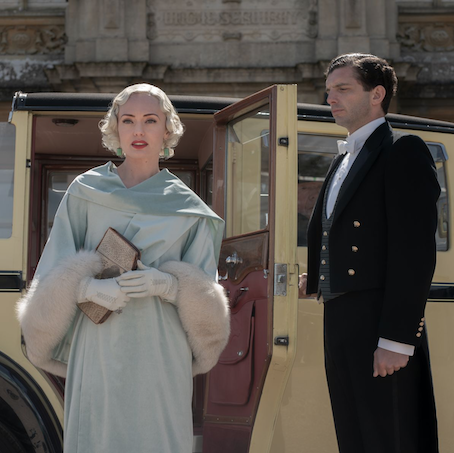
The plot is familiar. I was well ahead. Then, I’ve seen Babylon.They must transform The Gambler into a talkie by dubbing on dialogue to the footage they’ve already shot. Right, you’ve seen the issue, I expect. Silent film stock doesn’t have the running track on it for sound. Never mind, we’ll forget that along with the hot lights right under an extravagant 18th century ceiling. The dubbing is Lady Mary’s idea and none of the pros had thought of it. So Guy Dexter has a rich voice. No problem. Myrna Dalgleish has a squeaky Cockney voice. She is ludicrous as an aristocrat. Got it! RP wins! Lady Mary will read the lines and Myrna will mime them.
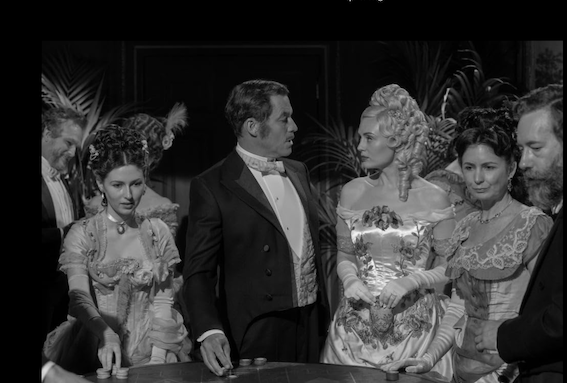

Myrna is understandably most upset. However, lip synching seems to be done effortlessly. (I have had to watch lip-synching being done. It’s a swine to get right). The ex-footman and school teacher Mr Moseley solves the problem of the sections still to be filmed by writing the dialogue. Myrna has a meltdown, but fortunately Daisy the kitchen maid and Anna (now wife of Mr Bates … ouch … the Butler, or rather valet) are able to persuade her to continue miming. Good things? Several. They were right about the soundproof booth to conceal the noise of the whirring camera motor, though Babylon did it rather better with the camera operator getting heat stroke, confined in the soundproofed box. I liked the way they talk bout ‘the films’ never ‘films’ – accurate for the time, as is the very careful ‘an hotel’ not ‘a hotel.’ I expect Julian Fellowes says that anyway.
The other main plot. Over in France the Marquis de Montmirail has died and left his extensive villa to Violet. Violet in turn decides to give it to little Sibyl (sorry ‘Sybbie’) as she is the only one without a massive inheritance and title. So Lord Grantham (Hugh Bonnevile) and Cora (Elizabeth McGovern) are invited to go and see it by the Marquis’ son (Jonathan Zaccai) even though his mother is incensed at the bequest.

Off they trot with Tom and Lucy and Maud and Lady Edith and her husband who I had forgotten to a new location then, and persuade Carson (Jim Carter) their retired butler, to accompany them as the sweating Brit Xenophobic comic relief in France. It turns out that Lady Violet had a passionate romance with the old Marquis in 1864, a mere sixty-four years ago. I would have thought longer. Was Lord Grantham really fathered by the marquis? Will he turn out (shock, horror) to be FRENCH!
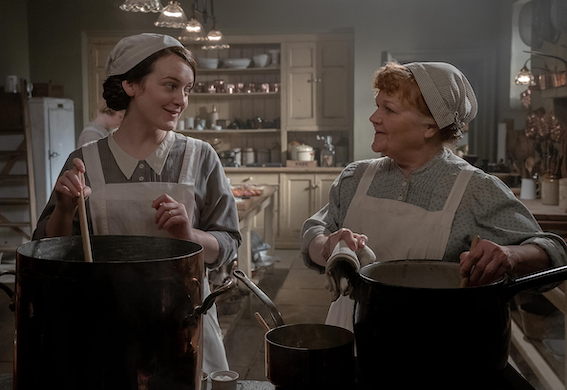
Then there are a dozen sub plots. Guy Dexter is gay and takes a fancy to Mr Barrow who has flown the rainbow flag through so many episodes. Can Mrs Patmore persuade the old farmer to live with her, leaving his tied cottage to the young couple? Will Violet survive? What’s wrong with Cora? Is it terminal?
Maggie Smith has one of the longest death bed scenes on film. But then every knot is neatly and happily tied up in the sub plots.
Rating? Perfect for a wet bank holiday.
NOW SEE …
Downton Abbey (film) 2019
Downton Abbey: A New Era (film 2022)
Downton Abbey: The Grand Finale (film) 2025
My 2012 comedy piece THE CURSE OF THE CRAWLEYS. DOWTON ABBEY SERIES 10 (LINKED)
UPDATED FROM THE 2019 REVIEW:
What struck me is how many of the cast we have seen on stage. They mainly look younger in real life too. We even saw Lesley Nicol (Mrs Patmore) sitting right by us watching Sophie McShera (Daisy) in the Mark Rylance Jerusalem. We saw Elizabeth McGovern in God of Carnage at Bath. There was Sue Johnston in The Man In The White Suit at Bath. Then we saw Brendan Coyle in The Price in the evening at Bath Theatre Royal, and Phyllis Logan in Switzerland at Bath Ustinov Studio the next afternoon, with Brendan Coyle in the audience right in front of us, watching intently. Hugh Bonneville in An Enemy of The People. Jonathan Coy in Much Ado About Nothing, Peter Gynt, Ivanov, Platonov, The Black Comedy, The Magistrate. Imelda Staunton in Gypsy. We saw Tuppence Middleton in The Motive and The Cue. Laura Carmichael in Private Lives at the Donmar. We have tickets to see Dominic West in A View From The Bridge in 2024.
Perhaps the secret of the Downton success is employing the cream of British acting talent.
 Peter Viney's Blog
Leave a comment