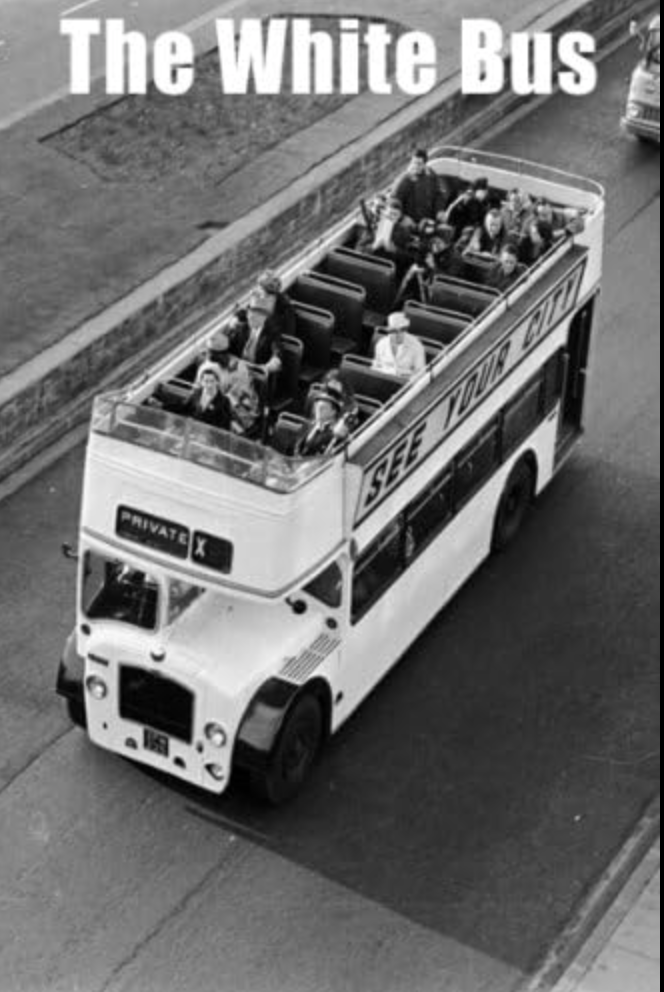
1967
Written by Shelagh Delaney
Directed by Lindsay Anderson
Edited by Kevin Brownlow
Amazon Prime
46 minutes
CAST
Patricia Healey- The Girl
Arthur Lowe- The Mayor
John Sharp – Mace bearer
Julie Perry – Conductress
Anthony Hopkins- Brechtian
Barry Evans – boy
Victor Henry- Transistorite
John Savident- supporter
Never heard of it, yet my favourite film of all time is Linday Anderson’s If …. and I have O! Lucky Man and Britannia Hospital too. We were browsing Amazon Prime and Karen said she fancied something 60s, and we saw it. A short too at 48 minutes.
The online listing said 1976, but I instantly said, there are no vehicles newer than 1966. So it was filmed in October 1965, released in 1967. It pre-dates If …. It was written by Shelagh Delaney, playwright of A Taste of Honey She adapted it from a 1963 short story. It was supposed to be part of a trilogy of Delaney stories, Red, White and Zero, with three short films, directed in turn by Lindsay Anderson, Tony Richardson and Karl Reisz,
It was Anthony Hopkins first film. Arthur Lowe appears as the mayor, three years before he became Captain Mainwaring. He was a most familiar face after five years as Mr Swindley, lay preacher and the clothes shop owner in Coronation Street. Lowe was part of the first cast in Britain’s longest series, currently in its 66th year on our screens.
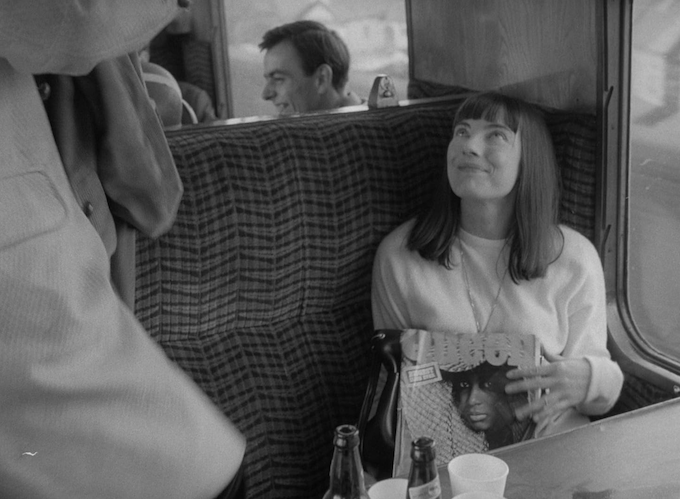
The girl (Patricia Healey) is the central character. She is first seen as a typist in a large open plan office. She’s working but the office cleaners are already there working round her. She gets up and leaves, walking past a hanged woman at a nearby desk. OK, it was 1965. Directors did that.
She leaves London on a train full of football supporters, presumably returning home, and arrives in an anonymous ‘Northern town’ which is based on Salford and Manchester. By that point, the supporters are asleep or dead.
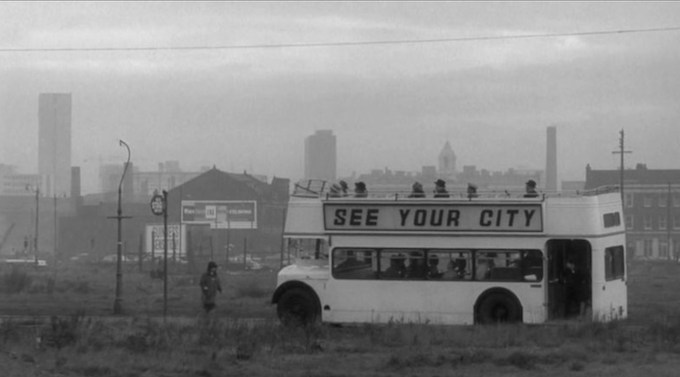
She joins a tour on an open top bus with the mayor (Arthur Lowe) and the Mace Bearer (John Sharp). They are taking a group of foreign visitors to explore the city. The bus is very familiar. They were running around Bournemouth and Poole in the 1960s, painted cream and run by Hants & Dorset buses (aka Pants and Corset).
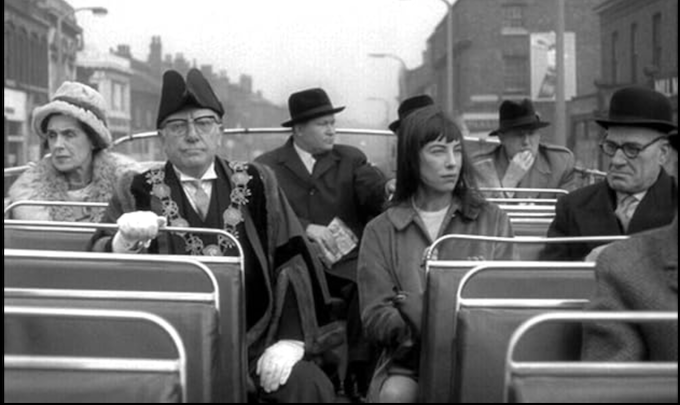
It’s filmed in black and white, but three or four times switches suddenly into glowing colour.
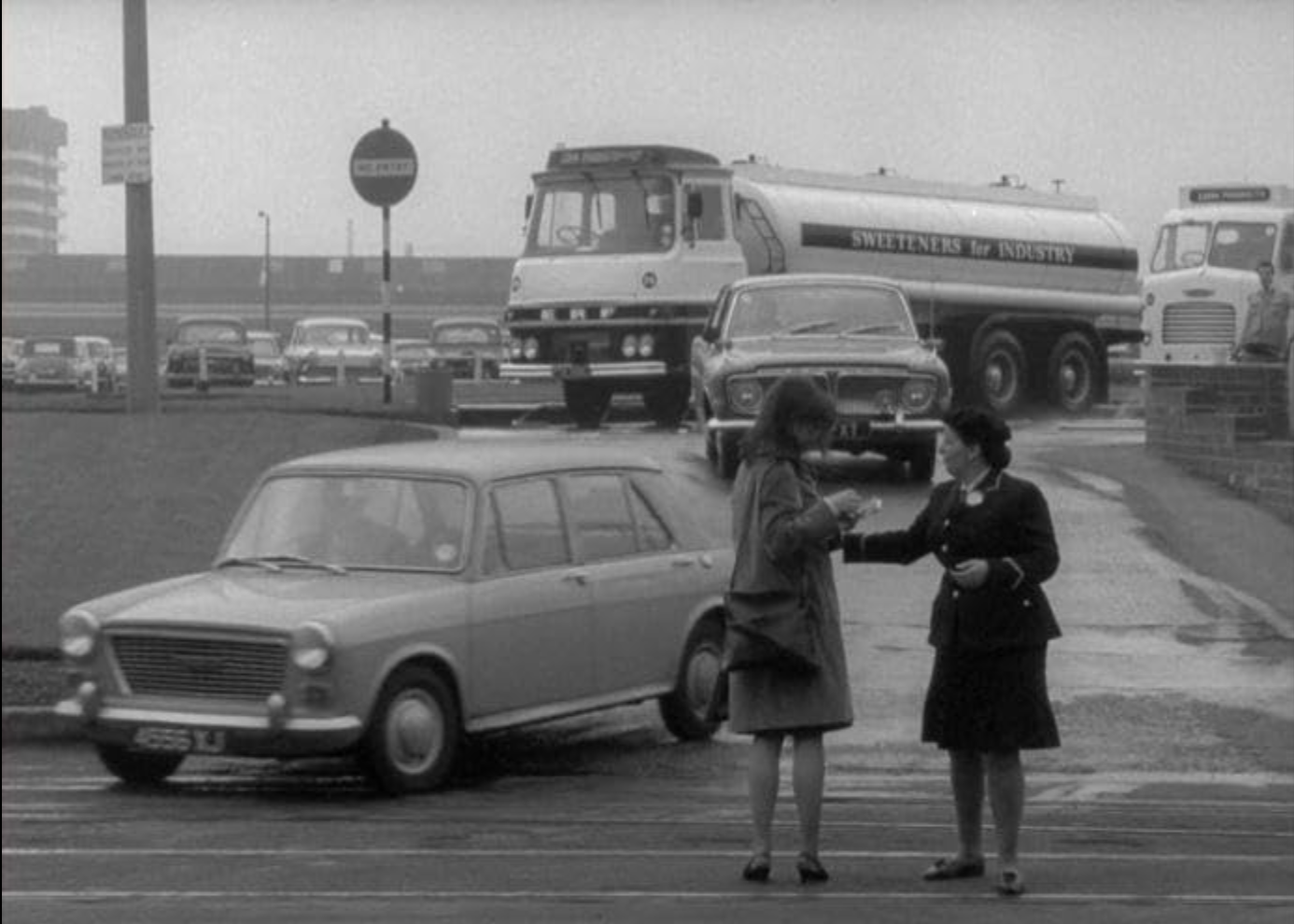
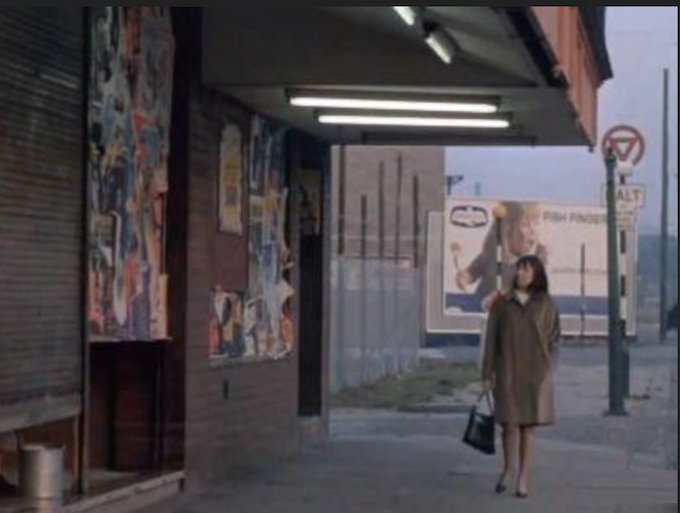
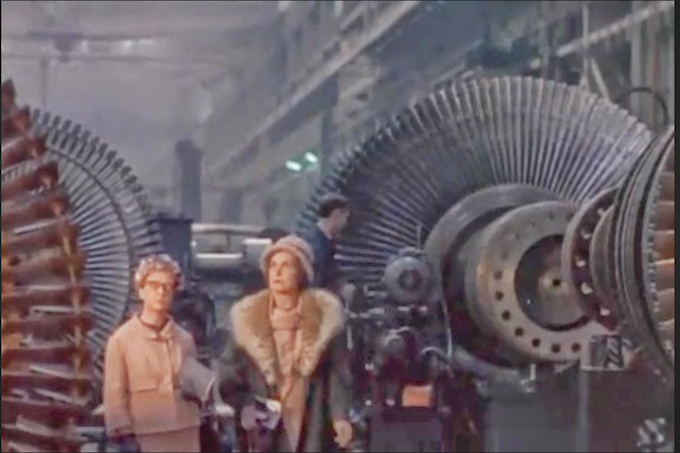
The grey, dismal, slightly foggy mood persists throughout, and Anderson has some excellent shots of factories and industrial machinery. Some industrial shots burst into colour. The mayor’s gown is suddenly blazing scarlet. Was it filmed separately? In those days the colour sequences would have been separate film.
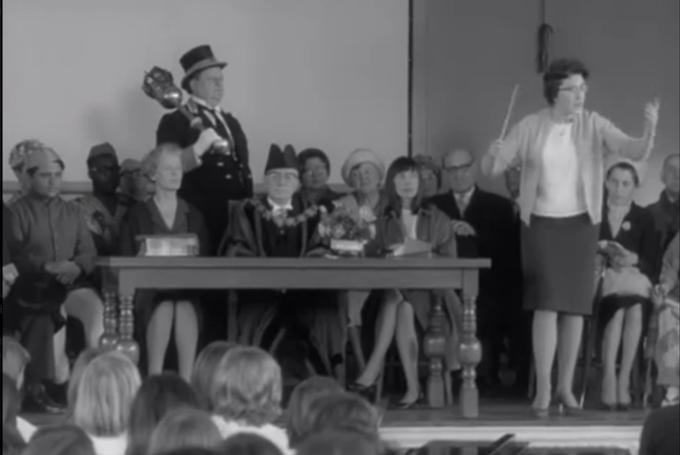
There’;s a school assembly sequence at a girls school, with the girls singing, conducted by a teacher. The dignitaries sit on the stage staring out. The Mayoress of Bournemouth used to turn up at our school assemblies and did much the same. That’s what mayors did. She has a school named after her some sixty odd years later. The hair styles and teachers were instant recognition for Karen. Anderson has a knack for showing schools. The girl switches from being on the stage to joining the assembled girls singing with them.
At the end, we centre on The Girl, but the other passengers have become shop mannequins.
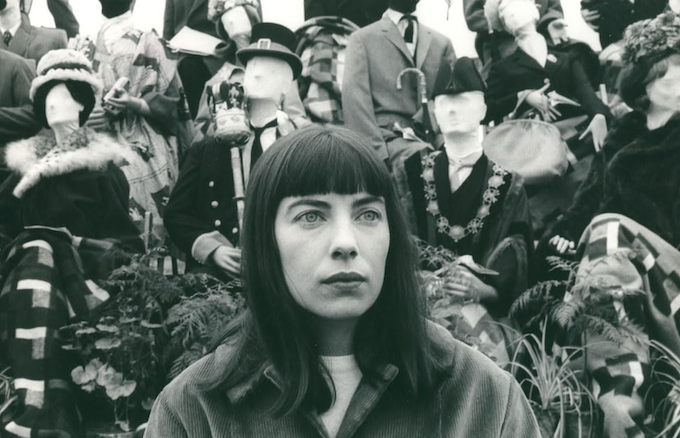
We enjoyed the picture of how grim Britain looked in the era. The girl made us think of ‘the girl’ in If …. too. Arthur Lowe channels Mr Swindley’s pomposity in preparation for Dad’s Army. It’s a minor work by a major director, but well worth 46 minutes of your time (or 54 with Amazon Prime’s adverts!) Camera operators I know would admire the shots, but would probably mutter ‘film school’ on the story which wasn’t a compliment.
REVIEWS FROM WIKI:
It emerges as a curiously muddled film, an interesting and ambitious experiment whose very diversity is ultimately its own undoing. The main problem is one of perspective. On a superficial level the film is about alienation, and a familiar alienation – that of the returning native … If the tour which the girl joins is meant to be a generalised attack on the prim self-satisfaction of provincial officialdom, we are surely entitled to something with a harder edge than the patronising attitudes which the film seems to be striking. Arthur Lowe’s Mayor is a telling caricature of bumptious officialdom, but since it is a caricature we can hardly be expected to accept at face value (as the film seems to want us to do) the facile jibes at soulless provincialism which Anderson makes by juxtaposing official statements with visual comment.”
The Monthly Film Bulletin, 1 January 1968
The film appears to be an attempt to explore a phase of loneliness, while it laughs at civic pomposity. It is all rather obvious, confected with gimmicky photography and flashes of harsh colour, and the humour consists of a few intellectual giggles among feet of humdrum sightseeing around a town hardly worth seeing. As the lonely girl Patricia Healey looks suitably agog with disinterest throughout.
Kine Weekly, 13 July 1968
LINKS ON THIS SITE
LINDSAY ANDERSON
If ….
O’ Lucky Man!
SHELAGH DELANEY
Taste of Honey (1961) FILM
A Taste of Honey PLAY
THE 60s RETROSPECTIVES
Film – the 60s retrospectives
A Hard Day’s Night
A Taste of Honey (1961)
Accident
Alfie (1966)
Barbarella (1968)
Be My Guest
Beat Girl
Blow-up
Bonnie and Clyde
Bullitt (1968)
Cat Ballou
Catch Us If You Can
Custer of The West
Darling
Deadfall (1968)
Doctor Zhivago
Fahrenheit 451 (1966)
Far From The Madding Crowd (1967)
Georgy Girl
Girl On A Motorcycle
Gonks Go Beat
Harper (aka The Moving Target)
Help!
Here We Go Round The Mulberry Bush
How I Won The War
I’ll Never Forget What’s ‘Is Name
If ….
Just For You
Little Fauss & Big Halsy
Live It Up!
Medium Cool
Modesty Blaise (1966)
Morgan – A Suitable Case For Treatment
Nevada Smith
O’ Lucky Man!
Performance
Petulia
Play It Cool
Poor Cow
Privilege
Six-Five Special
Some People
Sparrows Can’t Sing
Summer Holiday
Take A Girl Like You
Ten Little Indians
The Bofors Gun
The Carpetbaggers
The Chalk Garden (1964)
The Chase (1966)
The Devil Rides Out
The Family Way
The Fast Lady
The Ipcress File
The Knack … and how to get it
The Magic Christian
The Magus
The Party (1968)
The Party’s Over
The Rise and Rise of Michael Rimmer
The Small World of Sammy Lee
The Swimmer (1968)
The Thomas Crown Affair (1968)
The Trap
The White Bus
The Yellow Rolls-Royce
The Young Ones
Theorem (Teorema)
Tom Jones
What A Crazy World
Wonderful Life
Work Is A Four Letter Word
 Peter Viney's Blog