Both British & American English- 1 (the most popular article here) and British & American English 2 (inexplicably less popular) have had extensive additions today. A section on toilets / restrooms has been added to the first, and more on spelling added to the second.
Archive for the ‘1’ Category
More British & American
Posted in 1 on 19/05/2010| Leave a Comment »
Moving house
Posted in 1 on 11/05/2010| 2 Comments »
Posted one hour after David Cameron became the 12th Prime minister of Queen Elizabeth II’s reign.

Well it’s resolved. The election is finally over
But on these sorts of occasions so many questions come to mind. What’s the etiquette of deciding to call upon the Queen at her home to offer your resignation at 7.30 p.m.? Personally, I resent people turning up unexpectedly when I’m having dinner, and the Queen is 84 years young. She’s clearly accepting it graciously. But I wouldn’t dream of disturbing people of that age just before, during or just after their evening meal. Gordon Brown seemed determined to upstage the expected announcement of a Conservative-Liberal Democrat coalition,which had been timed for 8.30 p.m., but even so …
Then of course the Queen had to wait for David Cameron who got rather longer time with her. Did she and Prince Philip snatch a meal in the fifteen minute gap? Or were they served dried-up warmed-up supper later? Did the parade of politicians interfere with the royal TV viewing perhaps? Did Prince Philip manage to get the timer going on the TV recorder in time? The nation needs to know.
Then you have to think of David Cameron going back to No. 10 Downing Street. There’s no transition time in Britain, just 30 minutes. Former minister Nigel Hesseltine told the TV audience that he would be immediately whisked off to be briefed on the security codes for nuclear weapons.
But what then? Gordon Brown was intent on clinging on to power only a couple of hours earlier. But the new Prime Minister and family have to stay there in Number 10. Were the staff rushing around to change the beds? Was there a rush to get the ring off the bath and the hair out of the plug-hole? The Prime Minister’s apartment at the top of the house is allegedly self-financed. Did the Browns leave a welcoming bottle of milk in the fridge? We moved into one house to find milk and butter in the fridge, a loaf of bread and a wedge of cheese, and a bottle of fine red wine and two lovely wine glasses on the table. We resolved to do that whenever we moved out in future.
Or was Gordon unscrewing all the light bulbs and putting them in a box on the way out? He always had a parsimonious streak. The first flat we ever owned that happened. The previous owners took all the light bulbs. We moved in on a summer Saturday and it was virtually dark with no shops open before we noticed. We spent our first night by candlelight.
What it means for the TV reporters is the return to a nice warm studio after days standing outside 10 Downing Street and the offices of the various political parties and the Houses of Parliament. This has been the “live outside broadcast” election where for some reason the TV producers decided you can only talk about politics while standing out in the street on a bitterly cold night with a full film crew. It seems that we, the viewing public, can’t follow that it’s about politics unless we can see that the reporter is actually standing outside Number Ten or Big Ben.
Coining new words?
Posted in 1 on 26/04/2010| 1 Comment »
BBC Radio Four this morning. John Humphries was interviewing a polling expert about opinion polls for the forthcoming election. The pollster (Tim) was talking about the changes during the campaign and referred to the dramatic surge of support for Liberal Democrat Nick Clegg after the first TV debate.
Tim: Then we’ve had Cleggstacy …
John: Cleggstacy? I haven’t heard that one.
Tim: You hear a new one every day, John.
I don’t think Cleggstacy is a new word. It’s a journalistic pun on Clegg and ecstasy, of the kind that the tabloid newspapers invent by the dozen on a daily basis. But I was interested (see the article on Thatcherite under ELT Articles).
An example of a new word. Years ago, we needed a new remote control key for a Renault car. The dealer said, ‘Ah, you need a new plip.’ I was fascinated by the word, which appeared in the Renault handbook too. I submitted it to the OED with a photocopy. They replied that they’d only recorded one previous use, by Ford Australia. One use is circling around trademark / new coining. The addition of Renault was good evidence that it was a genuine new word.
I did a Google search, and got pages of PLIP (Parallel Line IP) which was irrelevant, then on about page 8 came a Wanted ad from someone seeking ‘a replacement plip’ for his 1991 Peugeot car. Add Peugeot to Renault and Ford Australia and you’re getting towards a decently researched new word. BUT did it catch on? I think not. Ford UK and Toyota call it a ‘remote key’. A pity really, because plip was a good descriptive word.
So, what do you call it? Years ago it was rare. Now it’s universal. I think you say ‘remote key’ or just ‘key’ because every car has one. A new word that failed to take off?
An interesting example: what do you call that strip of plastic that you put on a supermarket conveyor belt to divide your shopping from the next person’s shopping? This has been held up as an everyday object without a name. But the supermarket must have an order code and name for it.
Does anyone know?
Second debate …communication skills
Posted in 1, tagged communication skills, ELT, ELT viney communication skills prime ministerial debate, prime ministerial debate, use of names, Viney on 23/04/2010| 3 Comments »
“The three leaders began by calling each other by their first names, but as the debate developed Mr Clegg in particular started calling his rivals by their full names when he addressed them.” (BBC online news)
The comments below are on communication skills / use of language and as those maps on aircraft say “of no political significance”.

The debate was scored immediately afterwards by SKY NEWS (who hosted it) as Cameron – 36 / Clegg-32 / Brown – 29 . Twenty minutes later the BBC were scoring it as 30 / 30 / 30. One could add that SKY is part of the Murdoch Media Empire who are supporting Cameron. On the other hand, none of the people in the room with me saw it the BBC’s way, and I wouldn’t argue the gaps but suspect that in communication skills terms, SKY got it about right. I’m not commenting on content at all. I thought Brown was trailing all the way through, but bounced back somewhat with a strong closing statement.
The morning’s newspapers are a worrying example of the partiality of the press. See the longer version of this article under ELT Articles. Scroll down to The Second Debate where there are charts and headlines from the newspapers for the next day.
Brown has unfortunate grimaces when he thinks he’s smiling, which come over badly when the floor producer cuts the camera to him while someone else is talking. The others try to watch the speaker with a serious look on their faces. Brown tends to look down, shake his head or grimace and the producer had realized that and let us see it.
John Humphries on BBC Radio Four in the morning did his full rottweiler on the Lib Dem’s Chris Huhne which was entertaining, even if Huhne fended him off better than most politicians do. The communications skill of reiteration was extended beyond any sensible place by both of them. The Lib Dems love of people with weird name spellings extends from previous leader Menzies Campbell, who pronounced his first name “Mingus” to Mr Huhne. I don’t believe that Menzies Campbell’s choice was a tribute to the great American jazz bass player, Charles Mingus. That’s a shame. It’s a good job he was replaced.
The line up was deliberate, Brown on stage left (which is viewer’s right), Clegg centre, Cameron stage right. In looking at theatre positions “stage” means it’s right or left for the actor. It’s opposite for the audience. The central position in any line up is an advantage. Lead singers in rock bands don’t stand at one side of the stage.
On the names, which is the point here, Clegg was consistent in using the full names David Cameron and Gordon Brown. Brown was consistent in using Nick and David, and also used them a little too often. Cameron seemed as if he’d been told to use Gordon Brown rather than Gordon, and largely did, in spite of his surprised “I agree with Gordon” over nuclear weapons. Noticeably, Cameron used “Gordon Brown” but then “Nick”. I wondered if that was deliberate. It gives the impression of patronizing rather than friendship when used that way round. I thought Brown’s constant use of Nick and David made him look like a headmaster talking about bright but errant sixth formers, and reinforced the fact that he’s older than the other two. The possible plus for him is playing on his “experience”, the negative is that it reinforces the “old politician / time for a change” feeling.
Clothes? Clegg stuck to the yellow / gold tie. Cameron had switched from blue to a royal purple (and kept reinforcing If I was your Prime Minister … I didn’t transcribe it and that’s how BBC Radio Four reported it the next day. I couldn’t watch it again even if you paid me, but maybe someone could check whether it was “If I was …” or “If I were …” . Language has shifted towards “If I was “ and it had not struck me before that “If I was …” sounds less “conditional” and therefore tentative than “If I were …”.
Brown had switched to red with appropriate spots (moving left of his deep pink the previous week), with a pale blue rather than white shirt.
Mr Brown or Gordon?
Posted in 1 on 16/04/2010| 1 Comment »

The main three political party leaders in Britain did the first televised pre-election debate here on Thursday 15th April, standing behind lecterns. It was dull fare, but something you felt you should watch as a civic duty. To keep interest, I decided to focus on their presentation skills rather than content. In Handshake, we did a unit on the 1960 Kennedy / Nixon TV debates in America which created the politicians’ handbook. They adhered to it, all wearing dark suits and plain white shirts. I thought for a moment they had been dressed by ITV to help us distinguish them. Nick Clegg wore a tie in Liberal-Democrat yellow, David Cameron wore a blue tie, just on the lighter side of medium-blue for the Conservatives. Gordon Brown represented (New?) Labour with a deep rose pink rather than red. Even the variation from base party colours was significant.
The polls after the debate put Nick Clegg first, David Cameron second and Gordon Brown third. What they said hadn’t differed much, but both Cameron and Brown had grimaced when the other one was talking. Neither of them are particularly good-looking guys (well, they’re no Kennedy or Clinton or Obama), and facial contortion doesn’t help. There was also an interesting use of names.
In Britain in the last two decades a doctor, bank manager or lawyer will address you by your first name. My current doctor, dentist, lawyer and bank manager all addressed me as “Peter” at the initial meeting.
I find Americans prefer “Mr Viney” until it is made clear that we’re on first name terms, and will still then refer to me as “Mr Viney” to third parties. In a British office the host might ask someone to “Bring Peter a coffee” while in US offices it’s “Bring Mr Viney a coffee.” On the net (as an enthusiastic user of music sites) I find British correspondents refer to “Peter’s last posting” while Americans often refer to “Viney’s last posting” which I think is an academic influence, as in a scholarly article. In British English in a non-academic situation it sounds very abrupt (= bloody rude). Recently there were letters to newspapers complaining about hospital informality to elderly patients in Britain, who felt uncomfortable with doctors and nurses automatically addressing them by their first names. If you’re eighty, having a twenty year old saying, “Now, Doris, have you had a bowel movement, luv?” makes you feel ninety by infantilizing you.
It also removes some of the necessary medical mystique. British surgeons still like to wear dark blue pinstriped suits, unlike American surgeons who prefer green “scrubs” (as in the TV series ER). The British preference for pinstriped suits is said to be a factor in spreading MRSA in hospital, as surgeons’ ties were found to be full of nasty bugs. But, they say, formality gives patients confidence.
So what happened in our British TV debate? Both David Cameron and Gordon Brown referred to each other constantly as “David” and “Gordon.” This subliminally reinforced the public perception that all politicians are much the same, and that they’re members of a club we’re not admitted to. Public regard for politicians is at an all-time low following the expenses scandals of the last year.
On names, Nick Clegg did the first name too, but he also used “Mr Brown” and “Gordon Brown” and “David Cameron” rather than just “David” or “Gordon”. This distanced him from the “club” which was a sensible move, and his platform was that his party was different. Had I been either Brown or Cameron, in such an adversarial situation, I would have used “Mr” too. It’s not a question of respect (though both hold high office) but a question of not appearing to be all pals together. In retrospect, “Gordon Brown” is the best one to use, as it lacks the forelock-tugging deference of “Mr Brown” but also avoids the “we’re all good pals outside of work” of “Gordon.”
I’m also posting this under ELT articles in a longer version. Any comments? What form of address do politicians use to each other in other countries?
Stuck
Posted in 1 on 15/04/2010| Leave a Comment »
“Unusual travel suggestions are dancing lessons from God.”
Attributed to Bokonon (the Caribbean guru) in “Cat’s Cradle” by Kurt Vonnegut.
“Stuck Inside of Mobile (With The Memphis Blues Again)“, Bob Dylan, Blonde on Blonde. 1966
Vonnegut’s memorable line shouts out to thousands of travellers today, as the Icelandic volcano causes an unprecedented total shut-down of air travel in Northern Europe and across the Atlantic. We have friends en route to Canada and another en route from Germany to the UK. Stuck. In a word, stuck.
I thought back to the times I’ve been stuck. In thirty years of talks, my only no-show was Seville, after the runway collapsed and my late night flight from Barcelona was cancelled.
Then there was Japan in the early 80s when a hurricane struck. We were stranded in a hotel in Osaka unable to travel or even look outside. So was Robert O’Neill, and we paid a ridiculous sum for the straw-covered bottle of Chianti adorning the hotel bar. I phoned home to find a friend there looking after my older two kids. The youngest was in hospital. He’d been seriously ill three months earlier. I couldn’t get out of Japan. All flights were cancelled. It was the worst couple of days I can remember. By the time the storm subsided, he was out of hospital and I continued the tour. My heart goes out to all those who HAVE to get somewhere and can’t.
But sometimes the unexpected travel plans are a bonus. I once followed our friend’s route from Germany in 1971 by train. I was in a compartment with five Yugoslavs from Munich to Brussels (they had travelled from Belgrade). They had copious supplies of bread, salami, red wine, cheese. They insisted on sharing it with me, though they spoke not a word of English. It was one of those “Manchester United?” “Fantastic.” “Red Star, Belgrade?” “Fantastic!” conversations that lasted several hours. We established that I was an English teacher and they insisted I teach them English greetings and toasts. They taught me toasts in Serbo-Croat which I remembered for a few days then forgot. We parted in Brussels, good friends as far as it goes.
Magical places
Posted in 1 on 11/04/2010| Leave a Comment »
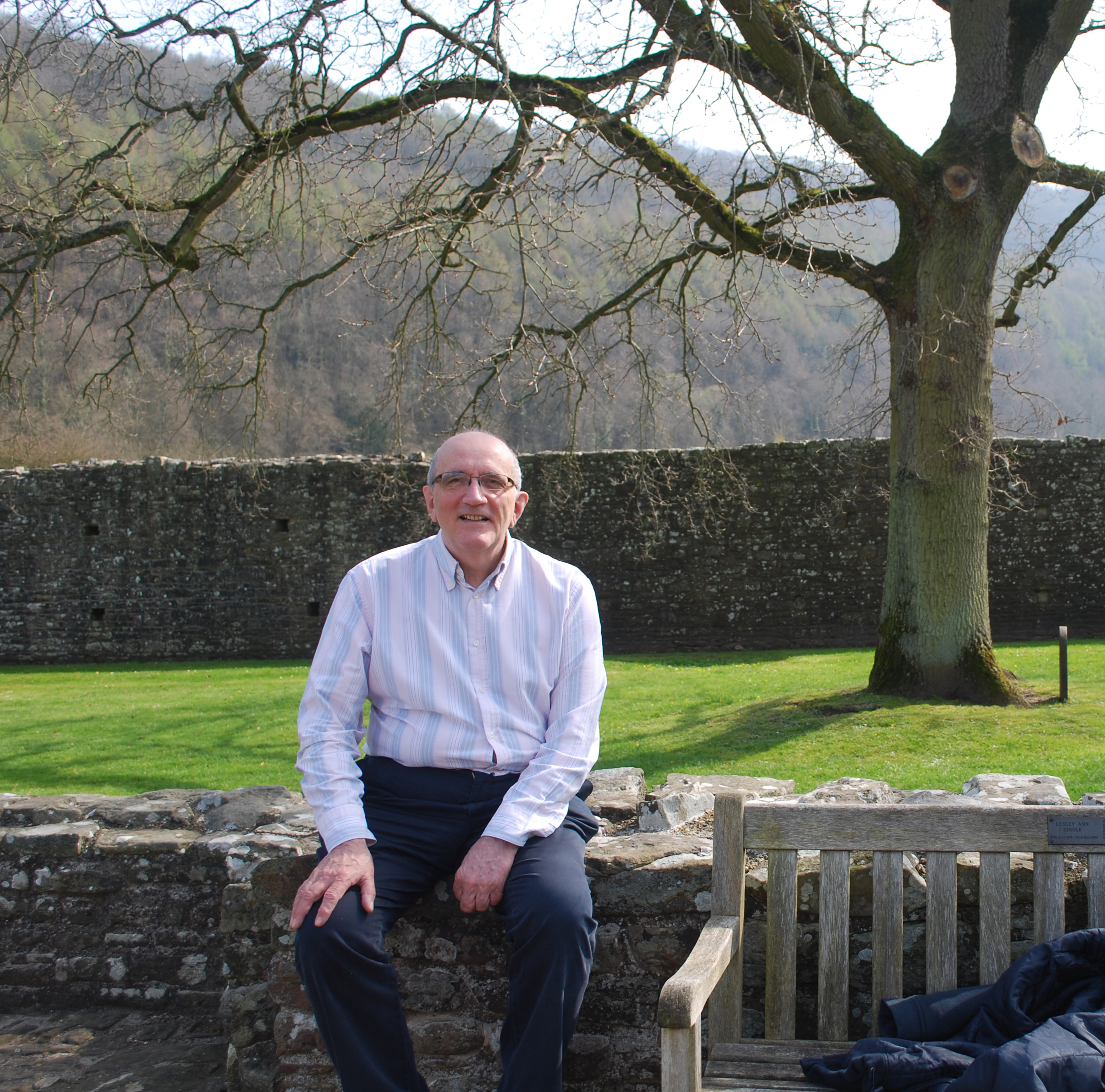
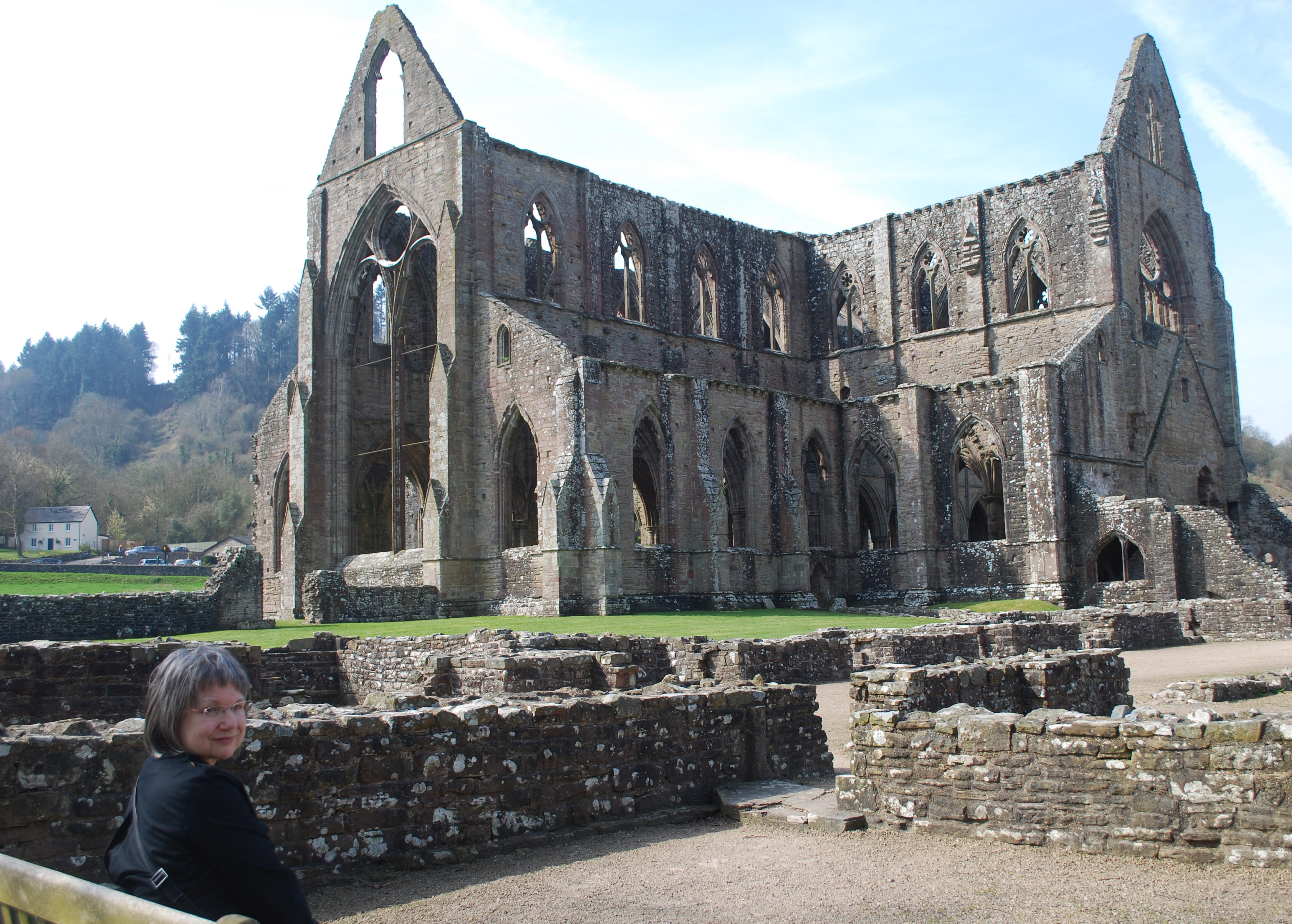
Peter at Tintern Abbey
Karen at Tintern Abbey
Every year we try to get to Tintern Abbey at least twice. The abbey, subject of Wordworth’s poem, is just over the Welsh border on the banks of the River Wye, around three hours drive away. The ruins are beautiful, but what attracts us is the setting. The Cistercian monks in the 12th century sought out magical places, or power spots, and two of their Welsh abbeys, Tintern and Strata Florida, are in very special locations. There’s a sense of tranquility in both that visitors can’t shatter. This year, with the long, late winter we were just too early, as the swifts which usually fly around the ruins weren’t yet there in numbers, and they form a soundtrack which adds to the ambience. So we’ll go again in a few weeks. We collect children’s illustrated books, and one of the half a dozen best secondhand children’s bookshops is in Tintern, Stella Books.
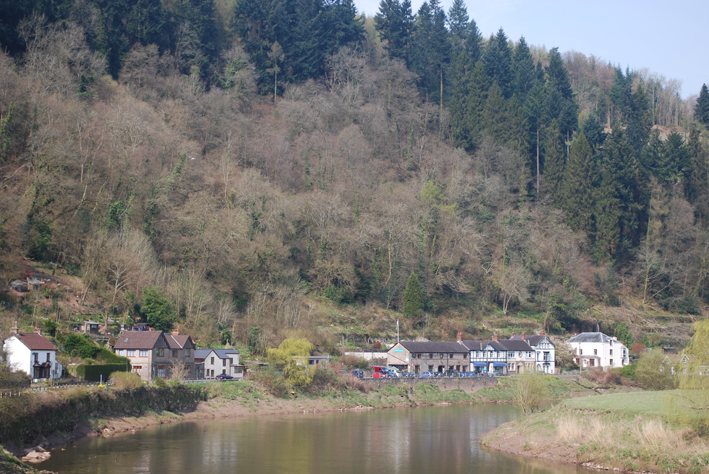
The setting of the bookshop at Tintern, white building just right of centre
See the article On Location with Grapevine Three for a description of what happened when we tried to film a video nearly twenty years ago, in an equally magical place, Glastonbury Tor. The resulting video was Glastonbury Story from the now out-of-print Grapevine Three Video. If we did a similar story again, Tintern would be a much more accessible setting.
Banal news reporting
Posted in 1 on 10/04/2010| Leave a Comment »
Politics for weeks. Extended news every evening. The run up to elections is dull. And the BBC keeps shooting itself in the foot with news coverage. They were reporting on plans to cut expenditure in public services and debating whether it was possible. For the next piece of news, reporting on how politicians appealed to the electorate, they started with a reporter standing live outside the House of Commons at night (to illustrate “parliament”). They moved to the home book-lined study of a writer on communication skills to interview him for a few lines (the books illustrated “writer”), then the cameras went to a dancing academy to mention that body language was important for politicians (dancing illustrates body language), and finally to a reporter standing in a boxing ring to explain that a contest was about to start. The reporter wore boxing gloves. (It illustrates “contest”).
That involved four location set-ups for film units, and like so much on TV news, insults the audience’s intelligence by banal over-illustration. The few minutes of script could easily have been done by one talking head in a studio. Add three researched still photos at most, if you really have to. It also undermined the argument that cuts can’t be made in the BBC as a public service when resources are ludicrously wasted on dumb location set-ups and the results patronize the viewing audience.
I believe the BBC is one of our greatest resources and that its independence and licence fee should be protected, but when producers show this sort of nonsense on a nightly basis, they seriously damage the case.
How To Train Your Dragon
Posted in 1 on 09/04/2010| Leave a Comment »
Accents in movies …
Kids give you an excuse to see this sort of 3D computer animated stuff. The story of How To Train Your Dragon is about a Viking village plagued by a variety of colourful dragons. Our hero, Hiccup, manages to befriend and tame a Night Fury dragon and then befriends all the dragons and people stop killing them and everyone learns to respect their differences and lives happily ever after. Love interest is provided by the teen queen Astrid, herself a dab hand with a chopper (or should I say “battleaxe”).
The first ten minutes is Hollywood scripting at its worst. You’re launched right into a noisy and confusing night attack by the dragons on the Vikings and you’re expected to pick up plot lines amidst the bangs and crashes and bolts of lightning and dragonian flame-throwing. Basically, everyone thinks the wispy Hiccup is a wimp. Our 6 year old and 4 year old companions looked bemused. From then it rapidly gets better.
It made me think about the old question of accents in films. The Vikings find themselves with Scottish accents, perhaps a legacy of Shrek for Dreamworks Animation meant that big, gruff, beefy blokes sound Scottish. Also, the Vikings are kilted and bearded, if lacking in sporran, dirk and bagpipes. However, the Vikings’ spotty teen offspring have eschewed the rich parental burr for high school movie teen American.
I never had any sympathy with those snooty 1950s film critics who complained about the characters in biblical epics having American accents. There is no such thing as English without an accent. Either you have a variety of accents in English, or you go the Mel Gibson route as in Passion of The Christ, and have the cast speaking Aramaic, Hebrew and Latin; or in Apocolypto where they speak Maya.
Assigning an accent that feels right for the audience is crucial. In some 1950s epics, they had the Romans speaking in British accents and everyone else speaking in American. This suited the British listener who identified with the patrician empire-builders. In the BBC TV adaptations of Emile Zola, the folk of the North-East French coalfields had Yorkshire accents … Eeh, bah, gum, monsieur, there’s trouble at mill. It makes sense, as it’s a regional accent from a mining area. What would they speak otherwise? French-accented English? The issue was sent up in ‘Allo ‘Allo, the World War II sit-com about the French resistance where everyone spoke comically French-accented English (or comically German-accented English), that is except the English pilots (trying to escape) who spoke either Advanced RP or schoolboy French. When the English-speaking resistance leader had to speak to them, she moved from French accented English to public school Advanced RP. Listen, chaps … To complicate matters, there’s an English secret agent who is disguised as a gendarme. He speaks French-accented English but can’t pronounce words correctly, so his daily greeting is Good Moaning. In the last series, David Jansen who played Kevin in our videos A Weekend Away and A Week By The Sea, joined the cast as the German officer Herr Flick.
Oliver Stone was widely criticized for having the Macedonians in Alexander speak with Irish accents, while the Athenians don’t. He argued that the Macedonians moved in from the periphery and took over so needed a Celtic fringe accent. At the time, the naysayers believed that Colin Farrell, as Alexander, couldn’t do any other accent, so the others had to adopt Irish accents to fit. For audiences outside Ireland itself the effect was slightly comical: Get your swords and shields … the Clancy Brothers and Tommy Makem are at the walls with a mighty army.
Going back to How To Train Your Dragon, the Scottish was a fair call. Mel Gibson would have had them speaking historically accurate Old Norse, but this is a kid’s film. The foreign accent route would have left them sounding like the Swedish chef in The Muppets. A mild Scottish accent works as it’s one of the most northerly native-English accents. Given the jealousies and bickering among the class of trainee dragon killers, the choice had to be a teen accent. High school USA or Grange Hill? You go with what the largest audience finds easiest on the ear, which means American.
Shrek humour influenced the names too. I failed to pick up on much more than Hiccup, Astrid and Hiccup’s dad, Stoick, but other characters are named Gobber, Snotlout, Fishlegs, Hoark the Haggard and Phlegma the Fierce.
The Boat Race
Posted in 1 on 03/04/2010| 2 Comments »
I was listening to the radio news about the Oxford and Cambridge annual boat race today. This is an event which has completely slipped beneath my radar, but it was brought into the news today by the presence of two burly identical twins in the Oxford team. Tyler and Cameron Winklevoss are Americans who as well as rowing at this high level, won a legal case over their role in the origins of Facebook.
It started me thinking about my childhood, when everyone in the country took sides in the boat race and everyone watched it on TV live. For no apparent reason, we all adopted sides and fervently supported one team or the other. The only reason for my choice of Cambridge all those years ago was a liking for light blue over dark blue, as we had no connections to either town and certainly not to either university. I liked light blue shirts and didn’t like dark blue pullovers.
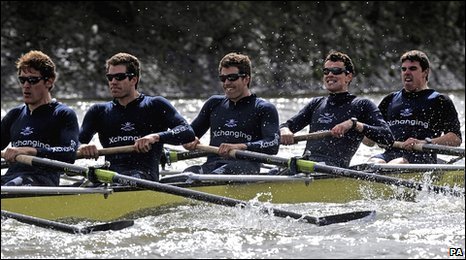
Many years later, as an OUP author, I remember expressing a mild preference for an Oxford victory to one of my OUP editors, but as he’d attended Cambridge himself, he was rooting for the other side, as it turned out were most of his colleagues.
The boat race on TV has proven a minefield for sports reporters. The person who steers the boat is usually chosen because they’re small and light, and is called the cox. Private Eye regularly lists unfortunate sports commentaries, and with the boat race they’re along predictable lines (The race is over! They’ve won! Everyone in the crew is hugging their little cox …)
I haven’t watched it in years, except for re-runs on the main evening news, though after thirty years connection with Oxford, I’d extremely vaguely hope they’d win. That’s more to do with having filmed various videos in so many obscure parts of the university, especially English Channel III: Double Identity.
 Peter Viney's Blog