2025 note. This article has been enhanced after finding a small pile of ACEG brochures while tidying the loft. I went for ones with persional interest. it was amusing to see that often directors, marketing staff and administrators pose in the photos. Possibly because they were smartly dressed.
The Swiss Connection
There are landmark people and places in ELT. John Haycraft at International House, the Bell schools from Cambridge, The Swan School in Oxford, Ealing College, Pilgrims.
My own experience was In Bournemouth, and the Swiss Connection in ELT is overlooked and under-estimated.
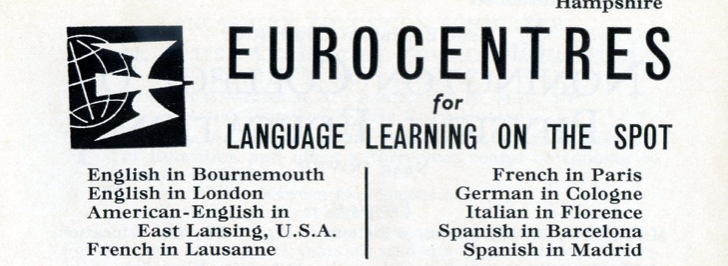
It starts with Eurocentres in 1948. The school was founded by Erhard Waespi, and Eurocentres also taught French in Paris, Italian in Florence and German in Cologne. They opened in Bournemouth (perhaps thinking it as attractive as Paris and Florence?) and an early student was Fritz Schillig, a young travel agent, under twenty years old.
He realized the potential at once. So much was based on Switzerland being a multi-lingual country … German, French, Italian and Romansh. Because everyone had to learn one or two of the other national languages at school, there was no time for English in the curriculum. The British holidaymakers’ view of abroad in the nineteen fifties and early sixties went in a straight line by coach through the tulip fields of Holland, into Luxembourg for a passport stamp, past the castles of the Rhine to the pretty chalets and cow horns of Switzerland, with an extra passport stamp in Leichtenstein. As post-war tourism took off, with Switzerland very much the centre, there was a demand for English.
So in 1950, Fritz Schillig hired a teacher, put him in a room in a guest house, and sent him two students. They moved on to a church hall. It was called the Anglo-Swiss School initially. The school changed name and moved to Wimborne Road, Bournemouth in 1955. That was the start of Anglo-Continental School of English, which by the late 70s was a group of nine large schools. On their fortieth anniversary, he described the start to me. He was immediately called up for National Service as he left Eurocentre … in Switzerland there was an initial training period, then three weeks every year. He said he was in an army camp with a huge pile of coins at a pay phone trying to run the school and find students. Within a few years, he was chartering flights from Switzerland to Bournemouth Hurn Airport to bring students over. He showed me photos of himself escorting them down the aircraft steps at Bournemouth.
Those flights continued until the early 1970s. As a teacher, you could get an empty seat a couple of days before the flight for free. My first holiday in autumn 1971 was a free flight to Basle (invited to sit up front with one of the directors), then taking a train to Zurich, where I ran into Linda, a fellow ACSE teacher, at the station, then another to stay with a friend in Munich. Then a train to stay with my sister in Brussels. That was overnight and memorable – I shared a compartment with four Yugoslavs who spoke no English, but had cheese, bread and quantities of red wine which they insisted on sharing with me. It was one of those ‘Manchester United?’ ‘Yes! Red Star Belgrade?’ ‘Bobby Charlton?’ conversations.
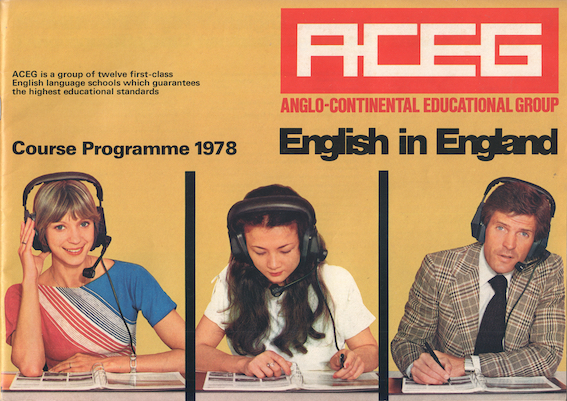
While Eurocentre stuck mainly with Switzerland and Japan, Anglo-Continental had far wider ambitions. When I started in January 1971, it was still mainly Swiss students with increasing numbers of German, French, Italian and Spanish students. There was also a large contract with Libya. Very soon we were getting students from Algeria, then ACSE pioneered Latin America, so we got large numbers from Mexico and Venezuela. We did “summer courses” in January and February for Brazil, Argentina, Chile and Uruguay. Then we started to get students from Turkey, Iran, Saudi Arabia, Kuwait, Francophone Africa, Quebec (a surprise), Indonesia, South Korea. There were tailor made courses … I recall a three month group of Kuwaiti firefighters, another of Kuwaiti nurses (female) and a three week course of English and golf for Japan. The Quebecois students told me they hadn’t wanted to learn English “in Canada.” At the end of several courses, I was offered a job setting up an ELT department by their sponsors at a university in Montreal. I seriously considered it … one of those different life path moments.
There were ELT implications of the Swiss connection that continue in ELT today. All those early 1950s and 1960s Swiss classes had three languages, so all teaching had to be in English. Most course book writers at that time were working abroad in just one country and directing their work at one language.
The first textbooks to emerge from Bournemouth were from Eurocentre with Robert O’Neill’s “English in Situations” then Robert O’Neill, Roy Kingsbury and Tony Yeadon with “Kernel Lessons Intermediate.” These were all admittedly Eurocentric, but at least were based on the experience of multilingual classes, and didn’t focus on problems related to one language only. I believe many of Robert O’Neill’s decisions on what to teach reflect right on until today.
Bernie Hartley was teaching on four week intensive Teacher Training courses for foreign teachers of English with Robert O’Neill at Eurocentre. Eurocentre continued as a centre of excellence with Roger Scott, Jeremy Harmer and John Arnold all writing textbooks.
Kings School of English furthered the Swiss connection in Bournemouth (Bernie taught there too, with Jake Allsop). Eurocentre, Anglo-Continental and Kings were about 5 minutes walking distance from each other. They were the three largest schools, with Anglo-Continental easily the largest. By the mid-70s it was apparently the biggest user of Xerox photocopying in the area as we developed and wrote our own courses.
When I started in 1971, Colin Granger was the Beginner level supervisor. We had six departments and you only taught in one level, so we were specialists and we had six separate staffrooms. We had Beginner, Elementary, Intermediate, Upper Intermediate, Advanced and Proficiency departments. We only had one female teacher in January 1971. She started the same day as me. Believe it or not, it is true. When Colin Granger left in September 1971, I transferred from Beginner to Elementary so as to work with Guy Wellman, who had become Elementary supervisor. In 1973 that was all combined as three large departments – Elementary, Intermediate and Advanced.
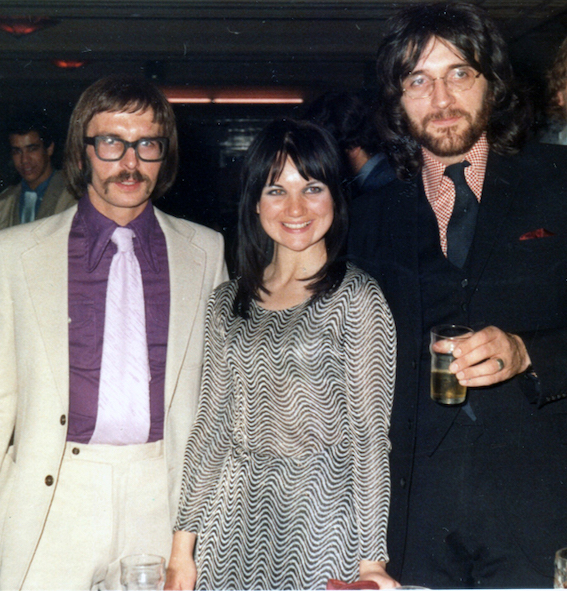
Mayor of Bournemouth’s Reception for Foreign Students, Bournemouth Pavilion
I had taught three summers as a student before I started at ACSE. Summer of 1967, I was a first year student. Kingsnorth Academy, an office over a shoe shop in Bournemouth. They had 100 plus teachers, each teaching eight German students, age 16, in their own home 9 a.m. to 12. You received a ticket per student per day and cashed them in on Friday afternoon. Full attendance meant £8 in total for the week. The material was Candlin “Modern Day English for The Foreign Student” plus a pile of Gestener sheets with lists like “duck – drake – duckling, swan-pen-cygnet.’ After two days I gave up (they were vaguely intermediate) and started using Beatles and Simon & Garfunkel songs (which took some preparation). Within two weeks they told their friends and I had sixteen packed in my mum’s living room earning me £16 for the week. That’s when I learned the importance of student interest in the material!

My first day’s teacher training at ACSE (a Monday) was watching Colin Granger and Guy Wellman (still two of the best classroom teachers I’ve ever seen). Tuesday at nine, and I was in front of a class. At that time, Colin was writing in the morning, we were recording audio at lunchtime (we always had our own recording studio, as did Eurocentre), it was typed and printed in the afternoon, and we were teaching it next morning. That’s how I assumed it was done (several of the situations appeared later in Colin’s Heinemann textbooks).
By 1973 I was Deputy Head of Elementary to John Curtin, and by 1975 Head, with Bernie Hartley as Deputy Head. Leo Jones was Head of Advanced and was writing Functions of English. John Curtin and I wrote Survival English for the new ACSE London (Stuart Redman and Ruth Gairnes taught there). The department used material I had written, and then Bernie joined me in writing Streamline (originally called English in England, then Express English.) OUP first publicized it as Express English and a London school objected. Legal advice was ‘no copyright on title’ but OUP didn’t want to miss the summer so changed the title to Streamline to match the train picture they had already commissioned. I only discovered very recently that the Letraset font used for the Express / Streamline logo is called “Streamline” which must have inspired Richard Morris, who designed the book, to suggest the name. In our department, Karen beat us all as the first to be published, with a reader for Mary Glasgow.

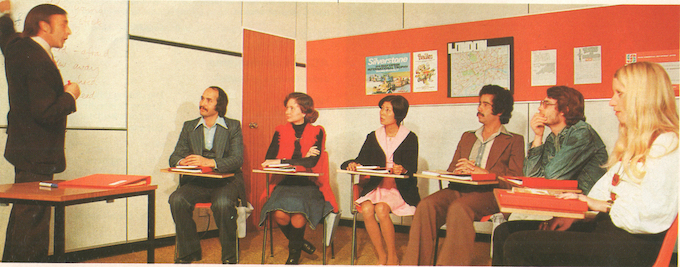
At ACSE, the central and “premium” school, students received four classroom lessons a day including two language lab sessions per week. Then there were two supplementary programme activities per day they were supposed to attend, plus one other voluntary supplementary session a day. Some were in large lecture rooms, where we showed the BBC On We Go films and exploited them, we had song sessions with Mr Monday and Seasons and People, Bernie developed ‘Everyday Conversations” using two teachers which ended up in Streamline. At higher levels there were Life & Institutions lectures and English literature. I was used to audiences of 50 to 200 several times a week, then 400 on Wednesday evening (Drama Evenings). It helped when I started promoting text books.I had no fear of large audiences.
There were also small group activities, like Drama Improvisation (me and Karen), and video. Then there was something on every evening. Language Lab classes, Business English, Technical English, Translation classes in French, German, Italian and Spanish. Extra writing classes for non-Roman alphabet students.
We did our sketch “Drama Evening” shows on Wednesdays to a packed restaurant. I met Karen when she came in from outside to act in ‘Playboy of the Western World’ in May 1971. She was immediately invited to become part of the theatre group, starting the next week. Once a month, we had Scottish Country Dancing on Fridays. Discos on Saturdays. A local amateur orchestra played regular concerts. We had mock elections when appropriate. One caused a storm of protest when John Curtin won for Liberal after giving his speech in Spanish, Portuguese, French, Italian and German with asides in Arabic. Michael Wide (head of the business school Anglo-International, chairing the mock election, pointed out that the whole point was practising listening in English and disqualified him.
Anglo-International was on the same premises. Karen was dragooned into it one Monday. A central part of their programme was English for Secretaries. The woman teaching the course lost her husband over the weekend and no one could take over the secretarial aspect of the course. I mentioned that Karen had a secretarial qualification, and she came out of her nine o’clock class to find herself transferred over to run the course at ten … three kinds of shorthand in one class, and none of them Pitman which she knew. (It doesn’t matter …you dictate, they use their own systems, you check back). Michael Wide said she’d have to ask the students where they were in the textbook, and she said, ‘No need, we’ll be doing letters of condolence first.’ I used that as an example of the RSA Cert TEFL observation sheet, ‘Ability to Adapt and Extemporise.’ Never be afraid to abandon the textbook for the ‘here and now.’
Then she was there for a few months (Michael liked the adapt and extemporise), running the Hotel & Catering autumn courses. She set up a hotel reception and restaurant for role play. The students (mainly Swiss, French and Austrian) were great fun to go out with in the evening too.
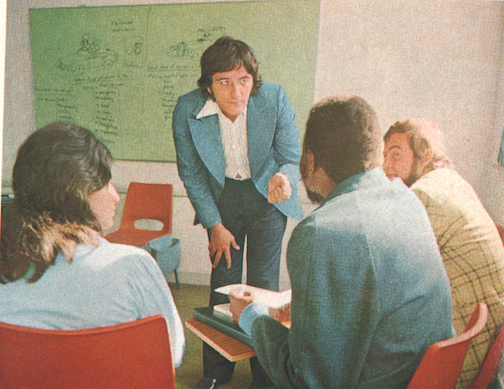
We were justly proud of our teaching. We had a group of Algerians with zero English. They stayed in Elementary for three months (they should have gone to Intermediate after two, but we kept them). They skipped Intermediate, and went straight into Cambridge FCE classes in Advanced for two months and all passed. Zero to FCE in about twenty weeks. I will add that they had been selected to send to the UK on IQ.
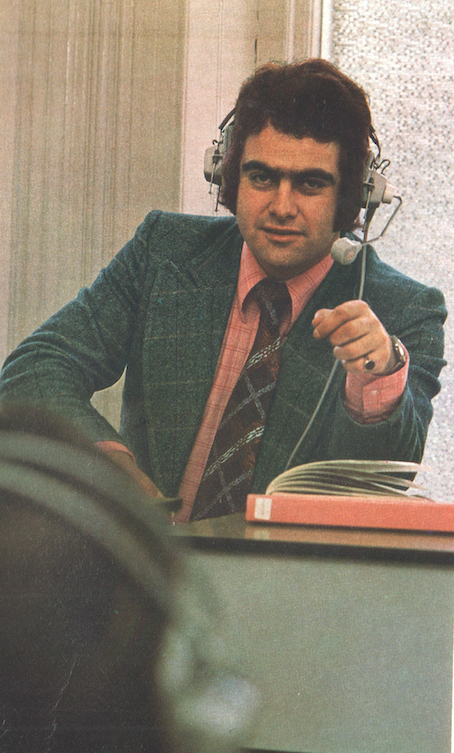
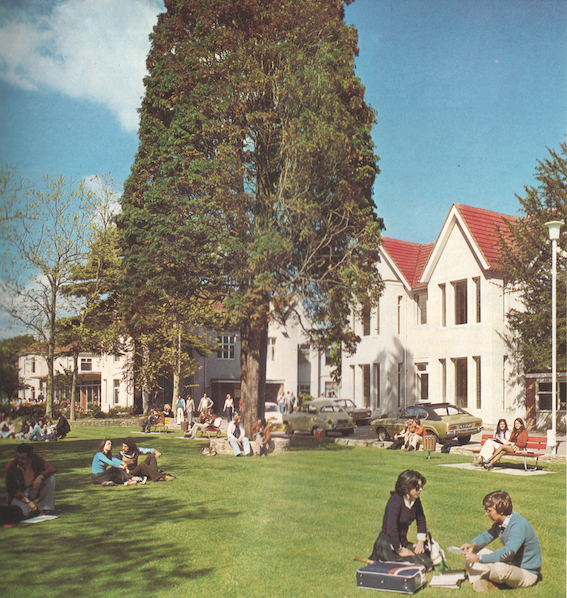
Academia School, circa 1976, one of the nine schools in the group
In the 70s, ACSE was attracting teachers from Eurocentre … Alan Tankard, Patrick O’Shea, both recruited by Guy Wellman for the new Academia school, of which he was Director of Studies and Katy Walker (to Elementary), then Laurie Allan. Karen, Alan Tankard and I had met Katy at an ARELS course at International House. Roy Kingsbury (ex-Eurocentre) was playing piano on our weekly shows, and Roy and Patrick O’Shea were publishing collections of ELT Songs.
When Academia opened, we ran a training course for the first teachers, one of whom was Karen. Karen had joined us in the Drama Evening shows in May 1971 and by October we were writing original material for them. She was working at the probation office. At Christmas 1973, we were speaking to Mr Schillig after our annual pantomime for host families – a major event over three nights. He told Karen that on student feedback surveys, she was the most popular teacher in the school. ‘But I don’t teach here,’ she said, ‘I just do the drama shows.’ ‘Yes, so when would you like to start?’ That first training course was the basis for our later RSA Cert TEFL courses. I don’t think the Director of Studies ever got over the fact thatg Karen had been directly employed by the owner, not by him!
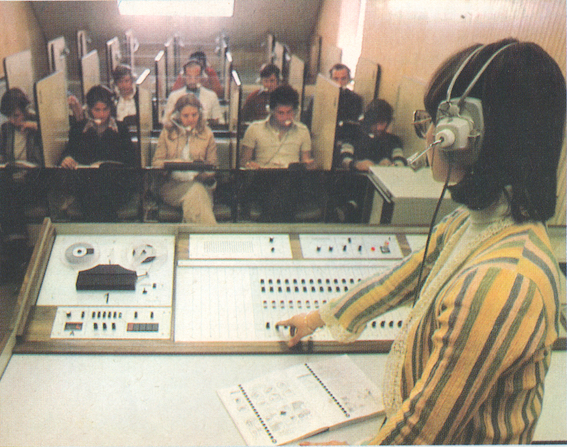
For the ARELS Oral exam, which was done by recording students in a Language Lab, only me, Karen and Leo Jones were confident enough on using the equipment
It may have been down to money. We had a 16 point incremental scale, linked to Burnham Further Education levels, which was as good as ELT ever got. ACSE was persuaded that if they paid the most, we would get the best teachers. It worked in recruiting from Eurocentre, Kings and other local schools … to a degree … and for a while. I could go on, but as we got into the late 70s nepotism / friendship took over from ability in appointing senior staff. There was one summer job, summer course supervisor for intermediate. Laurie Allen had applied, having run Eurocentre summer courses single-handed. He was the obviously best-qualified choice. Six out of seven of us voted for him, but were over-ruled by the DoS in favour of a friend of his. Karen was asked directly why she had not applied to run the Elementary summer courses circa 1977 (she being the directors’ first choice) and said, ‘I can’t do it. With Peter as Head, it would look like nepotism.’ If we had gone for sheer ability, I think we could have done better.
After disastrous results from Bournemouth College’s RSA Cert TEFL Course (2 passed out of 50), ACSE took over as the local RSA CertTEFL centre. That was inspired by Chris Goodchild, then Director of Studies. We observed classes, and had tutorial groups as well as class observation. We reversed it to 48 passed out of 50.
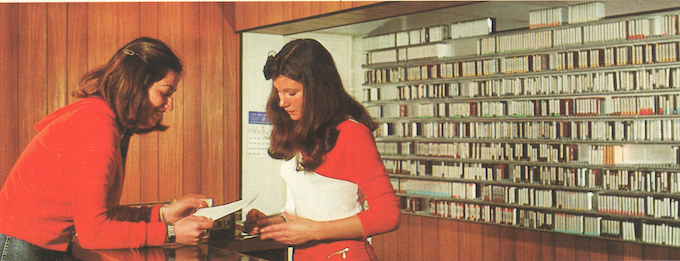
Karen was responsible for setting it up, with Laurie Allen
When Bernie and I started promoting Streamline we had a long chat with Brian Abbs. He had nodded and smiled attentively through our talk (at International House, Piccadilly). Afterwards he had glasses of wine for both of us ahead of the queue, then whispered, ‘I didn’t agree with you, but noticed that I looked as if I did. I hope you’ll do the same to new authors when you see them … and now, I want you to join the Society of Authors right away …’ Brilliant advice and I enjoyed many more discussions with Brian at conferences in the next few years. Anyway, Brian said he couldn’t understand why he’d never heard of us, and yet we’d come out with such a high profile launch of Streamline. We were not part of the London scene.
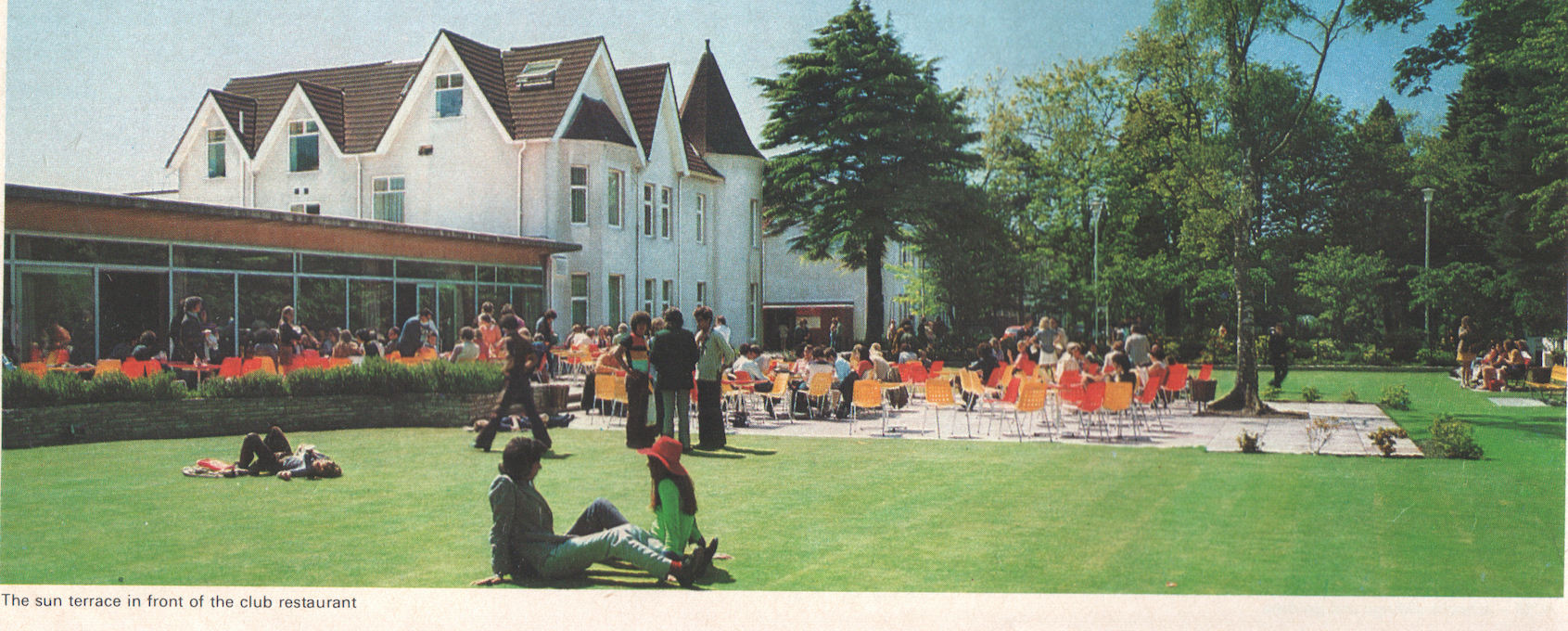
That was the general point about Bournemouth. We had the largest schools, mainly Swiss-owned. We didn’t mix and mingle much outside Bournemouth either. At one point when John Curtin wanted me to join IATEFL, I think he was the only member in a group with 120 teachers. No one in Bournemouth was interested in IATEFL then. When we did go elsewhere for ARELS courses, we were always shocked at how drab and shabby and run down other ELT schools looked inside … all three of the large Bournemouth Swiss ones were much nicer inside. The other Swiss connections was gleaming clean classrooms, spacious staff facilities, our own recording studio, five language laboratories, a private study listening centre, a large budget for materials, a subsidised and excellent staff restaurant. We even had a staff outdoor swimming pool in the 1970s, left over from when the building had been a hotel. Summer lunchtimes were idyllic lounging around the pool. After our weekly “Drama Evening” shows on particularly hot summer evenings, we were known to persuade the porter in charge of locking up to let us finish with a ten o’clock dip.
We weren’t totally remote. I organized two ARELS (Association of Recognized English Language Schools) weekend courses. One on Teaching Beginners and one on Teaching with Drama.
Our situation at ACSE had a direct influence on Streamline. We had mainly multi-lingual classes, but we also had monolingual classes on contracts … all Libyan, all Algerian, all Venezuelan oil industry, all French-Canadian, all Japanese at Easter, then in January, 90% of the classes would be Brazilian or Argentinian. Not only that, we had the different levels of school (number of contact hours) with experienced full-time teachers, and also summer schools with inexperienced teachers of ELT, often teachers of French or German in the state system. So we were testing in several different teaching situations. We wrote our Teacher’s Books to be foolproof.
Throughout England, the ELT schools hit problems in 1980. Many were suffering from bad debts because of the Iranian revolution. Also, the large schools were suffering from undercutting – the pavements outside had people handing out fliers for cheaper schools down the road. The cost of promoting in Latin America and the Far East involved a marketing department and large agency fees as well, and it was galling to invest that much, only to have students poached once they got here. Economies were being made. Bernie and I left in March 1980 to write full time, just before the shit hit the fan, there were mass redundancies and I believe ELT changed forever (and not for the better, as far as teachers were concerned). We started writing in an office over a condom distribution warehouse … it was cheap because no one liked walking in past the sign. I had a two year old and a new baby, and Nat West bank agreed to finance us for a year until royalties came in from OUP.
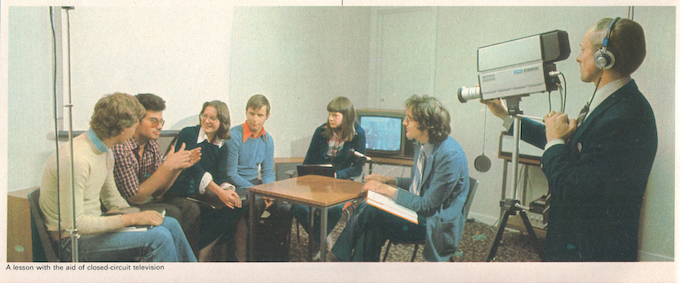
No, I didn’t use a technician on the camera, that was just for the catalogue
We went back to ACSE to teach on their courses for Foreign Teachers for a while, and I was saddened to see the department structure had gone, and with it our meticulous racks of handouts, cassettes for private study, rows of U-Matic videos (we made black and white videos for several Streamline units, mainly with Karen, me and Chris Owen acting out situations), cupboards of props and visual aids … if a lesson involved a telephone conversation, we used two telephones on the internal system.
Karen and I were delighted to be invited back to celebrate the 40th and 50th anniversaries. Karen always said it was the most fulfilling job she ever had, as well as the most pleasant working environment.
SEE ALSO: Drama Evenings article
FICTION by “DART TRAVIS” (my pseudonym)

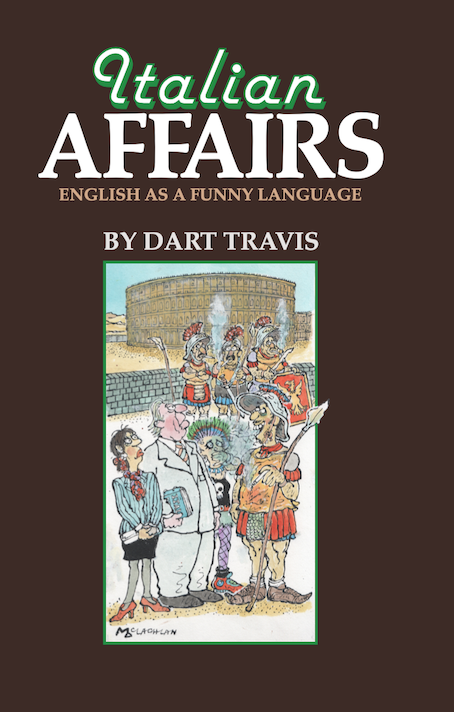

Fictional accounts of the eras in ELT can be found in FOREIGN AFFAIRS set in 1972, ITALIAN AFFAIRS set in 1977 and HOME AFFAIRS, set ten years later “after the crash” in 1982.
 Peter Viney's Blog
My family, (parents and two sets of aunts and uncles) ran the Norbreck Hotel during first half of the 1960s. Address: 41 Wimborne Road, Bournemouth, just along the road from the ‘Anglo Cont’ as we knew it. The Norbreck (later the Hotel Romantica, after we left, on the corner at Cemetery Junction) was a 20 room hotel which was always full through the summer with holiday makers but paid the bills through the winter by accommodating students – in my memory mostly Swiss students. Plenty of small hotels around Bournemouth had good reason to thankful for the existence of ACSE, Kings and others. There were several in the large houses around that part of town, down Wimborne Road and the roads off it to either side. What an irony that Bournemouth voted to leave the EU by an even greater margin than the rest of the UK.
LikeLike
It is indeed. It became a pub, the Dean Park Inn. The reception after Bernie Hartley’s funeral was held there. Anglo was 29-35 Wimborne Road.
LikeLike
The contribution to the local economy was immense. My mum took students from Eurocentre while I was at university. Many people took students as “host families”, and as teachers we were invited to several leaving parties at host family homes – students might be there for 9 months or a year and become close friends. I still remember one for a Japanese married couple with kilts and bagpipes. Much of the student host money went on home improvements, funding many local electricians, plumbers, builders, carpenters. Then there were the restaurants that lived off student trade … and still do. It’s interesting how, as more students achieve a higher standard at home before coming to the UK, that Bournemouth University has taken over much of the language school function, but the halls of residence do not feed the local economy in the way home stays used to.
LikeLike
“Note the jacket and tie.” And is that a cigarette? The coronavirus has caused me to cancel what I expected to be my last term of classroom teaching, and so the last time for me to use units of Streamline. Appointment in Samarra from Connections has been a favourite. I’m sure I’ll still enjoy thumbing through my 32-year old copies, and occasionally listening to the Story Of Willy the Kid. And I well remember conversations that went “England? Ah, Bobby Charlton!” and not much further.
LikeLiked by 1 person
No, I didn’t smoke (plus it certainly wasn’t allowed in class). It looks too small to be a board pen – and it’s not a chalk board so not chalk – though at that time some older classrooms were. I don’t know! There’s something in the other hand too, so it might be a pen in one, the top in another. Appointment in Samarra is certainly a tale for these weird times. I think about it when Karen says “Don’t touch the post for three days in case it’s infected.” I think that avoiding a virus on the letter might be an Appointment in Samara moment. Mind you, I’m leaving anything that looks like a bill or an official letter until after the lockdown!
LikeLike