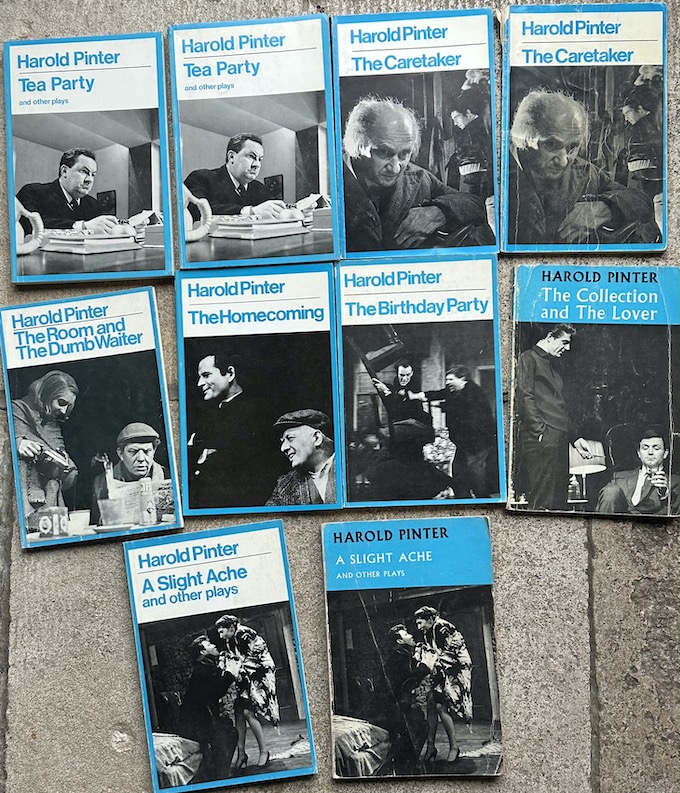
Harold Pinter would be my biggest non-ELT influence. I still have two copies of each of the earlier plays. At Anglo-Continental, the tradition of Wednesday drama was long. One in every four shows was advertised as a ‘rehearsed and costumed reading of a play’ which meant doing it with movement and action, but being allowed to hold the book. These had been going for a dozen years when I arrived, and the restaurant had a stage, theatre lights and could seat 350 to 400. We were told they began when Peter Cook spent a student summer there. My boss, Alan McInnes, would only perform in the three that we did twice a year: Private Lives, The Importance of Being Earnest and A View From The Bridge. We would all be shamed because he knew his parts (Elyot, Lane and Merriman, Eddie Carbone) and didn’t hold a book.
When I arrived in January 1971, Colin Granger produced them. I took over when he left nine months later. I know we did The Caretaker once (I did Aston) but never again, because after Karen became one of the basic team of four in May 1971, we didn’t do anything without a strong female role, except for Waiting for Godot (both our Vladimir and Estragon could do it book free) where she played ‘The boy.’
When I took over, I was handed two large boxes of the sets of acting editions, the older ones (Coward, Rattigan, Maugham) were French’s Acting Editions. Most I knew we’d never do. When I left, nearly ten years later, I took one of each out of the box for reference and donated the rest to a drama department at a school. Except Pinter. I took two of each early Pinter. Why?
One of the key points in the Streamline series (and our later books) was a section called Everyday Conversations. We called it Minimal Conversations, but OUP preferred ‘Everyday.’ These were “real English” and easy. An early example:
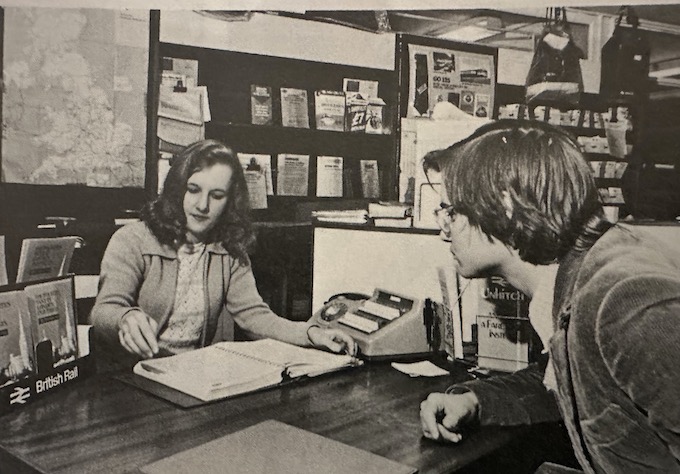
A: Excuse me …
B: Yes? Can I help you?
A: I’d like some information about trains.
B: Where to?
A: London.
B: When?
A: Tomorrow.
B: Morning or afternoon?
A: In the evening. About six o’clock.
B: There’s one at six forty.
A: Thank you.
As we pointed out, a traditional language text book would be:
A: Excuse me, I should like some information about trains, please.
B: About which trains would you like information?
A: I should like information about trains to London, please.
And so on.
We worked at these. The play copies were on the shelves of our shared office. Bernie Hartley would take down two copies of a Pinter, chuck one to me (the original concept was his) and we’d spend five minutes acting out dialogues aloud. We never lifted or used one. We just got into the feel of the language. Often we’d get into it and do fifteen minutes. The acting out concept was me. When we converted the Wednesday shows from play extracts to original material, Karen and I always wrote by acting out. This continued into Grapevine, Handshake, IN English and all our video scripts.
A: Never forgot him.
B: Who?
A: Pinter.
B: Yeah?
A: Yeah.
REVIEWS ON THIS BLOG
HAROLD PINTER
The Lover / The Collection by Harold Pinter, Bath Ustinov, 2024
The Birthday Party, by Harold Pinter, West End 2018
The Birthday Party, by Harold Pinter, Bath Ustinov 2024
No Man’s Land, by Harold Pinter, 2016 with Ian McKellan, Patrick Stewart
The Caretaker, by Harold Pinter, Old Vic, 2016
The Caretaker by Harold Pinter, Chichester Minerva, 2024
The Homecoming by Harold Pinter, Trafalgar Studios
The Hot House by Harold Pinter, Trafalgar Studios
Accident (film) 1967
 Peter Viney's Blog