The previous articles have proven popular:
Language Learning in Britain Past
Eng. Lit. in Britain Past
Music, Art & Divinity in Britain Past
Geography & History in Britain Past
Why? Sciences were my weakest areas. Every one of my kids got A in every Maths and Physics exam. Two did Maths A level, one a degree in Physics. My grandkids are the same. It must be in the DNA – but Karen’s dad’s DNA, not mine. He was a mathematician and taught evening classes, and was an aircraft stress analyst. In his late 90s in hospital, he always had The Times and whenever a doctor came round, he would be doing the “Fiendish” sudoku (which he could do in minutes) to prove he wasn’t senile. He was intolerant of any other subjects. When Karen started in the Sixth Form, choosing English, History and French he was furious. He went to the headmistress and demanded she be switched to mathematics. The headmistress explained carefully that Karen had only just passed O level Maths and had no aptitude in the subject. It got worse when she later opted for Drama. Neither of us have much aptitude in maths, though Karen is able to help kids with algebra homework, and I’m not. The maths DNA mainly skipped Karen, but landed on our children.
My grandkids have the maths gene squared (cubed? doubled?), as my son-in-law’s father was also an engineering / mathematical specialist.
I was fine at junior school. I was near the top in arithmetic, as I was also in the verbal reasoning section of the Eleven Plus. In those days, the duodecimal system for money meant we had to multiply and divide by 2, 3, 4, 5, 6, 8, 10, 12, 20 on a daily basis. We had twenty shillings to a pound. Twelve pence to a shilling. Three pennies were a threepenny bit. Four threepenny bits to a shilling. Two sixpences to a shilling. Ten florins to a pound. Eight half-crowns to a pound. Five sixpences to a half-crown, but four to a florin. Two ten shilling notes to a pound. A theoretical four crowns to a pound, but crowns were commemorative coins, so not really. So 240 pence to the pound. Or 480 halfpennies or 960 farthings. Four farthings to a penny. Then a guinea was twenty-one shillings, so lawyers and race horse owners could pass on 5%, the extra shilling, to clerks and jockeys. On a till in those days you could ring up £1.12s.7 3/4d. I agree that £1.63 makes more sense. Cashing up when I worked on the beach meant doing all of this. Duodecimal meant rapid mental arithmetic. You got proficient. I was shocked at my kids junior school when they stopped at the ten times table. Britain had gone decimal. No need for twelve … but that changed, because the eleven times table helps spark an interest in numbers. Twelve returned too, as did 20.

At Bournemouth School, my ability dive bombed dramatically.
I ponder why. Some is lack of interest on my part. I conclude it was at least partly bad teaching. Also, I was ill for ten days just as algebra was started. We know from ELT that language courses should not be linear but spiral. What happens if a kid misses the introduction of a major concept? It should be revisited and recycled. Our maths was straight in a row linear.
The other thing though was that Bournemouth School Maths department were a collection of nasty bastards, and terrifying bastards at that. In the first year we had Davis. He always wore a gown … the maths department were gown wearers. I’ll quote Roy. We were at junior school together. We were in different classes at Bournemouth School, but we both had Davis:
Roy: An absolute shit. A bully and sadist. I had ‘Spit and Dribble’ (because of his teeth) for maths in lower school. Used to bring kids with their exercise books out to his desk at the front and whack their heads if they’d get something wrong.
I remember the violent whacks across the side of the head well. Hitting kids was only allowed with a cane by the headmaster or deputy headmasters. He was one of many who ignored that, and he also went for the head which is totally unacceptable even among the violently disposed. He was our teacher for Arithmetic and Algebra plus an officer in the CCF, where he was also a bastard. At 11 I found him totally terrifying. I hated his lessons and dreaded them daily. We called him Horse Davis or Horseface Davis.
Then there was Geometry. Killer Read taught it. We called him that because he had the air of a serial killer. It’s hard to know why he was even more frightening than Davis, yet I don’t remember any physical violence from him at all. I think he had a son in our year. He used to appear silently, lips pursed in judgement, scathing and scornful of the slightest error. (You should use errors to promote learning, not to shame kids). A verbal bully.
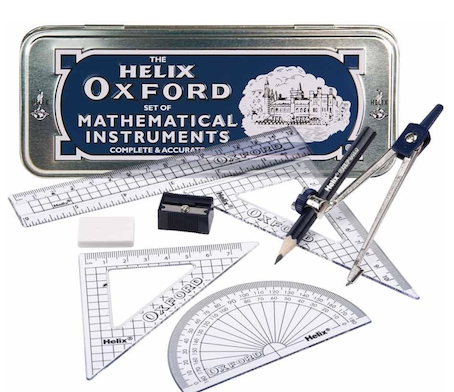
In my day, a maths set meant a 6″ ruler, two set squares, a protractor and a compass. Plus a pencil, a pencil sharpener and what used to be called a rubber, but in deference to Americans, is now called an eraser. Fine. You can still buy them. Now the 6 inch ruler is 15 cm on the other side, though as kids don’t use inches you have to wonder why inches are there at all. They’re the same Helix make in the same tin ‘The Oxford set.’ My grandkids have them. I think that’s enough for most of us. I’m bi-mathmatical. I use celsius. I measure in metric. I consider that advanced.
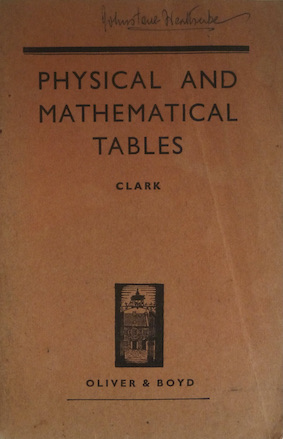
Then as the years progressed, what was all this trigonometry shite? Tan, cos, sine. Have you ever used any of them in your life? Then there were logarithms (or are they the same? Does it matter?)
From Wikipedia:
In mathematics, the logarithm to base b is the inverse function of exponentiation with base b. That means that the logarithm of a number x to the base b is the exponent to which b must be raised to produce x. For example, since 1000 = 10³, the logarithm base of 1000 is 3, or log₁₀ = 3.
Expressed mathematically, x is the logarithm of n to the base b if bx = n, in which case one writes x = logb n. For example, 23 = 8; therefore, 3 is the logarithm of 8 to base 2, or 3 = log2 8
They have lost me.
What were those books of trig tables about? What a total waste of our precious teenage. I looked them up online in the vain hope of finding out their purpose. They are now in colour in big print with diagrams. I just remember pages of tiny numbers in narrow columns. Of course nowadays they’re just buttons on a scientific calculator and I have no idea of what they’re for.
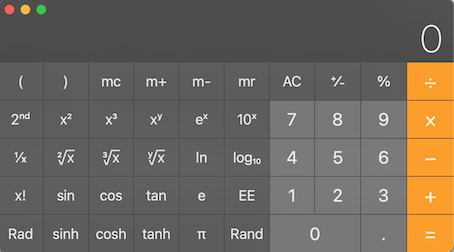
At one point I must have had some idea what they were because I do have maths O level. Just. I am reminded of a survey that found within a year of leaving school, 90% of people had forgotten how to do long division.
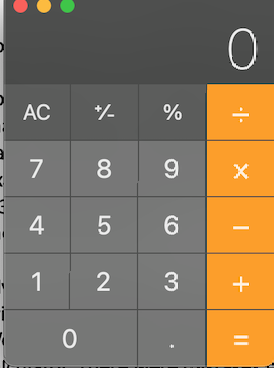
This is how my desktop calculator is set: Basic. Even then I don’t know what the +/- sign does.
I mentioned this in the CCF article here, but 1960s textbooks strove to make this crap interesting by the sniper on the church tower. Snipers were fond of sitting on top of church towers and apparently this stuff could be used to calculate angles and drop an artillery shell onto them. We more artistic kids wondered about the architectural vandalism in destroying ancient church towers. Those bent on a future career in the caring professions wondered why the art of negotiation was ignored in getting the sniper down. Those bent on the police as a career thought a water cannon would solve it. You can see where the jet of water is going and simply move it. Nowadays a drone would do it. Anyway, maths teachers were the sort of people who preferred venting death and destruction. Then the sniper had to calculate range, the weight of the bullet and how it dropped in its flight trajectory. They found that fascinating too.
My younger son, who has a degree in Physics, explained that this is all a gateway to Physics and that it was the teaching approach that was misconceived. He points out the classical Trivium as an introduction:
Number – arithmetic
Space – geometry
Time – music

He showed me this, and said there was a mid-19th century idea of teaching geometry through colour and so deliberately avoiding number. I had a look but am still puzzled.
Then came the third year. Hannant. Bastard is insufficient. A total C word. He was a born-again Christian and our form master in 3.22. He would put your hand in a desk lid and apply pressure. When there were exams and we had class assemblies, he would hit kids at his full strength for ‘praying too quietly.’ It seemed especially harsh on the Jewish kids who were excused school assemblies, but not class ones. No one could mumble through it. We hated him deeply. At the end of the year he was sacked. Two offences. One was skewering a boy’s hand to the desk with a compass in rage. The other was actually breaking a hand with his desk lid torture. Sacked? He should have gone to prison.
There’s more to it. My mum and dad used to go to dinner dances with friends. The friends had a daughter my age, Jenny. Because her grandmother lived with them, I was left there and collected on the way home. We mainly played card games with her grandmother. Jenny was very good looking, though being exactly my age, she was interested in boys a year or two older and I knew I had no chance. Still, we enjoyed chatting. Anyway, Mrs Hannant was the maths teacher at her girls grammar school (in Poole, not Bournemouth) and was sacked at exactly the same time … pulling hair, slapping girls around the face. She was also a fervent born-again. We speculated on what happened to them. We guessed that they went off as missionaries to a country where they could get away with it.
I remember the last lesson on the last day Hannant was there. Our classroom, Room 22, was a prefab furthest from the school main building. Because of our bad behaviour, we were made to wait outside between lessons. The sacked Hannant came for the last lesson of the entire year, or rather just to send us home. About ten boys suddenly went for him lifted him and threw him in the gorse bushes, yelling ‘School tradition, sir.’ It wasn’t. He left the scene. We never heard more about it. I have recounted this story to classmates. Only one remembers it. The others have no recall. It may be a dream.
Roy adds: There was another Maths teacher named Hannant. The classes before the lessons had to line up beside the prefabs outside the main building which served as classrooms. This nasty youngish ‘teacher’ of Maths used to whack the boys on the head as he walked past to start the lesson. I heard that boys had endured enough and turned on him as a vengeful mob.
So I blame the teaching, but … Yet, hold on … in the CCF I did well in Navigation, using a Dalton computer, a kind of slide rule, with ease, and calculated wind drift. Who taught us? Not a maths teacher but an earnest and careful Sixth Former with the CCF rank of corporal. Two years older than us. Clearly he was a better teacher than the masters. So was I that bad?
Or was it the syllabus? I liked my kids and grandkids maths homework. Approximation. We had to do stuff the regular way- no shortcuts, show your workings.
So a problem. Faiza (all people in maths problems have ethnic names) has to drive from A to B, 93.2 miles, then from B to C, 88.5 miles. How far has she driven? For a driver, you approximate. Round up and round down to 90. Then 90 x 2 = 180 miles. In the context, that’s enough. I don’t need to know more. We never did maths like that. They do now. We had to do it the hard way AND show those daft workings adding up in columns. If I wanted exact, I’d use a calculator (181.7) but on the road, about 180 does it. The way for exact? 180 + 3.2 = 183.2. Minus 1.5 = 181.7. In any 1960s maths exam, fail. I can do it the ‘new way’ but then I always could.
My old writing partner Bernie Hartley refused to use a calculator, saying it would atrophy his arithmetical ability. He always added up in columns, and did long division to calculate VAT. We were in partnership, and as I submitted accounts, I always checked his figures with a calculator. There were mistakes every single time.
Then the other stuff they do now – percentages, tables, charts and diagrams. Above all spreadsheets and analysing data. Yes, I’m interested in that. I couldn’t give a flying whatever about the sniper on the church tower.
I kept my head down and did just enough to get the essential O level.
I’ll continue, as with others in the series, on my older son’s later experience at Bournemouth School in the 1990s. He was advised by his sixth form tutor, a maths teacher, to follow his three favourite subjects at A level: Art, Maths, History. I said that was madness, as any arts degree would require at least three arts, and any science degree would require three sciences. No, no, the tutor said airily. That’s all changed. Oxbridge in particular will be impressed by a wide range. It was utter bullshit, as the only subject those three work for is archaeology. Still, it led to him taking two gap years and self-study in SATS II in math, English and history and going to an American university where no one specialises before the age of eighteen. Then for A level maths, that tutor did chapters in an order of his choosing. Unit 12, then unit 5, then unit 16, then unit 2 etc. Now I know little about maths at GCSE level, let alone A level, but I assume that like languages, the syllabus works by accretion, with the building blocks to concepts having a logical order. I asked a friend who taught maths, who confirmed that was the case. Anyway, in the middle of one term, they arrived on Monday to be told the tutor, who had taught them on Friday, had left. A new teacher would arrive. That doesn’t happen at grammar schools unless for a serious sackable offence. There was much speculation.
I met algebra again at university, where my girlfriend was reading philosophy and sociology. I got to know several of her fellow philosophy students. One drove me mad by saying after any statement, ‘’What exactly do you mean by that? Define your terms.’ It was an odd response to ‘What shall we have for dinner?’ They spent much time in the first year on logic which involved pages of algebraic equations. Most of them, hoping to study and discuss ideas passionately, couldn’t cope with it because none of them had done A level maths. My son’s maths and history would have been ideal.
 Peter Viney's Blog
I remember Hopkins and Read…..Read in my recollection was a small stocky man, who would no doubt have been a good study of Neanderthal Man, which was part of my niece’s Archaeology degree…… I was good at Maths, apart from Geometry. QED = it’s been proven, why reinvent the wheel? I had to do Calculus to pass an exam for entry into an HND course in Computer Aided Engineeering, and ended up top of the class….. the course was not as expected, so I took a further option in Business Information Technology, going into the professional when it was taking off…. another story….
Talking of supply teachers, especially Maths, we had a teacher called Datu, a rather inexperienced man from Madagascar, I seem to remember. He knew his subject, but at this time, was out of place in a massively white school…. there was no prejudice, apart from several boys who got him a box of Black Magic chocolates for Christmas one year…..no comment was made, but juvenile sniggers were apparent….. my aptitude for figures came in handy later on, when I was owner of a hotel in Plymouth….. but again that is another story, in fact Fawlty Towers was lived every single day while it lasted, and my then wife and I nearly caved in with the long hours……
I send best wishes to Paul Watts, who had a successful business in estate agency, and also was apparently a pretty reasonable painter, I was informed…. I did go by the shop some years ago, he was not there – but left some 20 or more years ago, and am in Tbilisi, Georgia, with a stress management business….. as an ex- Bournemouth School survivor, I feel I am well placed to help anyone who has suffered stress, or PTSD, if anyone could survive those tortuous years, they deserve a medal, or a plaque on the wall of the mental institution they are currently incarcerated in….
LikeLike
Hi Martin,
Yes, it was a hell hole but I found it improved in the sixth form. A number of the masters remained deranged though. Should have been locked up long before we got there. All the best. Paul
Are you on Facebook etc?
LikeLike