I was having a bath when the phone rang.
Wherever I speak at ELT events, people talk about the bits they remember from Streamline. At a recent conference, three people mentioned the same dialogue to me within an hour, “In Prison”, from Departures (actually not one of my favourites).
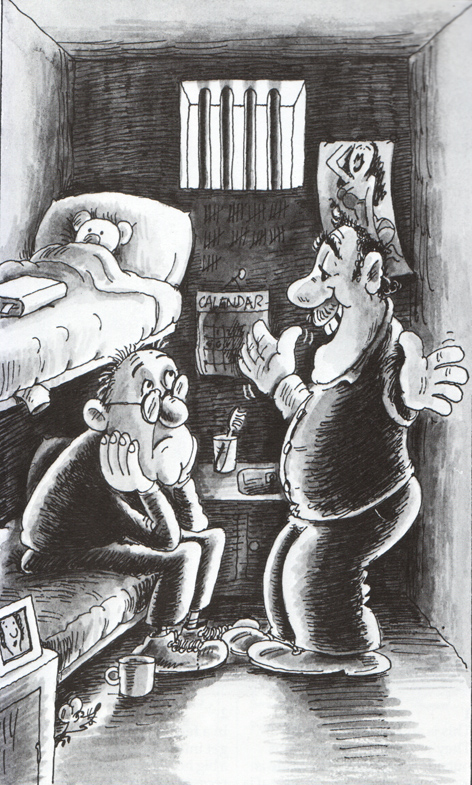
In Prison, Departures Unit 27, illustration by Paddy Mounter.
Two more mentioned Willy The Kid, which I think was the best contextualization of regular past simple that I’ve ever done. Elmer Colt got two reminiscences. Everyone remembers Streamline as the first full-colour adult ELT book (wrong: it was actually Access To English two years earlier), but it was 50% black and white, and surprisingly all three examples here had black and white illustrations.
Bernie and I sought hard for stuff in Streamline that would stick in students’ memories, and often we succeeded. Karen and I worked on Grapevine, Handshake and IN English in the same way.
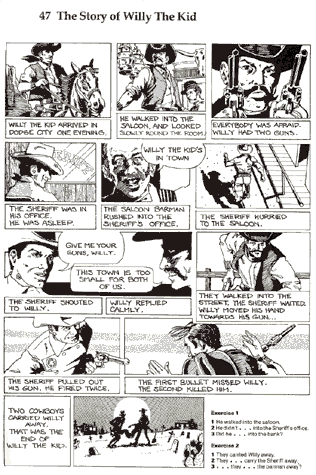
Streamline Departures, Unit 47, The Story of Willy The Kid
For the umpteenth time in twenty years, I also heard someone criticizing the use of example sentences such as:
“I was having a bath when the phone rang.”
“The phone rang while I was having a bath.”
That example appears in several books (not including Streamline in fact) and several grammar books too. I was informed yet again that it’s not frequent, not authentic and not communicatively useful. To which I can only reply that all three are true.
However, if I were writing a grammar summary on the past simple and past continuous tomorrow, that’s probably the example sentence I’d use. Why? Because we all know that for some reason the doorbell, the bath, the toilet and the shower have a mystical connection in real life. My postman rings the doorbell about twice a week, and inevitably does it at least one time in three when I literally have my trousers down. That’s probably as fake as any other statistic, but that’s what it feels like when it happens. And if it’s not the doorbell, it’s the phone. Why? Because I remember the times when it happens vividly.
The example of someone relaxing happily in a bath or shower when the doorbell or telephone interrupts them sticks in the mind. It’s mildly funny. It illustrates beautifully with a cartoon drawing. Students need memorable examples on which they can hang a structure. Sittting on the toilet is even more memorable, but too crude for any mainstream ELT publisher. It’s a good example for an exercise too. In IN English pre-intermediate, we have some fun with the idea by having someone sitting in a bath, and getting students to imagine what else they might be doing at the same time (listening to music, singing), then what might interrupt them.
When I was selecting people to do research and development, I used to get them to write example sentences. There is an art to composing examples which both pin down a grammatical point and exemplify it, and which are memorable. Robert O’Neill, in English in Situations and Kernel Lessons Intermediate was the master of that art. Raymond Murphy, in English Grammar In Use, is another skilled practicioner.
There’s also a difference between a grammar designed to be comprehensive at intermediate level, and a grammar summary in a starter or elementary course book. The former can draw on everything at the level for examples. The summary in a lower level book is restricted to what students know at that point in their studies. A “big” grammar doesn’t have to consider the sequence of student acquisition either, so can use (say) a present perfect sentence to illustrate (say) object pronouns: I’ve met her, but I’ve never met him or If you’d met them, you’d like them. However, the grammar summary in a lower level book has to take into account that the student seeking information on object pronouns will almost certainly not have studied beyond the present simple and continuous tenses … if that far. So the grammar summaries accumulate sequentially. This is why they almost certainly have to be composed rather than sought out from corpus examples.
Authentic material may or may not be memorable. It’s incomprehensible for beginners anyway. If you take a corpus extract on when or while with the target word in the middle and the authentic stuff that goes either side, you’ll have a bunch of “authentic” sentences that make little sense outside their context, and you’ll find it hard to detect a pattern.
Are they truly “authentic”? Probably not. Anything from a TV or radio programme is scripted, and when you script a TV programme, whether it be Friends or Eastenders, you remind people of the unfolding plot within your scripted dialogue. You use characters’ names more often than in unscripted dialogue (so as to orientate the viewer). You move from A to B with clarity. Any examples of native speaker poor communication are just part of the script.
Authentic dialogue, I would take, not as “designed for native speakers”, but as people being recorded surreptitiously. If people are interviewed on radio or TV, they think hard about what they’re saying. So we can only record truly “authentic” transactions without the speakers’ knowledge. They’re full of hesitations, false starts, incomplete sentences. Writers knew that already, without having the corpus to tell us. We just didn’t consider it to be particularly interesting in teaching the language. So an authentic speech act might be:
“Well. I’m like … Urgh? Yuk! … and so he’s like … ‘Right!’ … then it’s just … you know, kinda SO random, cos he is like … No way! Why are you askin’ me? … and so I’m kinda like, ‘You what? I dunno if… I mean, like … so, anyhow, what kinda crap you’re … “
Authentic. Yeah, right. Useful? Kinda not.
We cannot and should not teach learners to be inarticulate. Our model language demands clarity, and communication. There is no reason for a learner to emulate an inarticulate native speaker. Given enough exposure, they might acquire the ability to be as inarticulate, and sound as dumb, as a native speaker. But they don’t have to do that.
Example sentences are not phrase book examples for repeating parrot fashion. They’re designed to explain a grammatical point. All students need the set phrases, the formulas and fixed expressions (There you go / Anything else? / £5.67 altogether / Bear with me …) and the course book should provide those fixed formulas. Exemplifying grammar is different. It’s designed for explanation, not immediate transfer to real life situations.
 Peter Viney's Blog
hi sir, hope u r fine n in good health i m a language teacher n i have a query here, plz . why the unit willy the kid is in capital letters in all ? k b shakaib.regards
LikeLike
Yes, yes, yes! I’m a teacher in a french highschool and I’m sooooo fed up having to use “authentic material” and concentrate on “culture” instead of grammar when they can’t even make a simple sentence.
LikeLike