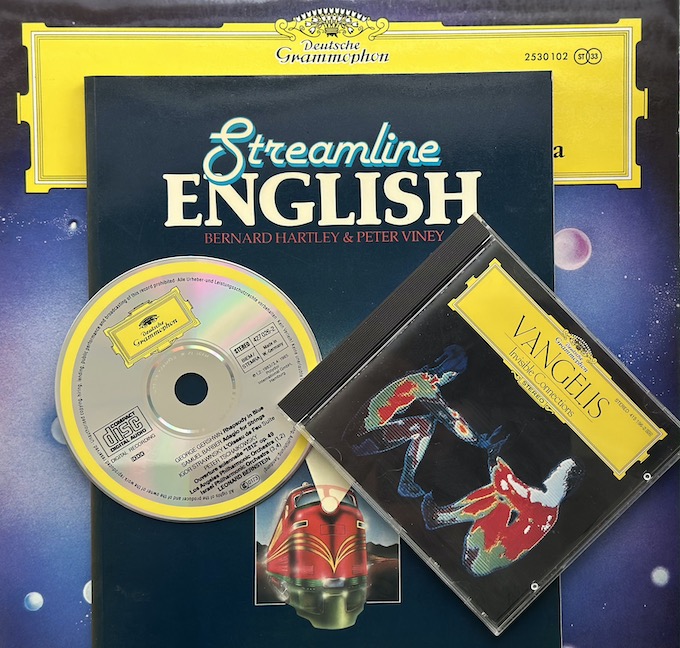
I have a soft spot for DGG, Deutsche Grammophon Gesselschaft. It’s a long story and not much to do with record collecting but it was recalled while I was adding an article about DGG to my Around & Around music site.
It was 1977. We’d had some Polygram / DGG executives on English Language courses at Anglo-Continental (ACSE), Bournemouth, and they’d liked the courses so much we then got a senior executive for a month. In my memory his name was Werner. At that time we were using our text book, which later became Streamline English, written by me and Bernard Hartley, on the courses. It was illustrated in house by Paul F. Newman. We were negotiating with Cambridge University Press for publication, and Oxford University Press was about to gazump them by offering colour illustration, unusual for textbooks then. We had the draft Cambridge contract in our hands, plus offers from two other publishers.
Werner invited us to dinner. A proper five star hotel dinner. He presented us with boxes of DGG cassettes and a box set of German selections from The Bible. He wanted our text book for DGG. He envisaged a massive TV and supermarket campaign for self-study under the title English From England. (The ACSE title was English In England). We not only had the textbook in use, but the Language Laboratory exercises which were available to students for self-study too. At that point neither CUP or OUP were interested in those, but Werner saw them as part of it (rightly). He also wanted me, Karen, Bernie Hartley and Guy Wellman to go to Hamburg to re-record them in a proper studio. he wanted our voices as on the ones he had studied. I was a little miffed in that I’d recorded them in the ACSE studio in stereo on twin Revox A77s with AKG mics and in my arrogance doubted you could improve them much. We also had non-copyright music LPs and the complete BBC Sound Effects series to enhance the recordings.
This is where it went wrong. DGG offered us a 1% royalty, not rare for new musical artists plus mechanicals (which we didn’t understand). They said they were aiming for one million sales (I expect they told every novice that) and that it would be a multi-cassette set with book, so 1% of quite a lot. OUP offered 10% of published price (later shifted to 15% of price received). DGG went white with shock when we told them. No, they couldn’t get anywhere near matching that. We declined their offer with thanks.
As a record collecting aside, DGG seemed keener on cassette than vinyl in 1977. Of course they were one of the first record labels to produce CDs in 1982. I gave the cassettes away to an editor when CD emerged. There was a complete Mahler.
Decades later, I just realised we were dumb. We needed an agent. OUP, like all English Language Teaching publishers, took world rights. An agent might have suggested excluding Germany from world rights, and doing a split deal. Because we’d had German and Swiss German students as one of our main nationality groups, we had high hopes for sales in Germany. Shortly after publication the then OUP Sales Manager told us that OUP’s German distributor, Cornelsen, said Streamline was ‘totally unsuitable for German students’ and they would not be promoting it. In vain, we pointed out DGG’s interest in it and the strong positive response from German speakers in the piloting. OUP had a major deal with Cornelsen, who sold vast quantities of their ELT dictionaries and grammar books. However, Cornelsen were also a major textbook publisher themselves. They wanted OUP’s dictionaries (and so reputation). They did not want competing textbooks. This was a head in the sand attitude. In contrast, La Nuova Italia in Italy distributed OUP, and did wonderful work in promoting Streamline, in spite of being major textbook producers themselves.
Cornelsen were pretty extreme about it. I was invited to speak at the European International Schools annual conference in Frankfurt in the mid 80s. Being the ELT speaker was an honour- Sir Hugh Casson was talking on art. Sebastian Coe was talking on PE, or Sports Science as we might have to call it now. Cornelsen refused to display Streamline on their stand in the book exhibition. OUP’s Education Division agreed to display it instead among the maths and physics books, and were very pleasant and sincere in asking me what to say about it. I also found that International Schools in Germany were already using Streamline, purchased from a bookshop in Zurich. Later, the English distributors said German schools were a major mail order buyer. I know teachers in Bavaria bought their copies from Switzerland.
Could we have done a split deal? I don’t know. Would it have worked for self-study? It depended on promotion.
But there is an alternative universe where we stood with Herbert von Karajan, Leonard Bernstein and Vangelis on the DGG label.
 Peter Viney's Blog
Leave a comment