As ever, this is on communication skills, NOT political comment. These have proved popular. As on the last two, it’s also been added to the Mr Brown or Gordon article (in third place) with additional material.
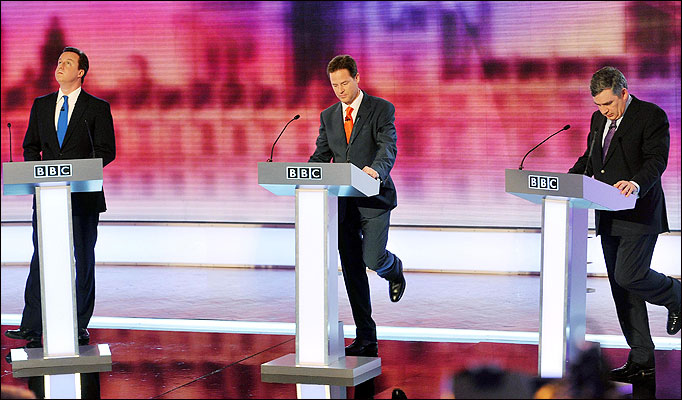
Picture from “The Sun” website
The final debate was much sparkier, the first real “debate”. The names issue first. All three are now thinking about it and coming to different conclusions.
Clothes showed a slight change. Cameron in dark suit and blue tie, Brown trying to gain the middle ground perhaps by combining red and blue and sporting a purple tie. Clegg reverting to the orange of the traditional Liberals rather than the more recent yellow. Clegg was wearing a mid-grey suit, lighter than the others.
Nick Clegg stuck resolutely to David Cameron and Gordon Brown. I ticked off ten ‘David Cameron’ and nine ‘Gordon Brown.’ He also, cleverly, almost always mentioned them in pairs ‘Gordon Brown and David Cameron’, reinforcing his references to ‘the old parties’ by lumping them together.
Gordon Brown never deviated from first names, and tried to ignore Nick Clegg as much as possible. At a rough count he used David 23 times and Nick 8 times. Three things were going on; he was drawing them into his circle of professional politicians, talking down to them and marginalising Clegg.
Cameron had, I think, been told to drop the ‘Gordon.’ He still used it 5 times, but he used Gordon Brown 5 times too. He used ‘The Prime Minister’ seven times, which reinforced his economic point that the economy was in a mess. Brown had been in charge when it became a mess. I only counted a single reference to ‘Nick Clegg.’ Like Brown, Cameron was trying to marginalise him, in spite of having some of the fieriest interchanges with him.
Sticking to communication skills, what else? Brown’s raised shoulders at several points betrayed stress. As in other debates, the BBC were running a select panel who showed their approval or disapproval electronically.There were red, blue and yellow lines which went up or down depending on reaction. Whenever Brown gives that truly horrible smirking smile, the red line dives. If I were his advisor, I don’t know what I’d do to stop him, but like ITV and Sky, the floor producer couldn’t stop themself from cutting to it whenever that dragon’s leer emerges. (Language aside, because Microsoft Word had crashed it had reset itself to autochange grammar. It refused to let me type themself, an inclusive singular used by both Shakespeare and Chaucer!)
Clegg has decided that agreeing with the questioner by name is a good move. He overdid it and virtually wrote a section for our next textbook on agreeing expressions:
Medina, I think you’re absolutely right.
Medina, you are right.
I strongly agree with you, Jean.
I’m totally with you, Randall.
Where’s Randall? Of course you’re right.
I agree.
We really all must agree with that.
As happens with language, Cameron caught the language virus towards the end and added:
Ian is absolutely right.
I think Jean is absolutely right.
Then Brown caught it too:
Anna’s absolutely right.
In political-speak it seems a modifier should always go with agreement. Absolutely is the favourite, with strongly and totally following on.
The other language virus was Clegg’s almost absurd overuse of the word create. As he can’t pronounce it, it was better avoided. Cameron and Brown started out saying create with two syllables. Clegg says crate and crated. Again, by the end, Brown had caught the virus and was saying crate too. Bad move, don’t copy your opponent’s body language or verbal ticks in these debates.
I was pretty busy noting communication skills, but bits of the content did find its way through. They all had a trick which they repeated.
same old
Brown’s was to keep using Same old Conservative / Tory party hoping to revive spectres of the 1980s. He must have used same old half a dozen times. On unemployment Brown talked about people being forced to and compelled to work. Not a pleasant vision, conjuring up Siberian salt mines, and one which neither Clegg nor Cameron noted.
two old
Clegg’s was the two old parties as well as saying after Brown / Cameron interchanes, Let’s avoid the political point scoring and There they go again.
the right thing
Cameron’s was a reliance, as in the previous two debates, on references to People who do the right thing / People who’ve done the right thing / People who obey the rules / People who play by the rules / People who’ve worked hard all their lives. This was used to refer to savers, immigrants, workers, pensioners. It came across as a smug People like us, but watching analysis of those moving red, blue and yellow approval graphs, it struck a chord.
A further aspect (and I stray dangerously close to content here) was Brown’s constant references to tax credits and inheritance tax. In BBC’s Question Time afterwards Janet Street Porter said she thought she couldn’t take Brown saying ‘tax credits’ ever again. She also said the whole debate was a middle-aged white male event of no appeal to the majority of voters: women.
Inheritance tax was an interesting one because Brown kept saying that the Conservatives planned to scrap (or reduce it) giving huge sums to the richest 300 families in the land. He did it seven times. Cameron plain refused to engage. He made a point about people wanting to pass on their houses to their children (having done the right thing, obeyed the rules, worked hard all their lives) and the subsequent viewing of the “approval graph” showed the blue line shooting up. Then he refused to address it again. I thought at the time that this avoidance was a poor move, but the comments on the graph showed afterwards that the audience didn’t like repetition or fierce interchanges, and someone commented that his refusal to engage was wise.



 Peter Viney's Blog